Ten years in the making. An Oregon Coast Aquarium dive team rigged a blue whale skeleton to the floor of Yaquina Bay in 2016 and pulled it back up in 2019. In 2026 it went on display at Hatfield.
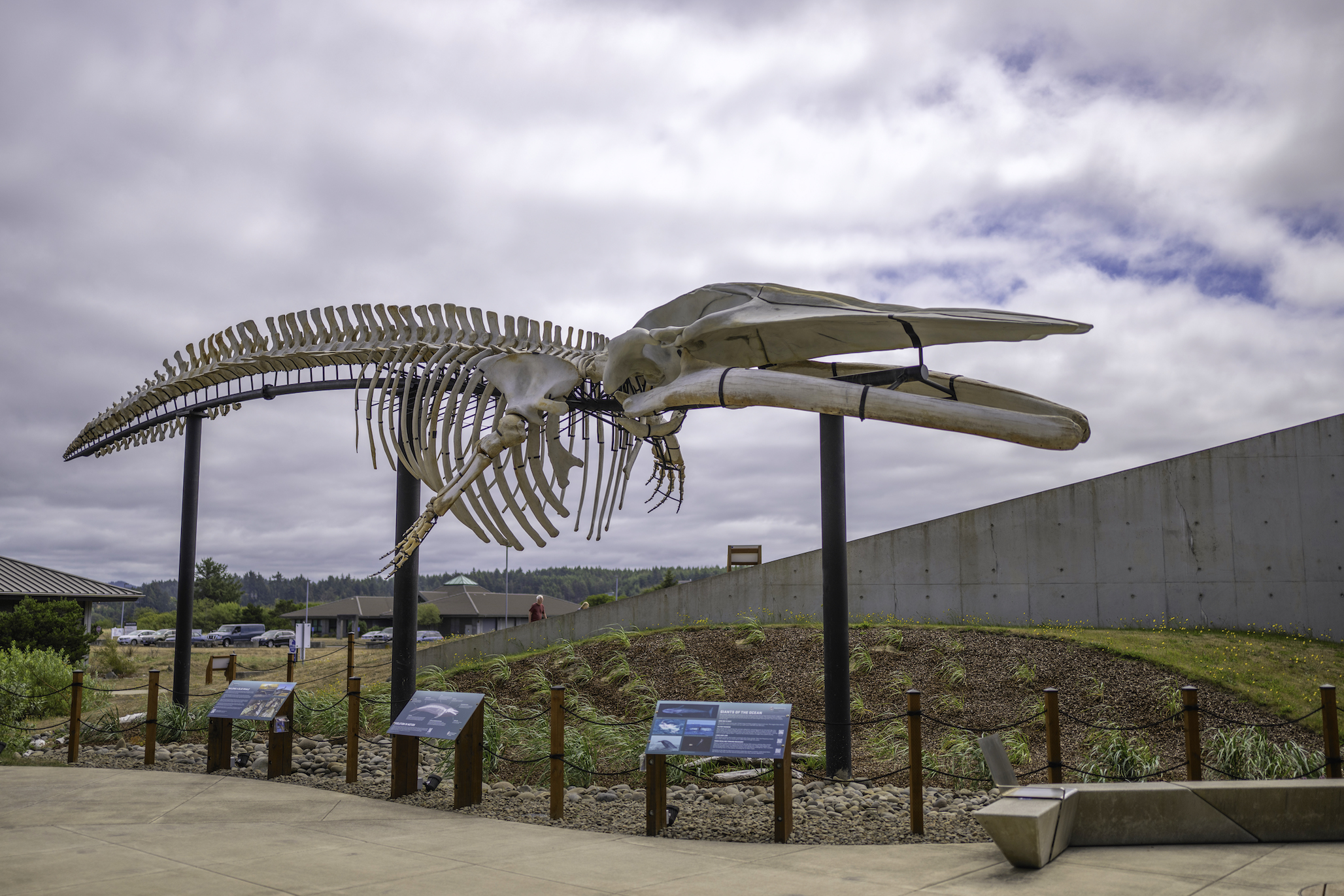
A roughly 70-foot blue whale now stands in the courtyard of the Gladys Valley Marine Studies Building at Oregon State University’s Hatfield Marine Science Center. It went up in May and was dedicated in July. It is one of only a handful on public display in North America, and the only one between Vancouver and San Francisco Bay.
Most of that story has been told. A ship struck the whale, it washed ashore in Curry County in the fall of 2015, and crews spent days on the beach stripping some 58 tons of flesh off 365 bones. The chapter in the middle got less attention, because it happened underwater.
How the whale got clean
A blue whale’s lower jaw runs 18 feet, about the length of a parking space. This one’s skull weighed 6,500 pounds, more than a full-size pickup. Bones that big can’t be cleaned by hand.
The first idea was to bury them. Bruce Mate asked Jim Lewis, who handled facilities at Hatfield, about digging a pit in the yard.
“We don’t need the sand,” Lewis says. “We need the ocean critters to do the work.”
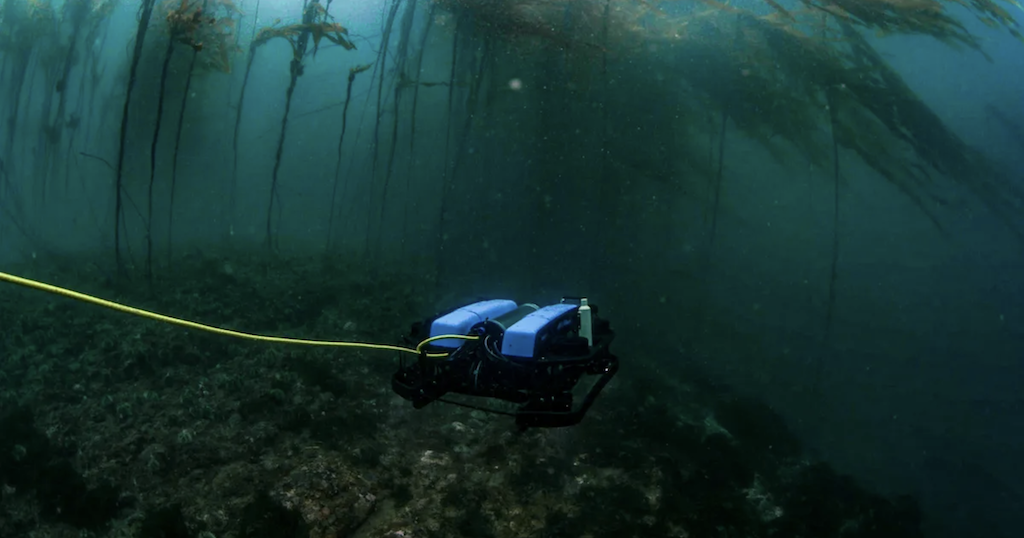
So the plan became the bay. Sink the skeleton in Yaquina Bay and let the scavengers on the bottom pick it clean. That took a dive team willing to rig several tons of whale to the bay floor, in the dark if they had to. Lewis knew where to look. The Aquarium’s dive team had worked with Hatfield before, and in November 2015 he brought the problem over along with Bob Cowen, then Hatfield’s director, and Bruce Mate of OSU’s Marine Mammal Institute. Director of Animal Care Jim Burke said yes and handed it to Jenna Clos, then the Aquarium’s dive safety officer and now its COO. The dive team looked at the scope of work and the Aquarium took it on at no charge.
Planning started that same month. The team surveyed a shallow, protected stretch on the south side of the OSU pier, staked out a 25-by-25-foot site, and marked it with buoys. In January they replaced the stakes with permanent ones. The bottom could drop to zero visibility on any tide, so they kept diving the site through the spring, running rescue and search drills until they could work it blind. Delays getting the bones north pushed the operation to April 28, 2016.
The day they sank the whale
Four divers did all the underwater work: Jenna Clos, Doug Batson, and Aquarists Kevin Clifford and Mark Murray. Jim Burke ran the topside work with the lift director and drove the Aquarium’s research vessel, the Gracie Lynn. He kept the boat upwind of the dock, where the whale was staged.
They started with the mooring. The crane set four 800-pound anchors at the corners of the site and a fifth in the center. Divers linked them with three-inch chain around the outside, then laid a second chain in an X through the middle. That gave them a grid to tie the bones to. They moused every shackle, wiring the pin shut so nothing could back out over three winters of storms.
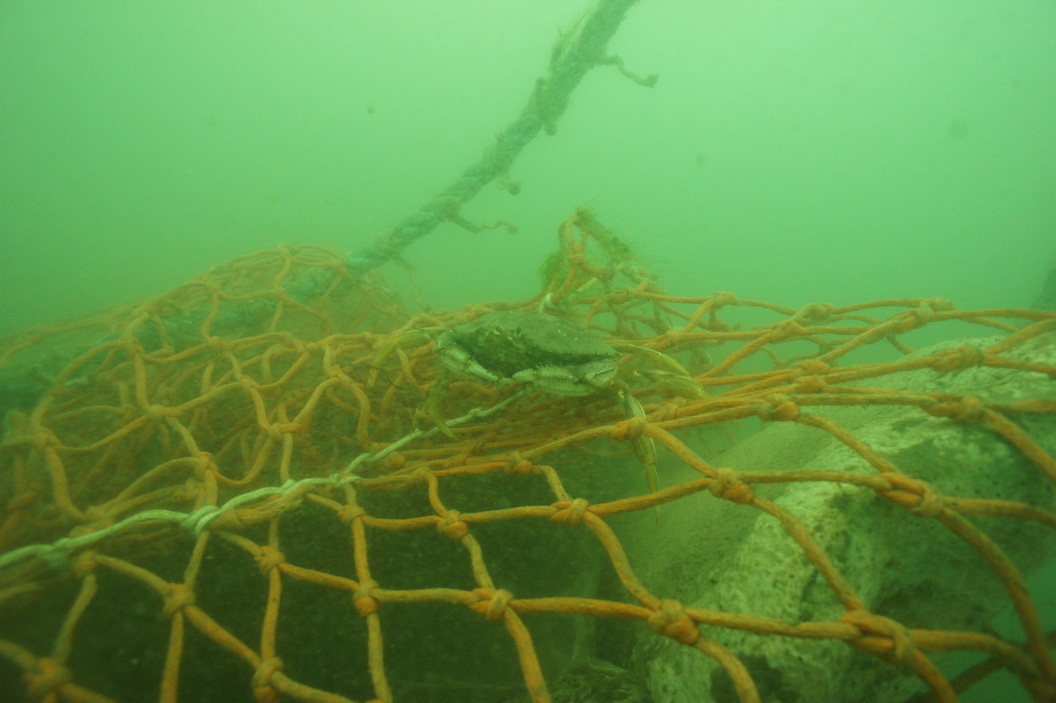
Then the bones came down. Bruce Mate’s team had divided the skeleton into 17 bundles, each wrapped in heavy fishing net like a burrito. The crane lowered them one at a time. Once there was slack in the line, divers descended, unclipped the safety latch, swam the bundle into position, shackled it, then surfaced and signaled for the lift. After a few rounds they worked out a shortcut: a signal sent up the moment the latch came off, so the crane could stage the next bundle while divers still worked below. The crane crew put the bundles almost exactly where the divers wanted them, and the water was the clearest the team had ever seen there.
Lewis, running the crane side from the dock, says the topside rigging was never the hard part. “The real work was done in the water. What made this unique is the dive team rigging in a very complicated location, with the large changes in tides. The divers are controlling the crane operators from underwater.” That went on for eight or nine hours.
The skull was harder. Even stripped, it wanted to float. They added 800 pounds of weight and it still lifted off the bottom. Another 800 wasn’t enough. It took 2,400 pounds before the skull stayed down.
One bundle split its seams underwater. Clos and Batson re-rigged it on the bottom so the crane could lift it back to the pier, with the topside crew testing the load in stages first. Afterward they joked that underwater basket weaving had finally paid off.
They expected to need a second day. They finished in one.
Three years down, then up
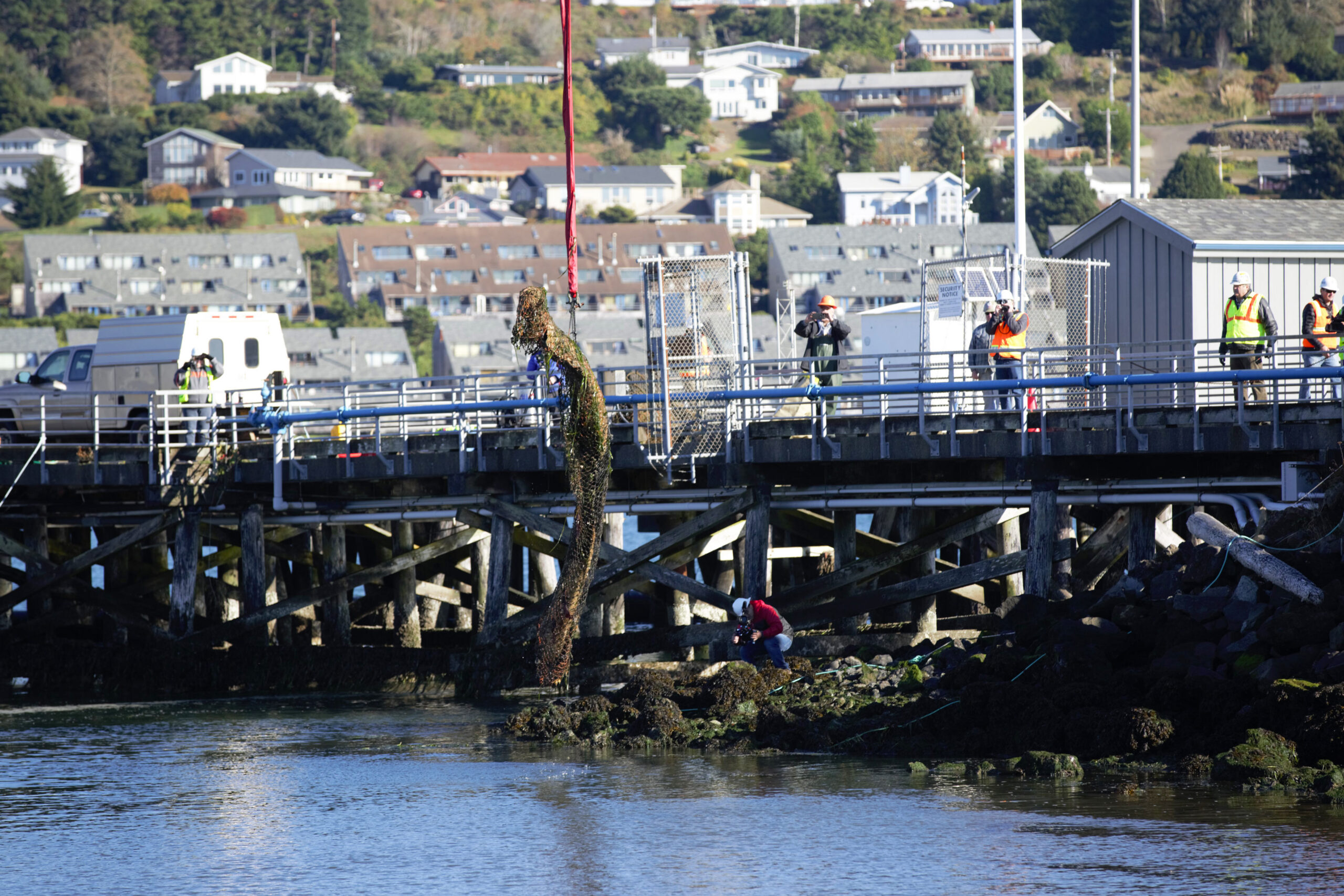
The dive team went back quarterly for three years to inspect. By 2019 sand had buried much of the skeleton. Getting the bones out was less complicated than putting them in, Lewis says, as long as they had good weather and the right tide. Below the surface it was still grim work. Divers dug the site out with an airlift until the shackles showed, then floated each bundle up with lift bags. Clos, Clifford, Batson, and Senior Aquarists Sage Butts and Trevor Ermann staged all 17 packages on the bottom before the crane arrived.
“Although we were relatively shallow, the water was dark and murky, and even with dive lights we could only see a few feet,” Batson says. “Once we started manipulating the bags of bones, that stirred up the mud and reduced visibility further. The bay water is cold, so our team wore drysuits to stay insulated and warm.”
It worked. The bay had done what no crew with knives could have, and every bundle came back up. The bones spent a year drying in a local warehouse before heading to Dinosaur Valley Studios in Alberta for restoration. Seven years after they left the bay, they went up at Hatfield.
The Aquarium never sent a bill. “When all was said and done,” Lewis says, “this would have cost over $40,000 that the Aquarium donated to this project.”
Clos says the trust is what stuck with her. “To have been asked and trusted by the Marine Mammal Institute to complete this specialized work was humbling.”
The whale is on display a quarter mile from the Aquarium, in the Gladys Valley courtyard at the Hatfield Marine Science Center. It’s open dawn to dusk.