To get the most out of your beach exploration experience, the best time to visit is during low tide — when the ocean recedes to reveal the various animals and seaweeds that live along our shores. The ocean’s tides are controlled by the gravitational pull of the moon, and to a lesser extent the sun.
The moon pulls the ocean water towards it, creating a bulge of water or a high tide. There are usually two high tides in every 24-hour cycle. Because these tide-causing forces are so well known, the height of sea level can be predicted pretty accurately. These predictions are published as tide tables. When you get your local tide table, search for the location of the beach you want to visit and the date you want to visit on. The information will be organized chronologically (by time), so you can see what hours are the best for you to visit.
How Do I Read A Traditional Tide Chart?
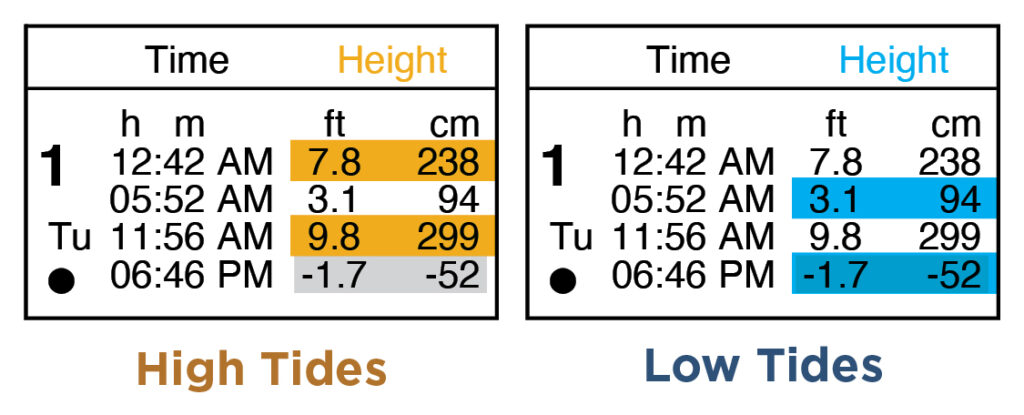
When looking at a tide chart, there are two things to pay attention to: the height, and the time. When the number under ‘Height’ is larger, it signifies it will be a high tide. When the number is lower, it will be a low tide. There are two high tides and two low tides every day. The ‘Time’ tells you approximately when the high or low tide will occur.
Wondering what the year has in store? Check out a full list of predicted upcoming tides:
King Tides take place every year when the Earth, moon and the sun are all aligned, creating a strong gravitational pull. During this time, be aware of stronger waves and higher waters when visiting the coast!
Remember:
Never turn your back on the ocean. Don’t do it. Don’t.
Watch from a distance! The tides are predicted to be nearly 10 feet high. Make way for royalty.
Wear a rain jacket. Maybe two. It’s Oregon.
Always plan your trip in advance!
This Year’s King Tides:
November 24-26, 2026 December 22-26, 2026 January 20-23, 2027
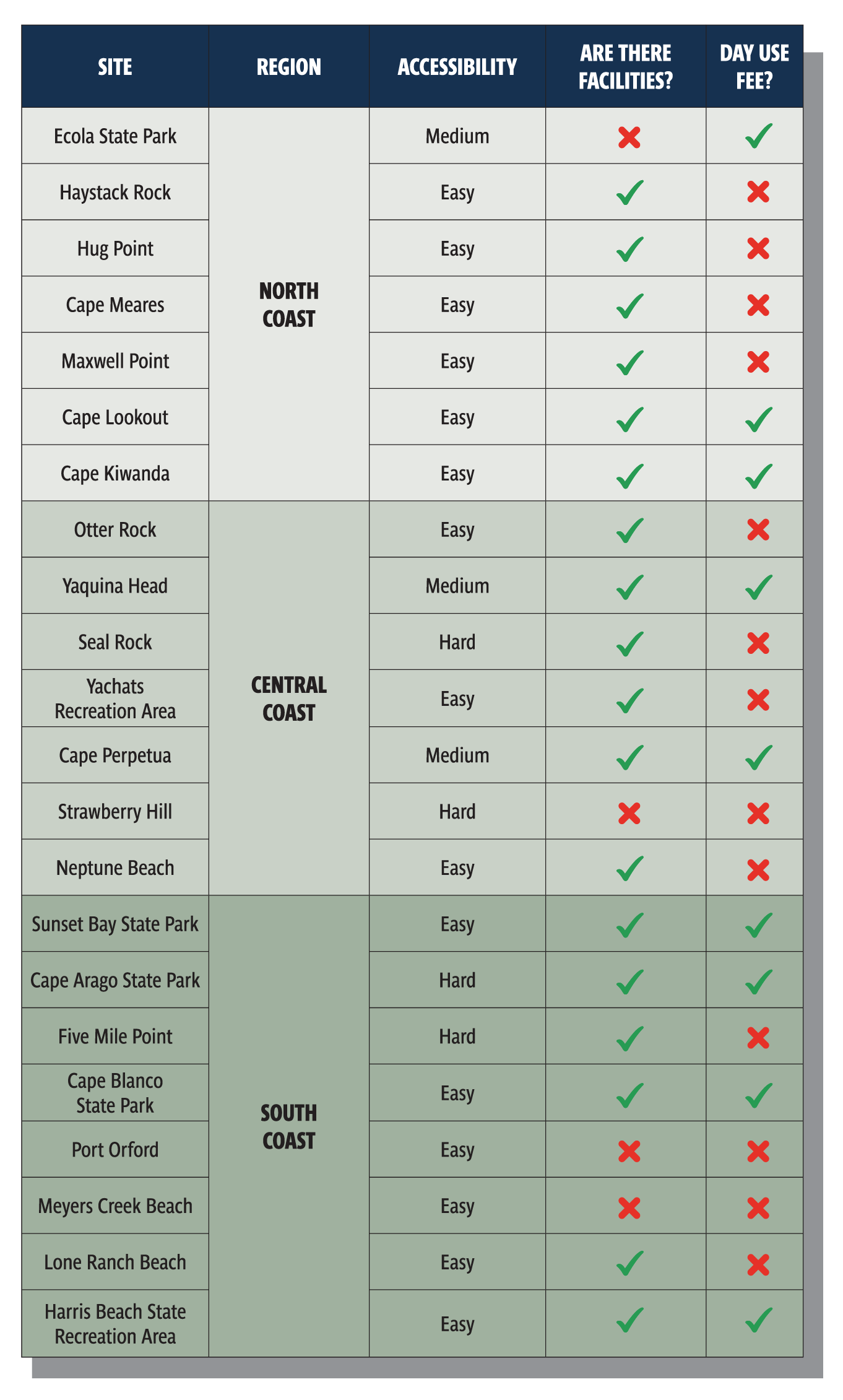
Top Tidepooling Spots on the Oregon Coast
Rocky Coast inhabitants are well adapted to the challenging ecosystem that they call home – however, they are also sensitive animals that need our protection. To help these critters and their homes thrive please consider the following:
*This chart is from 2026. Conditions may have changed. Visit stateparks.oregon.gov for the most up to date information.
STEP CAREFULLY Only step on bare rock and sand while exploring. Look out for loose rocks or uneven ground. Staying low and maintaining three points of contact can help you stay balanced.
LOOK, DON’T LIFT Choose to sit and observe different tidepools – leave animals on rocks and avoid turning over rocks. This can injure animals that may be hiding underneath or inside of them.
BE GENTLE Remember that these are wild animals. Please be gentle when interacting with them and use 2 fingers to carefully touch animals that you encounter.
LEAVE EVERYTHING WHERE YOU FOUND IT Shells, rocks, and creatures should stay in their homes.
TIDE + SNEAKER WAVE AWARENESS Check the tide before you go and pay attention to the incoming tide. Never turn your back to the ocean!
WEAR STURDY, CLOSE-TOED SHOES Shoes that have a tread with good grip to avoid slipping on sharp rocks and seaweed.
DRESS IN LAYERS! The weather on the Oregon Coast can be unpredictable––bringing extra layers that are easy to move in can help keep you warm and dry.
Become a Champion Tidepool Guardian!
Tidepools are home to a diversity of wildlife and are critical to ocean health. Unfortunately, these areas are sensitive to stressors like climate change, pollution and human interaction. To keep them healthy, we need ecosystem champions like you to share with others how they can help! See below for activities and ways you can help & spread the word!
What You Love About Tidepools
Write a letter of support sharing why you love tidepools and why you think it is important for us to continue protecting them. Use the template below to help you create your own personal statement. Once completed, send it along to your local legislator!
Letter of Support Template:
Hello,
My name is ___________________, I am writing to share why tidepools are important to me and why I believe they should be protected.
I love tidepools because ____________________________________________. (Examples: I like exploring them with my family, I enjoy learning about the animals, they make me feel curious.)
When I visit tidepools, I discover species like ________________________________. (Examples: sea stars, anemones, crabs, fish, shells.)These animals are special because __________________________________.
Tidepools are important to our environment because ___________________. (Examples: they are homes for many animals, they help us learn about the ocean, etc.)
I am concerned about tidepools because _______________________________. (Examples: people stepping on animals, trash, pollution, etc.) If we do not protect this ecosystem, ___________________________________________.
I believe we can help protect tidepools by ____________________________. (Examples: teaching people how to visit carefully, keeping beaches clean, following rules, protecting ocean habitats.)
Thank you for taking the time to read my letter and for helping protect tidepools for kids like me and for future generations.
Sincerely,
______________________
Critter Challenge
Choose your favorite tidepool critter that you spotted and learn more about them. What threats are they facing and how can people help? What actions can you take today to help them? How can you double your impact? Challenge 2 people in your community to join you in taking action.
Volunteer & Get Involved
Become a Summer Youth Volunteer at OCAq or find a volunteer opportunity near you! Here are a few local community organizations that are coming together to properly steward these habitats:
Call the NOAA West Coast Stranding Hotline at 1-866-767-6114. This hotline covers the entire West Coast area and they will send your report to the appropriate stranding contact.
We use cookies to improve your experience and see how our guests are navigating the website. If this is alright by you, hit 'Accept All', or 'Settings' to customize and learn more.
Read our cookie policy