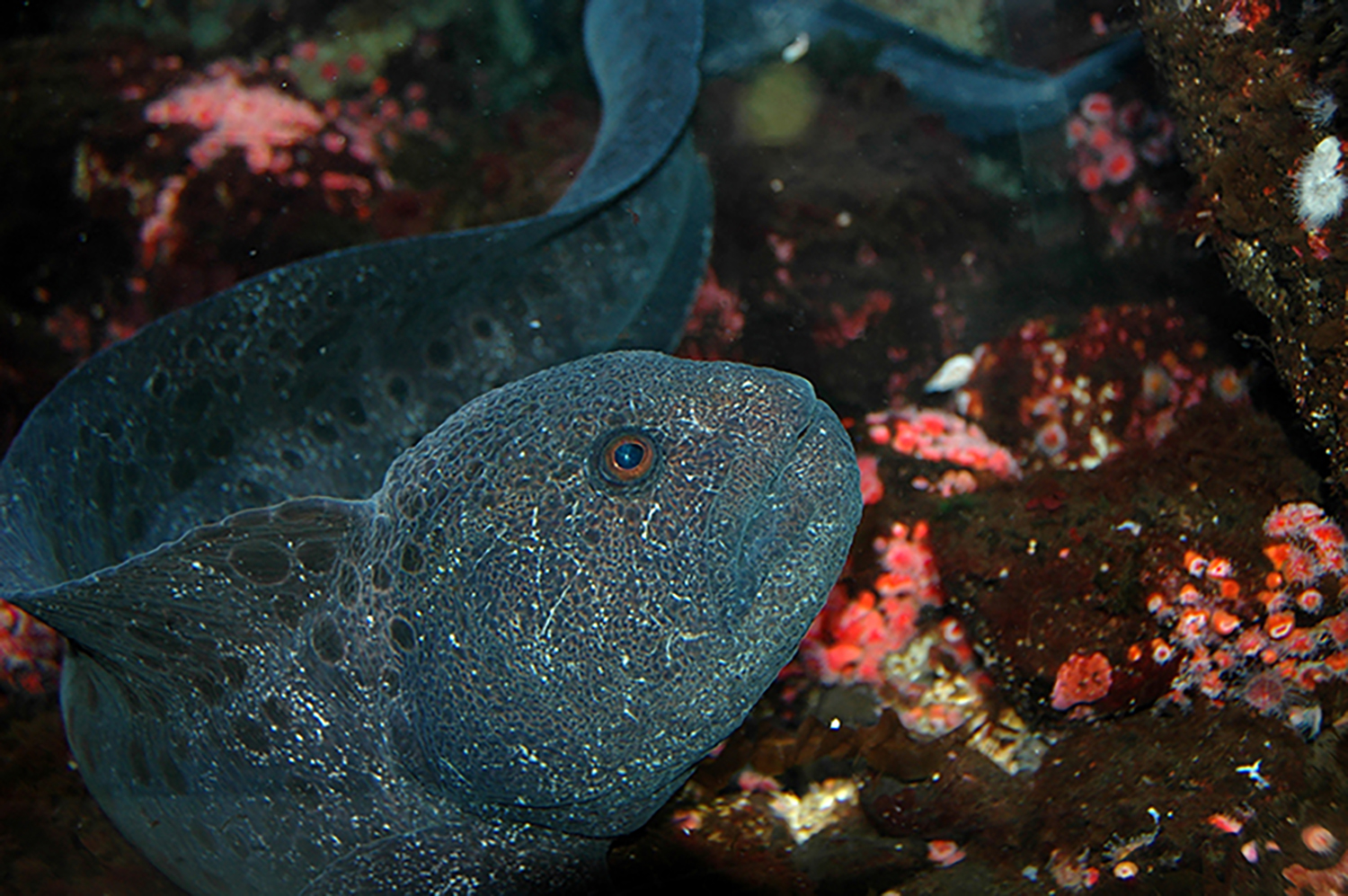
Wolf-eels are mostly gray to brown and sometimes greenish. Females tend to be brown while males are dominantly grey. This species has dark round spots with pale rings along the body and fins. Larger individuals tend to be more mottled.
They have a large, square head and stout canine teeth at the front of the mouth. Wolf-eels lack pelvic fins and have no lateral line. The dorsal fin is long with flexible spines and no soft rays. Males can be told apart from females by their thick jaws and bulging forehead.
Young wolf-eels are often orangish with dark areas forming into stripes at the rear of the body.
Wolf-eels can grow up to 8.2 feet long.
Habitat
Rocky reefs, artificial reefs, kelp forests and coastal areas with caves and crevices. At depths from the intertidal to more than 1000 feet.
Diet
Crustaceans, echinoderms, and fish.
Life History
Wolf eels mate for life. Spawning usually occurs from October through February. Beginning around age seven, females lay up to 10,000 eggs at a time.
After the female deposits the eggs, both parents guard the eggs. The female coils around the egg mass while the male coils around the female. As the eggs develop, the female messages them periodically to help circulate the water around the eggs to keep them supplied with oxygen.
Eggs are incubated for 3 to 4.5 months and once they hatch the larvae float away on currents, entering a free-swimming phase. They spend this pelagic phase in the middle depths of the ocean.
As juvenile wolf-eels mature, they move to shallower water and wander the sea bottom looking for food and a mate. Once they find a mate and a suitable habitat they settle down, typically spending the rest of their lives there. Adults often occupy only one den, unless they are driven out by a larger wolf-eel or a large octopus.
Wolf-eels in the wild have been recorded to live up to about 20 years old.
IUCN Status
Least Concern
Ecosystem & Cultural Importance
Wolf-eel eggs are prey for kelp greenlings and rockfish. Juveniles are eaten by lingcod, rockfish, and cabezon. Adult wolf eels only have a few predators including seals, otters and occasionally salmon.
Wolf-eels are important predators in the North Pacific, controlling populations of hard-shelled prey.
Wolf-eels hold cultural significance for Northwest Native American tribes. The wolf-eel was often reserved for tribal healers.
Despite their eel-like appearance, wolf-eels are not true eels. This species is actually not related to other eels but is one of five species in the “wolffish” family.
Even in the beginning of their lives wolf-eels are skilled hunters. Young wolf-eels don’t have the powerful molars that adults use to crush shelled animals so they rely on catching fish with their long canine teeth. Adults grab prey with their jaws and use the broad molars in the back of their mouths to crunch through the shells. Even though this species may look ferocious, they tend to be aggressive only to other wolf-eels.
Citations & Other Resources
Orr, W. and G. Workman. 2021. Anarrhichthys ocellatus. The IUCN Red List of Threatened Species 2021.
California Department of Fish and Wildlife. 2020. Wolf-Eel. Marine Species Portal. https://marinespecies.wildlife.ca.gov/wolf-eel/false/
Washington Department of Fish & Wildlife. N.d. Wolf Eel. https://wdfw.wa.gov/species-habitats/species/anarrhichthys-ocellatus#regs-seasons
Monterey Bay Aquarium. N.d. Wolf-eel. https://www.montereybayaquarium.org/animals/animals-a-to-z/wolf-eel
California Department of Fish and Wildlife. 2024. Creature Feature: Wolf-Eeel. Marine Management News. https://cdfwmarine.wordpress.com/2024/01/19/creature-feature-wolf-eel/
We use cookies to improve your experience and see how our guests are navigating the website. If this is alright by you, hit 'Accept All', or 'Settings' to customize and learn more.
Read our cookie policy