
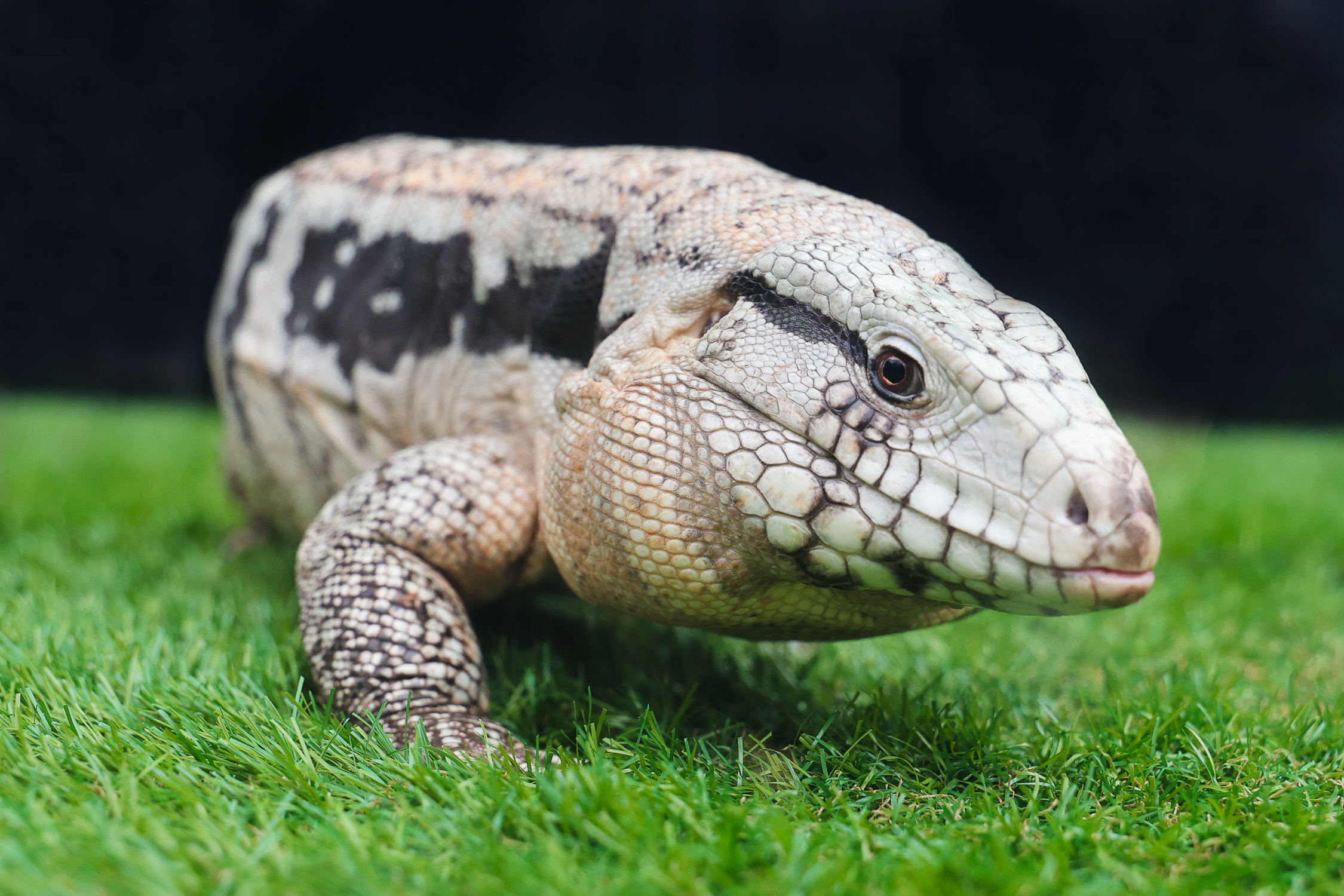
Argentine Black & White Tegu

Salvator merianae

Argentine Black & White Tegu

Salvator merianae
Other Common Names
Black-and-white tegu, Huge tegu, Argentine giant tegu
Other Common Names
Black-and-white tegu, Huge tegu, Argentine giant tegu

At the Aquarium

Amazon Basin

Appearance

A black and white lizard with banding along the tail. Hatchlings have largely green heads which fades to the standard black or white markings after a few months. Males can grow up to 4ft in length, while females typically will reach lengths of only 3ft. Males also typically have much more distinct jowls, while females will have a more streamline facial appearance.

Habitat

They live in tropical rain forests, savannas, and semi-desert regions.

Diet

Tegus are omnivorous! They will eat a variety of fruits, seeds, birds, fish, amphibians, invertebrates, insects, reptiles, and other small mammals. Eggs are a notable preference, often seeking out the nests of birds or other reptiles. This especially can have an impact on areas they are invasive to.

Life History

Tegus will have yearly clutches of eggs, usually hatching in the spring. When it hatches, it weighs as little as .35oz (10g). Over the next few years it will grow to nearly 800 times that in size and weight.

IUCN Status

Least Concern

Ecosystem & Cultural Importance

Like other ‘bushmeat’ animals, they are a common food source in their native regions. After escaping from the pet trade, they are well documented invasive species found throughout parts of Thailand, Australia, and the southern United States. They are well adapted to becoming invasive species, their diet and reproductive habits posing threats to native bird and reptile populations in habitats they are introduced in.
Found in Uruguay, Bolivia, Argentina, and parts of Brazil and Paraguay.
This animal is not found on the Oregon Coast. It can be found at the Oregon Coast Aquarium as part of our temporary exhibit Amazon Basin: Adventure for the Senses.
The Aquarium’s tegu is named Chowder! They are known for dog-like intelligence and curiosity. They are one of South America’s largest lizards. Unlike most reptiles, they are both endothermic (warm-blooded) and ectothermic (cold-blooded)! During their breeding season, tegus have been recorded to have an interior heat that will actually remain at a higher temperature than the ambient temperature of the burrow. However, the rest of the year they display classically ectothermic behavior like sunbathing, and have a temperature matching their ambient environment temperature as normal. Because of all this, many call them partial or seasonal endotherms.

Citations & Other Resources

  • https://www.iucnredlist.org/species/178340/61322552
  • Moon, Peter (February 24, 2016). “Giant tegu lizard is warm-blooded, researchers discover”. Agência FAPESP.
  • Goetz, Scott M.; Steen, David A.; Miller, Melissa A.; Guyer, Craig; Kottwitz, Jack; Roberts, John F.; Blankenship, Emmett; Pearson, Phillip R.; Warner, Daniel A.; Reed, Robert N. (10 March 2021). “Argentine Black and White Tegu (Salvator merianae) can survive the winter under semi-natural conditions well beyond their current invasive range”. PLOS ONE. 16 (3) e0245877. Bibcode:2021PLoSO..1645877G. doi:10.1371/journal.pone.0245877. PMC 7946314. PMID 33690637.
  • “Argentine black and white tegu” (profile). Florida Fish and Wildlife Conservation Commission. Retrieved 2023-03-07.
  • “Tegu Lizards – Everglades CISMA”. 21 September 2022.
  • FAPESP. (2016). Giant tegu lizard is warm-blooded, researchers discover. Agência Fapesp. https://agencia.fapesp.br/giant-tegu-lizard-is-warm-blooded-researchers-discover/22723 Accessed 24 Aug. 2026.