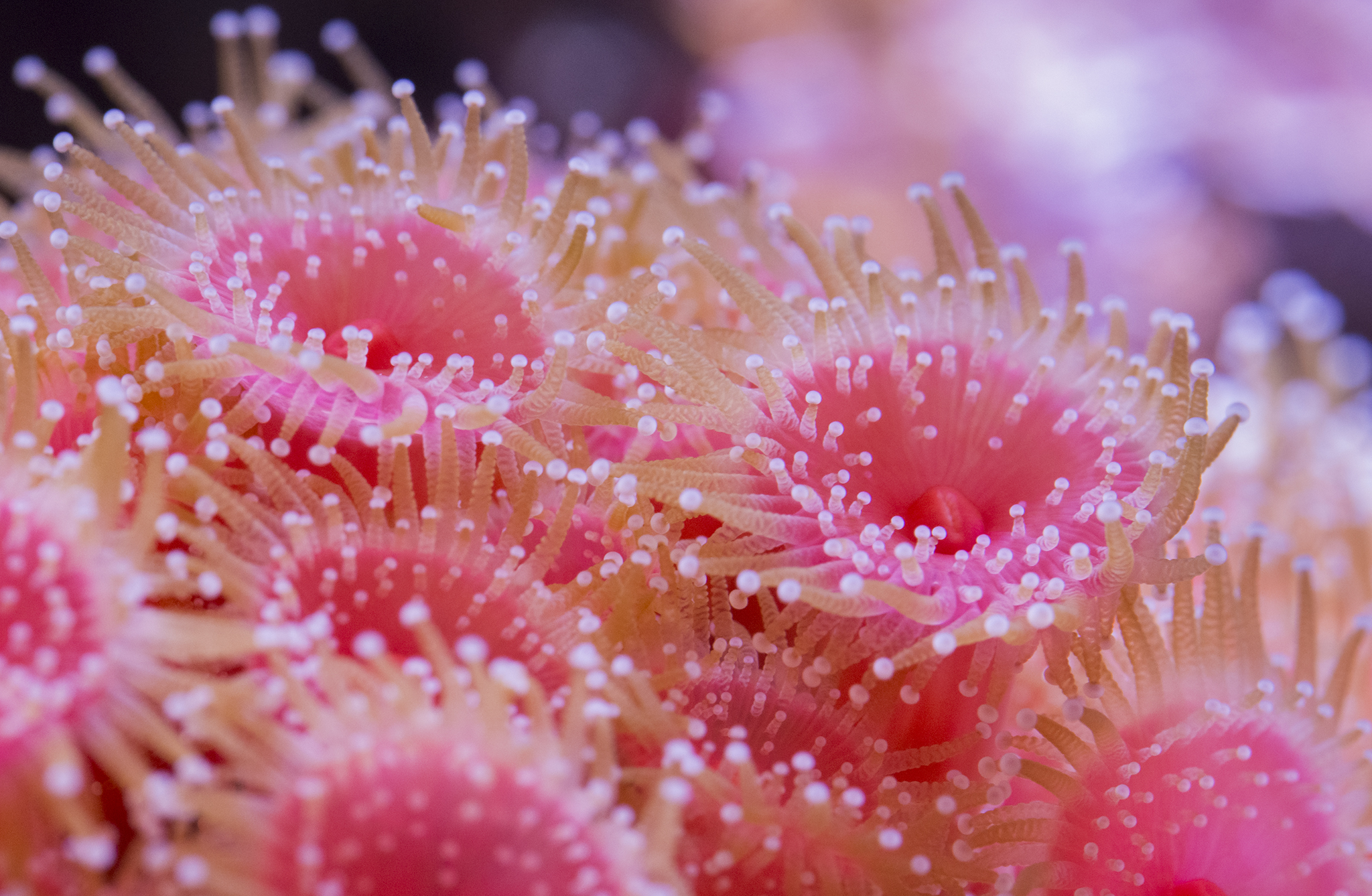
Strawberry anemones are bright in color but variable between colonies. They are often pink but can be red, orange, lavender, pale blue, crimson, or purple. They have white or clear tentacles capped with white knobs, surrounding a central disk.
They are densely packed, occurring in groups of the same color. Colonies can reach widths of 66ft.
Individuals are about 1cm tall and 1 to 1.5cm in diameter.
Habitat
From the lower intertidal zone to at least 50 meters in rocky shore and kelp forest habitats.
Diet
Small invertebrates and fish larvae.
Life History
Strawberry anemones prefer to live on rocky shores where they can attach onto rock walls, under rock ledges, surrounding wharf pilings, and generally any hard substrate. This even includes other animals like giant acorn barnacles and decorator crabs.
Strawberry anemones reproduce sexually by annual broadcast spawning and asexually by multiple or longitudinal fission to form single-sexed clones of various colors and sizes. A colony will contain all male or female clones.
IUCN Status
Not Evaluated
Ecosystem & Cultural Importance
Strawberry anemones are prey for a variety of species, including the leather star Dermasterias imbricata.
When attached to oysters and mussels, strawberry anemones may provide these animals protection with their stinging cells.
Strawberry anemones have stinging cells within their tentacles called nematocysts that are used to protect themselves and to feed. The outstretched tentacles wait for potential prey to drift by and the stinging cells subdue the small prey.
Strawberry anemones are not true sea anemones, but rather are more closely related to corals. They are a corallimorpharian and have an appearance similar to corals, but lack the exoskeleton.
National Ocean Service. N.d. Strawberry Anemone. Earth Is Blue Magazine. https://sanctuaries.noaa.gov/magazine/5/cordell-bank/
Schnitzler, C. E., R.J. Keenan, R. McCord, A. Matysik, L.M. Christianson, L. M., and S.H.D. Haddock. 2008. Spectral Diversity of Fluorescent Proteins from the Anthozoan Corynactis californica. Marine Biotechnology (New York, N.Y.), 10(3), 328–342. https://doi.org/10.1007/s10126-007-9072-7
We use cookies to improve your experience and see how our guests are navigating the website. If this is alright by you, hit 'Accept All', or 'Settings' to customize and learn more.
Read our cookie policy