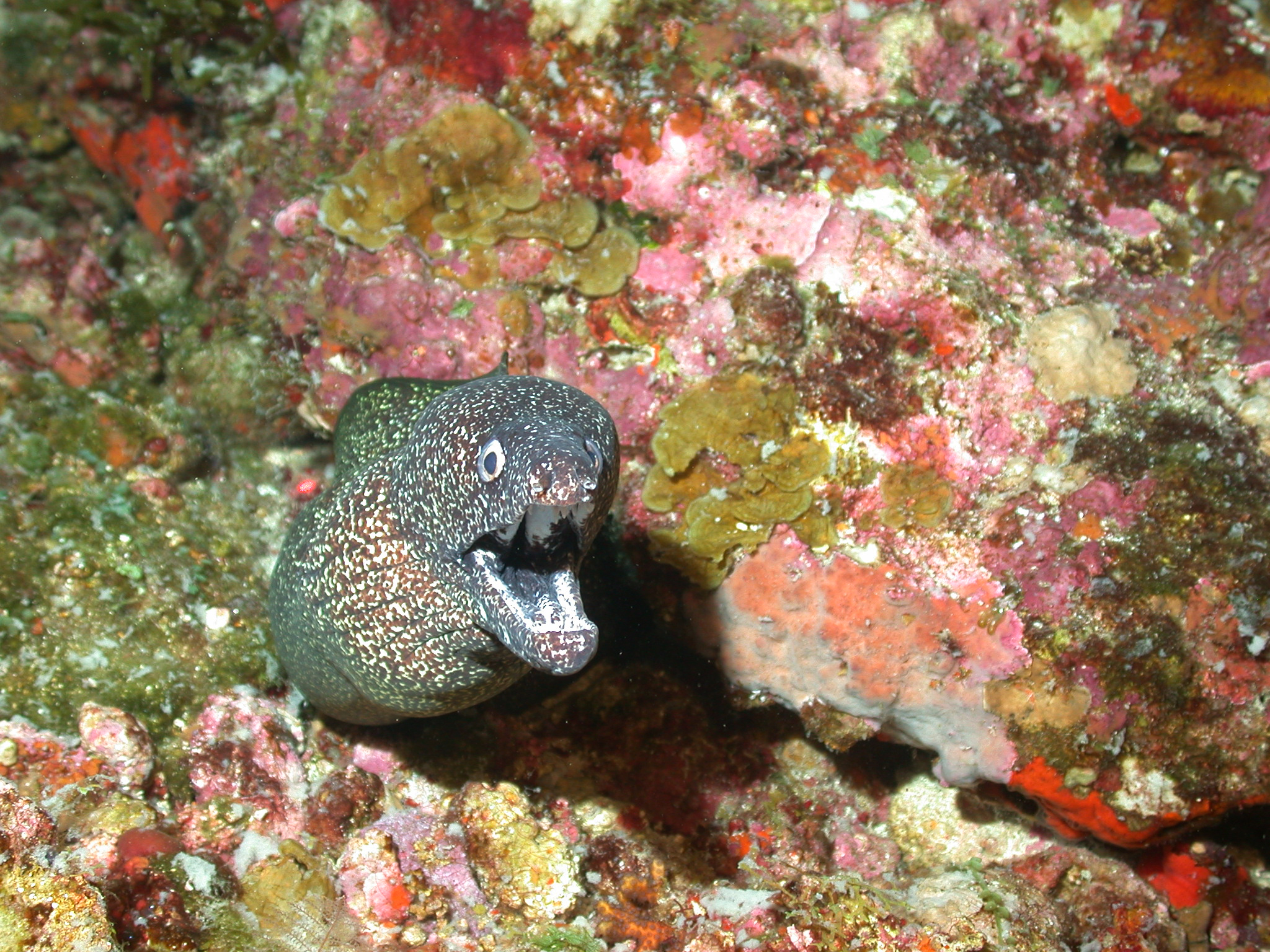
The spotted moray eel is cream-colored with many red-brown to brown spots. This species can reach at least 40 inches in total length. Males tend to grow to longer lengths than females.
Habitat
Shallow rocky and grassy areas, as well as coral reefs. Lives at depths as deep as 200 m.
Diet
Fish, crustaceans and octopus.
Life History
Spotted moray eels are capable of spawning throughout the year. Spotted moray eels spawn by releasing eggs and sperm into the water. Fertilized eggs then hatch and undergo a pelagic larval stage where they float and drift with ocean currents. The young spotted moray eels continue to grow until they eventually settle in shallow rocky and grassy areas, as well as coral reefs.
The spotted moray eel lives alone and is usually seen with its head sticking out from a hole while the rest of its body is hidden.
The results of a research study indicated that this species can live at least 23 years, with females living longer on average than males.
IUCN Status
Least Concern
Ecosystem & Cultural Importance
The spotted moray eel is caught in local subsistence fisheries which involves small-scale fishing practices done by individuals and for local consumption.
The spotted moray eel is an important predator in reef ecosystems of the Atlantic Ocean. As a predator, the spotted moray eel helps maintain and control the populations of a variety of prey species.
In the western Atlantic from North Carolina south along the U.S., Bermuda, the Bahamas, throughout the Gulf of Mexico and Caribbean Sea, and along South America to southern Brazil, including Trinidade Island. In the eastern Atlantic from the Ascension and St. Helena Islands.
This animal is not native to the Oregon Coast, however is found in the larger Pacific Ocean. It lives in the Aquarium as part of our Connected Coasts gallery.
This species is primarily nocturnal. It hides in holes in the reef during the day and hunts prey in the surrounding area at night.
Citations & Other Resources
Smith, D.G. and J. McCosker. 2015. Gymnothorax moringa. The IUCN Red List of Threatened Species 2015.
Zokan, M. A., D.M Wyanski, D.B. White, and G.R. Sedberry. 2022. Life history of the spotted moray (Gymnothorax moringa) off the Atlantic coast of the southeastern United States: age, growth, and reproduction. Fishery Bulletin (Washington, D.C.), 120(3–4), 195–204. https://doi.org/10.7755/FB.120.3-4.
Eisenberg, E., and P.J. Lynch. 2002. A Field Guide to the Southeast Coast and Gulf of Mexico : Coastal Habitats, Seabirds, Marine Mammals, Fish, & Other Wildlife. Yale University Press,. https://doi.org/10.12987/9780300178401
Hoese, H. D., and R.H. Moore. 1998. Fishes of the Gulf of Mexico, Texas, Louisiana, and adjacent waters (2nd ed.). Texas A & M University Press.
We use cookies to improve your experience and see how our guests are navigating the website. If this is alright by you, hit 'Accept All', or 'Settings' to customize and learn more.
Read our cookie policy