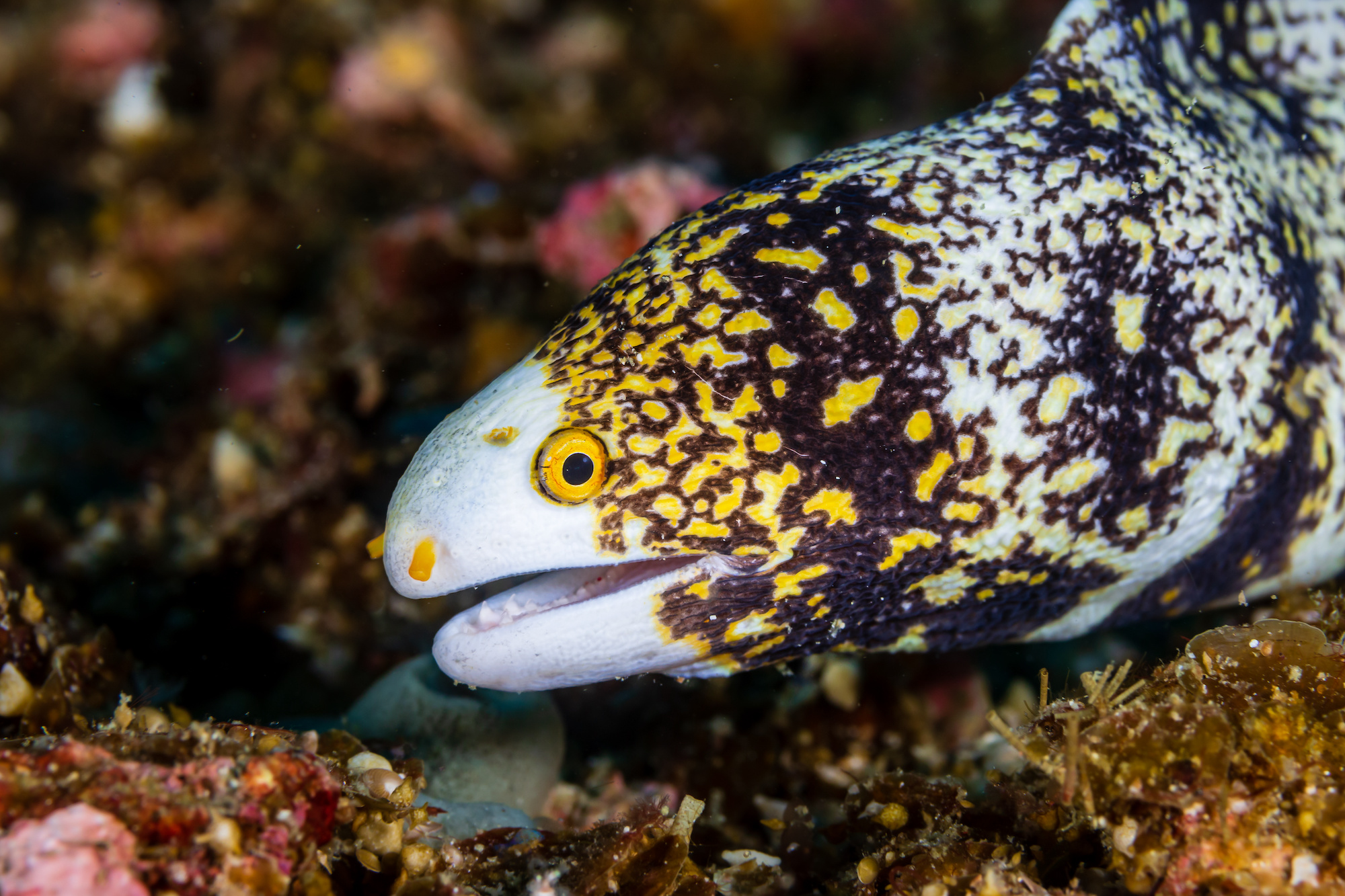
The snowflake moray is white with two rows of black blotches and yellow spots that span its entire body. There are many smaller black spots between the large blotches. These smaller black spots become more numerous and nonuniform with age.
Males of this species can grow up to 100 cm.
Habitat
Reefs and occasionally seagrass beds with rock rubble. Lives at depths of 1 to 48 m, but is usually found at around 10 m.
Diet
Crustaceans and sometimes smaller fish.
Life History
Snowflake morays may be protogynous hermaphrodites, meaning they begin life as female and then change into male at some point in their lifespan. However, this is unconfirmed and more research is needed to fully understand this species’ life history.
Snowflake morays spawn by releasing eggs and sperm into the water. Fertilized eggs then hatch and undergo a pelagic larval stage where they drift with ocean currents. The larvae are called leptocephalus. Moray’s pelagic larval stages are the longest among reef fishes which explains why this species is widely distributed.
Leptocephalus are transparent except for their eye color and the body wall. The young snowflake morays continue to grow and eventually settle in the reef ecosystems.
IUCN Status
Least Concern
Ecosystem & Cultural Importance
The snowflake moray is an important predator throughout its range and helps keep reef ecosystems in balance.
Snowflake morays and other moray eels are important to Hawaiian culture and are often featured in local folklore.
This animal is not native to the Oregon Coast, however is found in the larger Pacific Ocean. It lives in the Aquarium as part of our Connected Coasts gallery.
There have been observations of snowflake morays moving into or even above the intertidal zone, the area between the ocean and land where the tides go in and out. They have been observed to move from the aquatic environment to feed on crabs out of the water.
Like other moray eels, the snowflake moray has a second set of pharyngeal jaws located in the back of its throat that grasps and pulls the prey into its throat.
Citations & Other Resources
Smith, D.G., K. Tighe and J. McCosker. 2019. Echidna nebulosa. The IUCN Red List of Threatened Species 2019.
Myers, R. F. 1991. Micronesian reef fishes : a practical guide to the identification of the coral reef fishes of the tropical central and western Pacific (2nd ed.). Coral Graphics.
Randall, J. E., G.R. Allen, and R.C. Steene. 1990. Fishes of the Great Barrier Reef and Coral Sea. University of Hawaii Press.
Mehta, R. S., and K.R. Donohoe. 2021. Snowflake morays, Echidna nebulosa, exhibit similar feeding kinematics in terrestrial and aquatic treatments. Journal of Experimental Biology, 224(11). https://doi.org/10.1242/jeb.234047
We use cookies to improve your experience and see how our guests are navigating the website. If this is alright by you, hit 'Accept All', or 'Settings' to customize and learn more.
Read our cookie policy