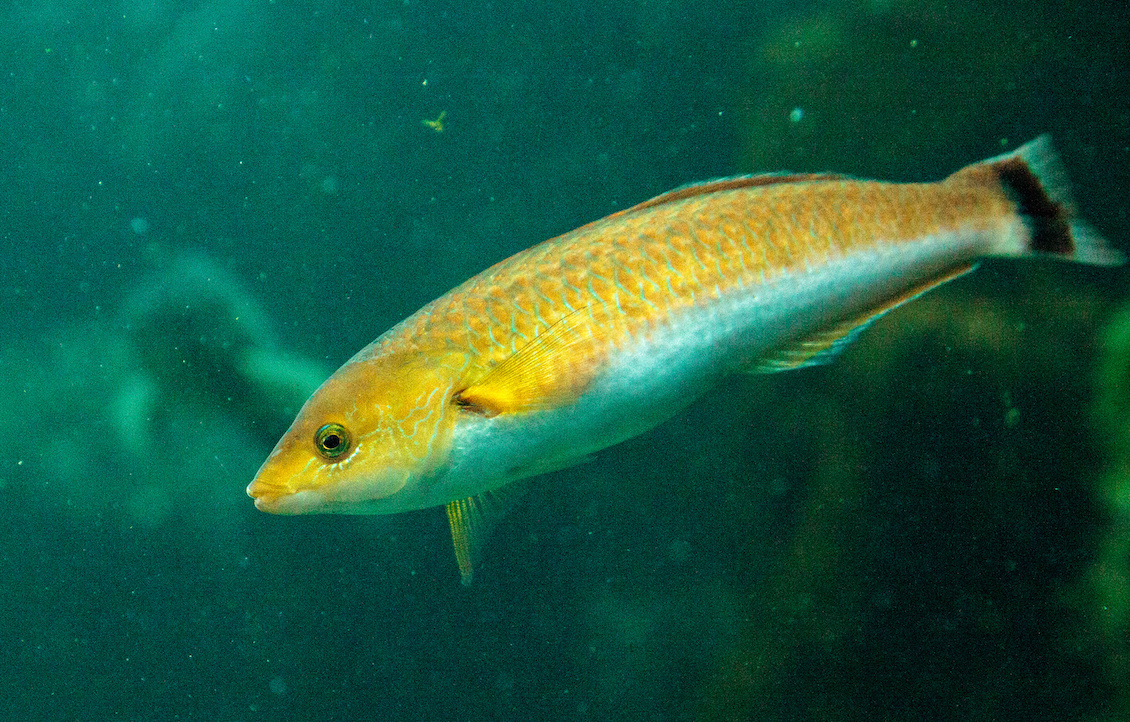
Señoritas are long and slender. Their backs are brown to olive, while their bellies are yellow or pearly white. Their scales have dark centers and they may have several pale bands on their cheeks. The base of their caudal fin has a large blackish spot. Females and males are similar in color and pattern. Señoritas can grow to a length of 25.4 cm or 10 inches.
Habitat
Rocky reefs and kelp forests in depths of 1-73 m, but is most common above 20 m.
Diet
Small invertebrates and may act as a “cleaner” for larger fishes, eating dead skin and small parasites.
Life History
Their reproduction has not been well studied so far; some believe they do not change sex while others believe they are all born female and change sex to male at some point in their life. Fertilized eggs float in the water and drift with ocean currents. The hatched larvae grow into juveniles who eat zooplankton. They eventually become adults, forming loose schools or living alone.
Señoritas have only been recorded up to 4 years old, so their lifespan is not known.
IUCN Status
Least Concern
Ecosystem & Cultural Importance
Señoritas are a food source for bocaccio rockfish, kelp bass, starry rockfish as well as Brandt’s cormorants and California sea lions.
Señoritas clean blacksmith, garibaldi, and other fishes. This is a mutually beneficial relationship with señoritas receiving food in the form of small parasites and dead skin while the other fish are freed of irritants on their skin.
Señoritas are important in maintaining the wellbeing and balance of kelp forest ecosystems. They have positive indirect effects on kelp since they eat organisms that eat kelp.
This animal is not native to the Oregon Coast, however is found in the larger Pacific Ocean. It lives in the Aquarium as part of our Connected Coasts gallery.
Señoritas burrow into the sand at night and sleep. Their bodies are coated in mucus which helps them easily go through the sand.
Citations & Other Resources
Craig, M.T. 2010. Oxyjulis californica. The IUCN Red List of Threatened Species 2010.
CA Marine Species Portal. (n.d.). . https://marinespecies.wildlife.ca.gov/se%C3%B1orita/false/.
Davenport, A. C., and T. W. Anderson. 2007. Positive Indirect Effects of Reef Fishes on Kelp Performance: The Importance of Mesograzers. Ecology 88:1548–1561.
Hartney, K. B. 1996. Site fidelity and homing behaviour of some kelp-bed fishes. Journal of fish biology 49:1062–1069.
Kells, V. A. 2016. A field guide to coastal fishes. From Alaska to California. Johns Hopkins University Press, Baltimore.
We use cookies to improve your experience and see how our guests are navigating the website. If this is alright by you, hit 'Accept All', or 'Settings' to customize and learn more.
Read our cookie policy