Red-Footed Tortoise

Chelonoidis carbonarius

Red-Footed Tortoise

Chelonoidis carbonarius
Other Common Names
Red-leg, red-legged, red-foot, savannah tortoise
Other Common Names
Red-leg, red-legged, red-foot, savannah tortoise

At the Aquarium

Amazon Basin

Appearance

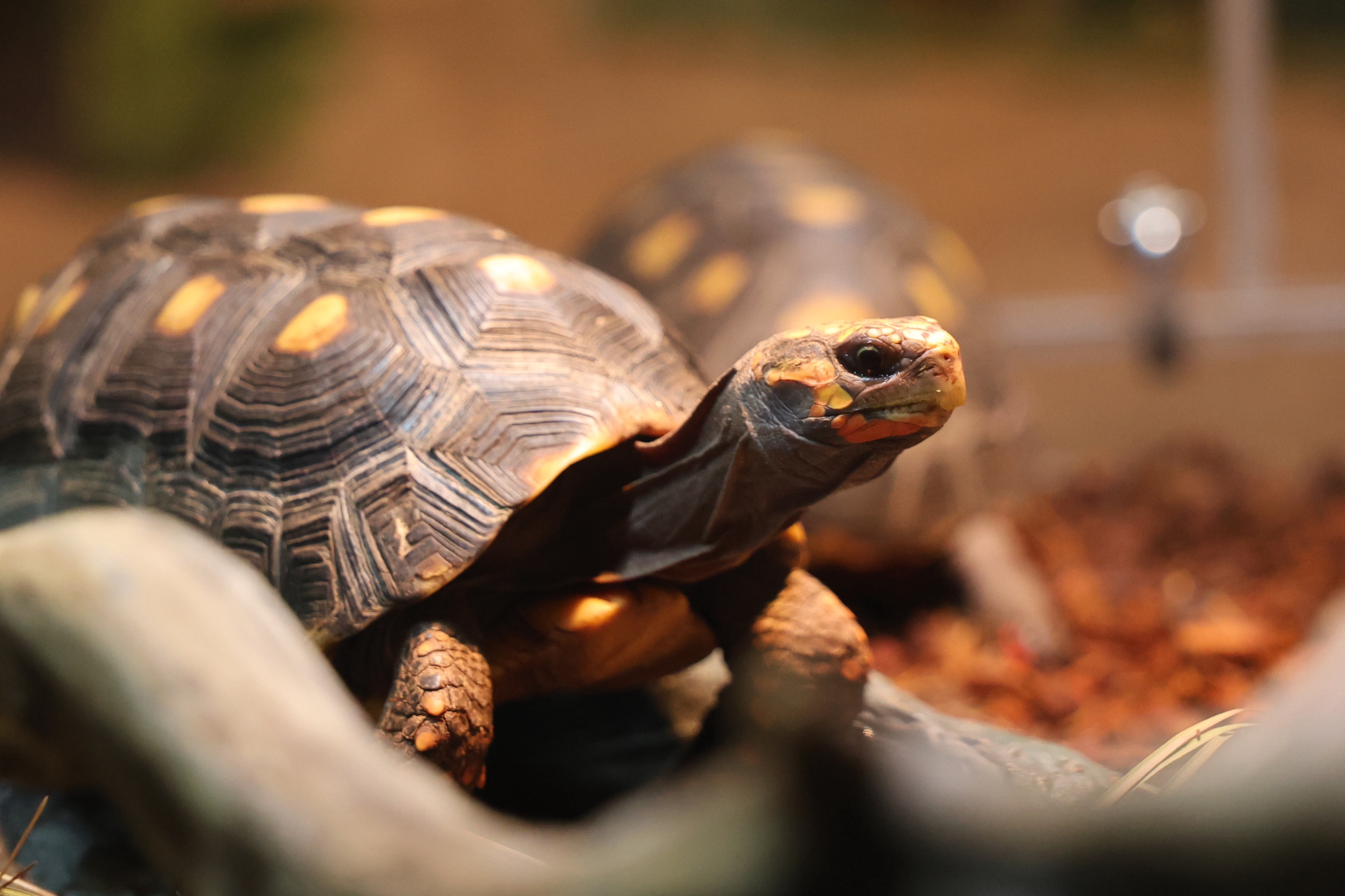
Sporting bright red scales on their toes like little bursts of color. Their shells are mostly dark brown or black ovals, with a pale yellow areole (bump) in the middle of each scute of the shell.

Habitat

Savannahs and forests

Diet

They are omnivorous. Their diet mostly consists of various grass, flowers, fruit, fungi, worms, other invertebrates, and occasional carrion.

Life History

They do not brumate, but may aestivate in the hotter months of the year.

IUCN Status

Endangered

Ecosystem & Cultural Importance

They are commonly kept as pets.
They are keystone species, playing a key role in dispersing seeds and helping to regenerate forests. Foundations like the Turtle Survival Alliance and the Turtle Conservancy were founded to help protect and establish self-sustaining populations of red-footed tortoises.
Throughout northern South America
This animal is not found on the Oregon Coast. It can be found at the Oregon Coast Aquarium as part of our temporary exhibit Amazon Basin: Adventure for the Senses.
Bunny and Cricket may be familiar faces if you’ve been to an ambassador animal presentation in the past few months! You can find them either in their home in the Amazon Basin exhibit, or at any one of our ambassador stages for a presentation.

Citations & Other Resources

  • https://www.turtleconservancy.org/programs/red-footed-tortoise
  • https://www.turtleconservancy.org/turtlesoftheworld/chelonoidis-chelonoidis-carbonarius
  • https://turtlesurvival.org/red-footed-tortoises-rewilded-in-landmark-colombian-conservation-effort/
  • Vargas-Ramirez, Mario; Jerome Maran; Uwe Fritz (2010). “Red- and yellow-footed tortoises, Chelonoidis carbonaria and C. denticulata (Reptilia: Testudines: Testudinidae), in South American savannahs and forests: do their phylogeographies reflect distinct habitats?” (PDF). Organisms Diversity & Evolution. 10 (2): 161–172. Bibcode:2010ODivE..10..161V. doi:10.1007/s13127-010-0016-0. S2CID 28894541. Archived from the original (PDF) on 2013-10-04.
  • Strong, Joel N.; Jose M. V. Fragoso (2006). “Seed Dispersal by Geochelone carbonaria and G. denticulata in Northwestern Brazil”. Biotropica. 38 (5): 683–686. doi:10.1111/j.1744-7429.2006.00185.x.