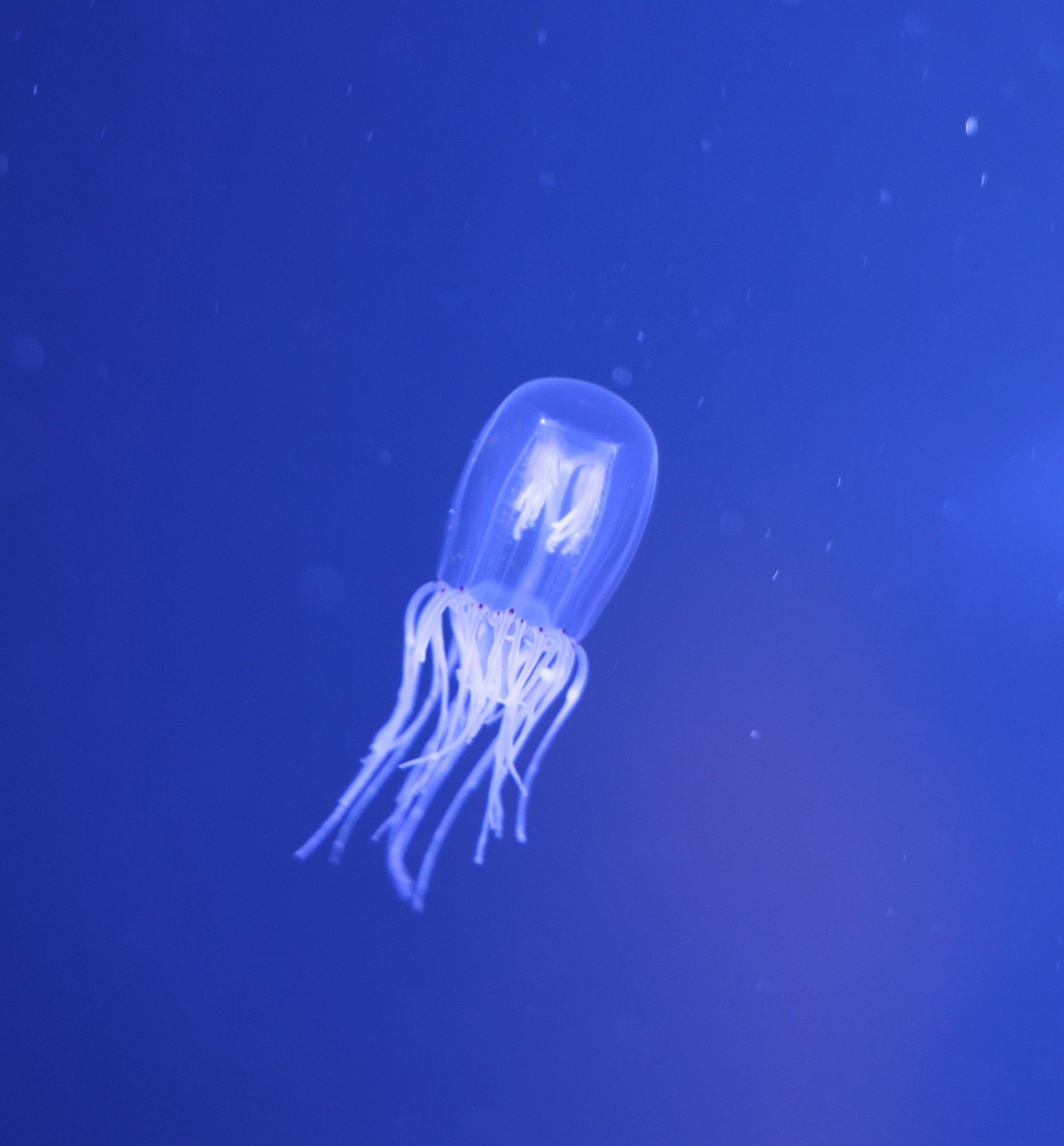
Red-eyed jellyfish, Red-eye medusa, bell medusa, bell-shaped jellyfish, penicillate jellyfish
At the Aquarium
Jelly Gallery
Appearance
The red-eyed bell jelly are a bit taller than wide, clear bell with 100-160 evenly-spaced extendable tentacles hanging from the bell margin. Evenly spaced, small red dots on the margin are its light-sensing eyes, called ocelli. The stinging cells occur on the tentacles and on the manubrium, at the center of the bell, which has 4 oral lips. The gonads appear as 4-11 finger-like projections hanging from the center of the bell’s underside. The gonads and other internal organs may appear yellow, yellow-brown, reddish-brown, or purple in color. There are 4 unbranched radial canals that contain 15-25 pairs of blind sacks.
Habitat
Coastal waters, bays and harbors, often near eelgrass
Diet
Eats small crustaceans, including benthic amphipods and planktonic copepods, and worms
Life History
The polyps haven’t been found yet in the wild nor successfully raised in a lab. Planulae have been produced in a lab but so far researchers have been unable to get them to settle. It could be that this species requires a specific host to settle upon and we just don’t know yet what that host is.
Like other jellies, the medusa phase can be either male or female. Females are highly fecund, able to produce 10,000 eggs every day. Spawning occurs over less than 10 minutes, 1 hour after dark. Bell diameter can grow up to 7” and reach lengths of 5”. The medusae phase lasts around a few months.
IUCN Status
Not Evaluated
Ecosystem & Cultural Importance
Red-eyed bell jellies are important to their predators, which include other jellies, fishes, sea anemones, and red rock crabs.
Red-eyed bell jellies are usually found near the seabed during the day and migrate up into the water column at night. They use their stinging cells to capture prey and they have 2 ways they feed: on the seabed or in the water column. To feed on the seabed, they use their tentacles to perch on bottom sediments, with their mouth touching the substrate. They may also use a “hopping” motion up and down to help stir up zooplankton on the seafloor. In the water column, they use a method called sink fishing. To do this, they extend their tentacles out and either hold their position in the water column or sink slowly, stinging any prey that comes into contact with their tentacles. Once prey has been subdued, the tentacle is retracted to bring it to the mouth.
Weinandt, Sydney. “Change in Rate of Swimming Contractions and Behavioral Patterns of Polyorchis penicillatus in Response to Different Wavelengths of Light.” (2023).
We use cookies to improve your experience and see how our guests are navigating the website. If this is alright by you, hit 'Accept All', or 'Settings' to customize and learn more.
Read our cookie policy