Other Common Names Different species belonging to this genus go by a variety of names. For instance Porites porites is commonly known as hump coral or finger coral.
Different species belonging to this genus go by a variety of names. For instance Porites porites is commonly known as hump coral or finger coral.
At the Aquarium
Connected Coasts
Appearance
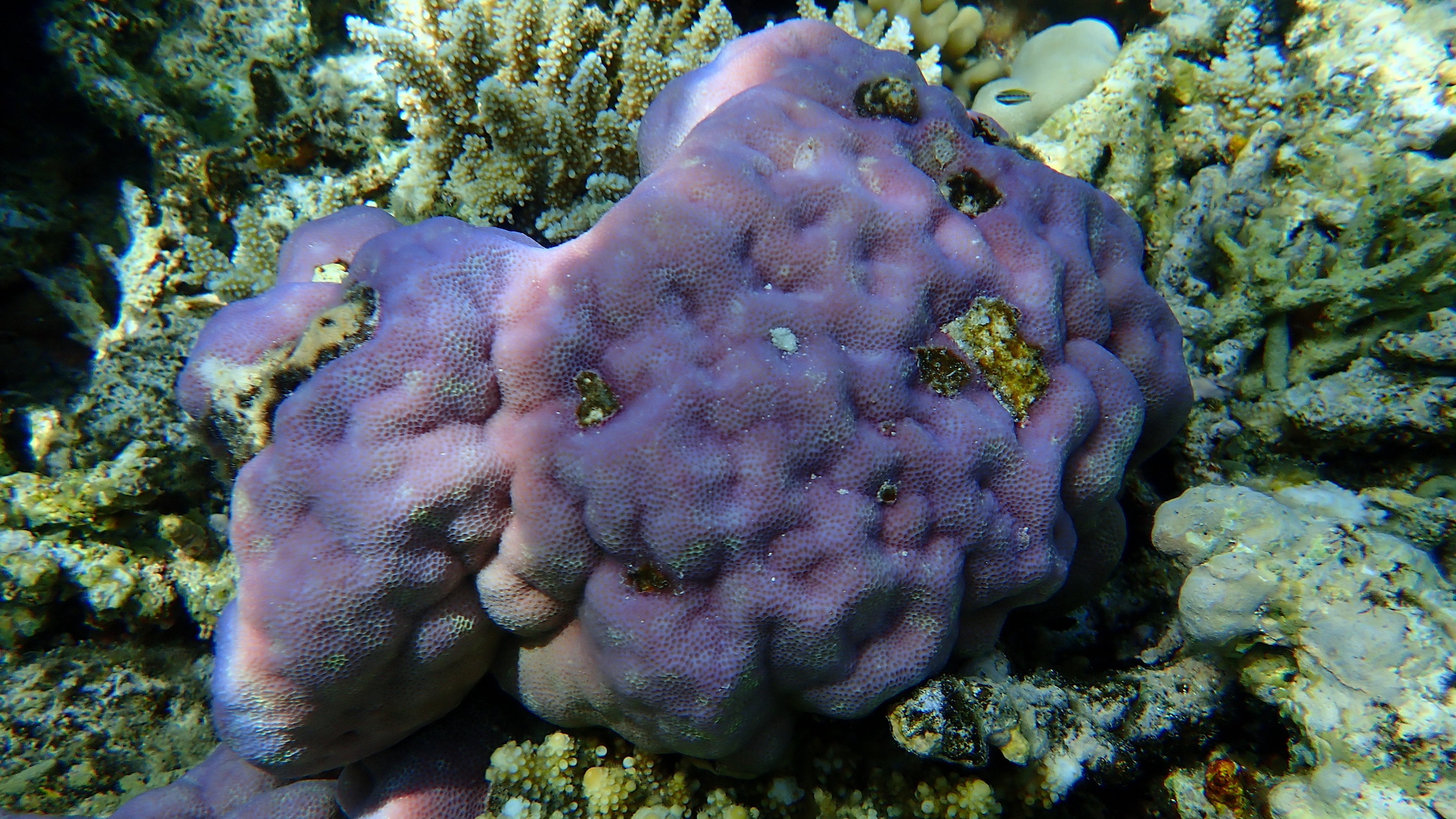
A corallite is the skeleton of a single polyp, in which the polyp sits and can retract into. Even though Porites have really small corallites, these corals form some of the largest of all coral colonies.
Colonies are flat, massive or branching. Massive colonies are spherical or hemispherical when small and dome-shaped when large. They are commonly over 5m in diameter.
Porites corals display a wide range of colors including cream, yellow, green, brown, blue and pink.
Habitat
Coral Reefs
Diet
Porites coral receives most of its nutrients from its relationship with zooxanthellae, a type of algae that performs photosynthesis and lives within the coral.
Life History
Porites coral have separate male and female colonies. With a few exceptions, most members of this genus are brooders. This means that polyps of female colonies brood planulae larvae in their body cavity after being fertilized by the free-swimming sperm of male colonies.
The planulae are then released by the parent colony, dispersing and eventually settling where they form a new polyp and their own colony.
Porites coral have an average growth rate of about 1cm per year.
IUCN Status
Least Concern, Near Threatened, Vulnerable, Endangered, Critically Endangered
Ecosystem & Cultural Importance
Various parrotfish species including Scarus gibbus and Cetoscarus bicolor feed on Porites species.
As reef-building corals, members of the Porites genus are important to the structure of reefs and provide habitat for a variety of marine species.
Coral reef ecosystems hold cultural value for Native Hawaiians and other Indigenous groups in the Pacific. These ecosystems also provide economic value through coastal fisheries and tourism.
This animal is not native to the Oregon Coast, however is found in the larger Pacific Ocean. It lives in the Aquarium as part of our Connected Coasts gallery.
Some of the oldest and largest Porites coral heads in the world are located in and protected by the National Marine Sanctuary of American Samoa. One of the coral heads called “Big Momma” is more than 500 years old and over 6 meters high.
The IUCN status varies vastly among the different Porites species, ranges from least concern to critically endangered.
Citations & Other Resources
Veron, J. E. N. 1986. Corals of Australia and the Indo-Pacific. Angus & Robertson, North Ryde, NSW, Australia.
Hopley, D. (2011). Encyclopedia of modern coral reefs : structure, form and process. Springer. https://doi.org/10.1007/978-90-481-2639-2
National Marine Sanctuary of American Samoa. N.d. “Big Momma” Coral Head. NOAA. https://sanctuaries.noaa.gov/vr/american-samoa/big-momma/#:~:text=Big%20Momma%20is%20more%20than,Seaview%20Survey%20/%20The%20Ocean%20Agency.
We use cookies to improve your experience and see how our guests are navigating the website. If this is alright by you, hit 'Accept All', or 'Settings' to customize and learn more.
Read our cookie policy