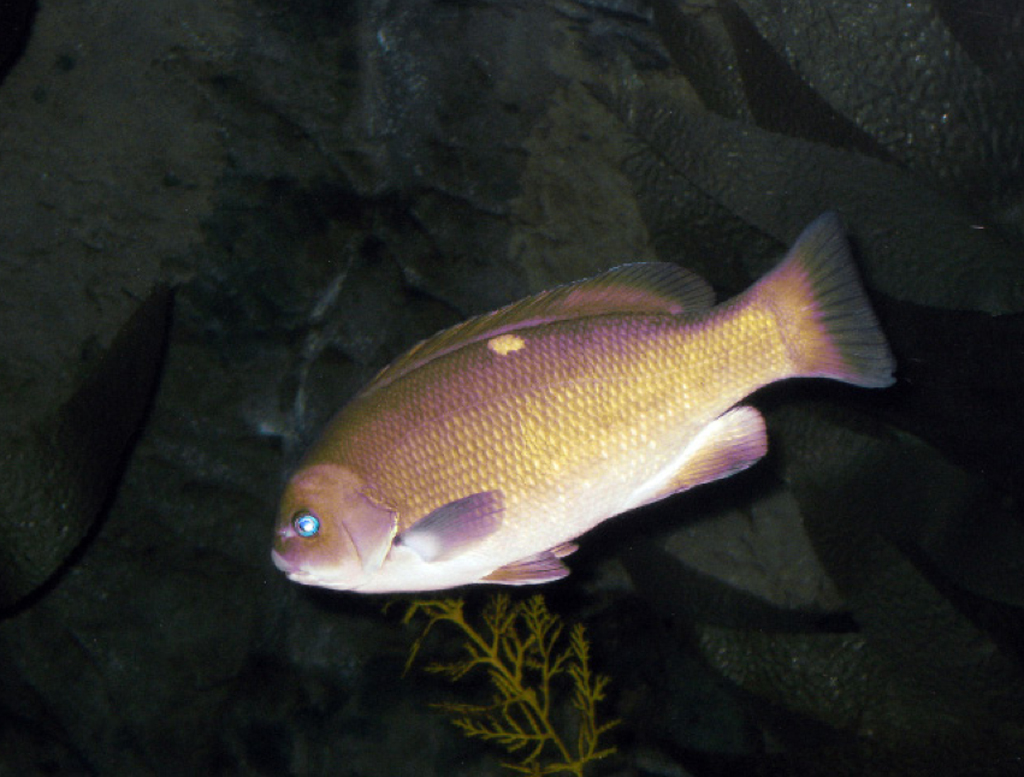
Opaleye perch are dark olive green, usually with one or two white spots on each side of their back under the middle of the dorsal fin.
They have large blue-green eyes.
Their oval shaped body can grow to lengths of 26 inches and weigh up to 13.5 pounds.
Habitat
Rocky shorelines and kelp beds. May be found as deep as 32m.
Diet
Primarily marine algae including feather boa kelp, giant kelp, sea lettuce, and coralline algae. They also consume small tube-dwelling worms.
Life History
Opaleye perch form dense schools in kelp beds and shallow water where spawning takes place. Eggs and larvae float freely in the water and are sometimes found a number of miles from shore.
Juveniles form schools of up to two dozen individuals. Then when they are about 1 inch long they settle in tidepools. As they grow larger, they seek deeper water.
Opaleye perch mature and spawn when they are about 8 to 9 inches long at an age of about 2 to 3 years old.
Opaleye perch are known to live up to 10 years.
IUCN Status
Least Concern
Ecosystem & Cultural Importance
Opaleye perch are considered to be commercially important and an important game fish.
Opaleye perch are prey for a variety of species including bald eagles, Brandt’s cormorants, least tern, seals, sea lions and larger fish species.
Opaleye perch play an important role in kelp forests by controlling the growth of marine algae.
From northern California to Baja California, Mexico. Occasionally found near the Oregon coast. An isolated population can be found in the central and northern Gulf of California.
Opaleye perch can breathe air or survive out of the water for hours as long as they remain wet.
Citations & Other Resources
Allen, G., and R. Robertson. 2010. Girella nigricans. The IUCN Red List of Threatened Species 2010.
California Department of Fish and Wildlife. 2020. Opaleye. Marine Species Portal. https://marinespecies.wildlife.ca.gov/opaleye/false/
California Department of Fish and Wildlife. 2024. Creature Feature: Opaleye. Marine Management News. https://cdfwmarine.wordpress.com/2024/03/13/creature-feature-opaleye/
We use cookies to improve your experience and see how our guests are navigating the website. If this is alright by you, hit 'Accept All', or 'Settings' to customize and learn more.
Read our cookie policy