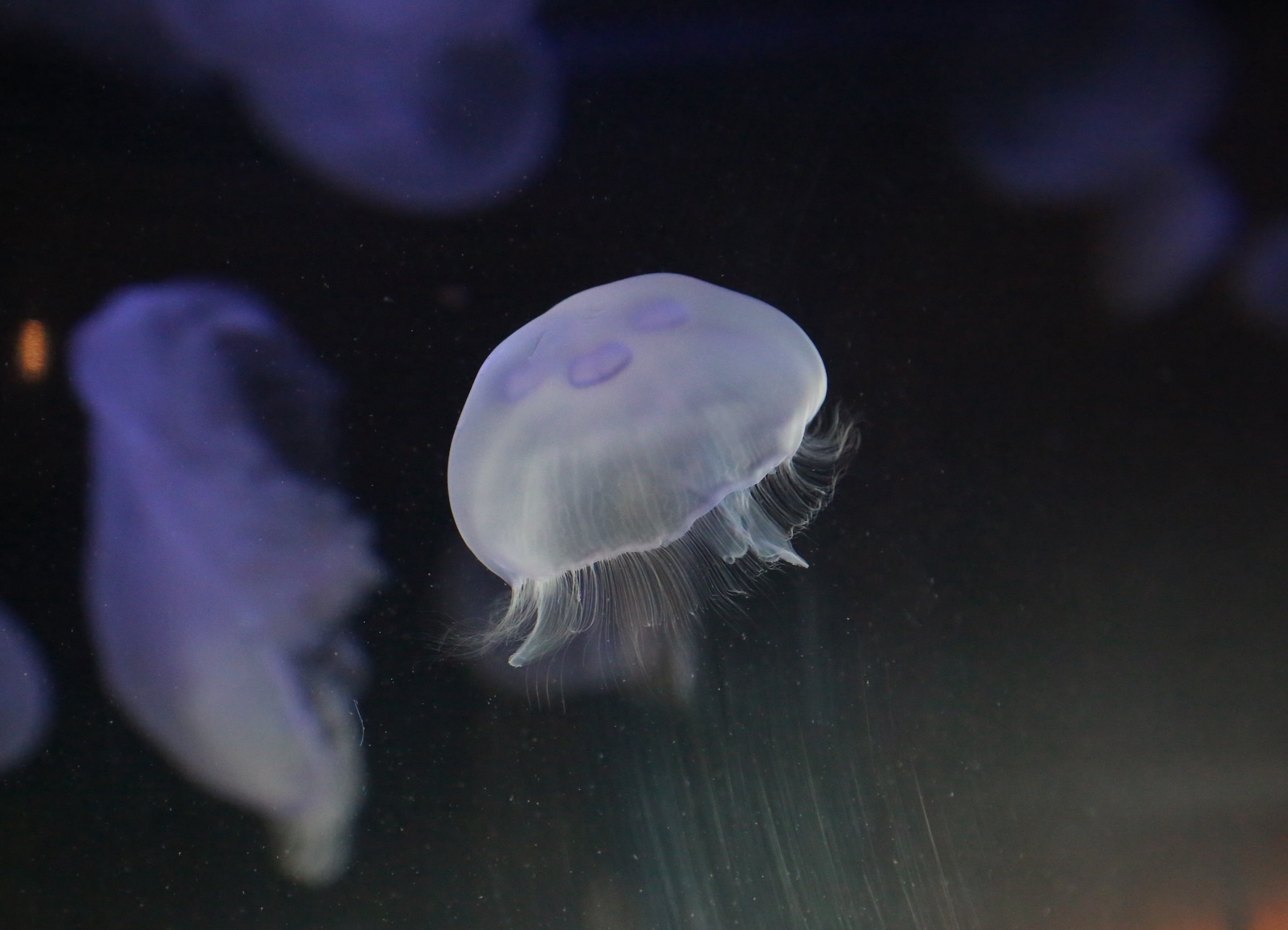
Moon jellies have transparent outer bells that surround an inner bell with a blue to clear tint and covered in blue veins. Small tentacles hang from beneath the inner bell, as well as four oral arms which contain stinging cells.
Habitat
Moon jellies are found in the coastal waters at depths of 200 – 1,000m.
Diet
Sea nettles are carnivorous. Their stinging cells paralyze prey, such as other sea jellies, zooplankton, and copepods. They use their oral arms to shuttle the food to their digestive system.
Life History
The jelly releases eggs into the water which fertilize in the water column. Those eggs then hatch into ephyra and settle to the seafloor. The ephyra develop into small polyps. A polyp resembles a small sea anemone. Once the water conditions are just right the polyp strobilates. The polyp now resembles a stack of plates. Each “plate” in the stack is an identical clone of a jelly. Baby jellies, called ephyra, bud off of the polyp. Each ephyra that buds off a jelly then slowly grows into an adult jelly.
IUCN Status
Not Evaluated
Ecosystem & Cultural Importance
Moon jellies eat zooplankton and smaller jellies. When eaten by larger animals it helps move nutrition up the food chain.
They can be found around the coasts of the Americas, Eurasia, most of Australia, near Greenland, and around Madagascar. They are typically not found in the Arctic ocean, and aside from Madagascar are largely absent around Africa.
We use cookies to improve your experience and see how our guests are navigating the website. If this is alright by you, hit 'Accept All', or 'Settings' to customize and learn more.
Read our cookie policy