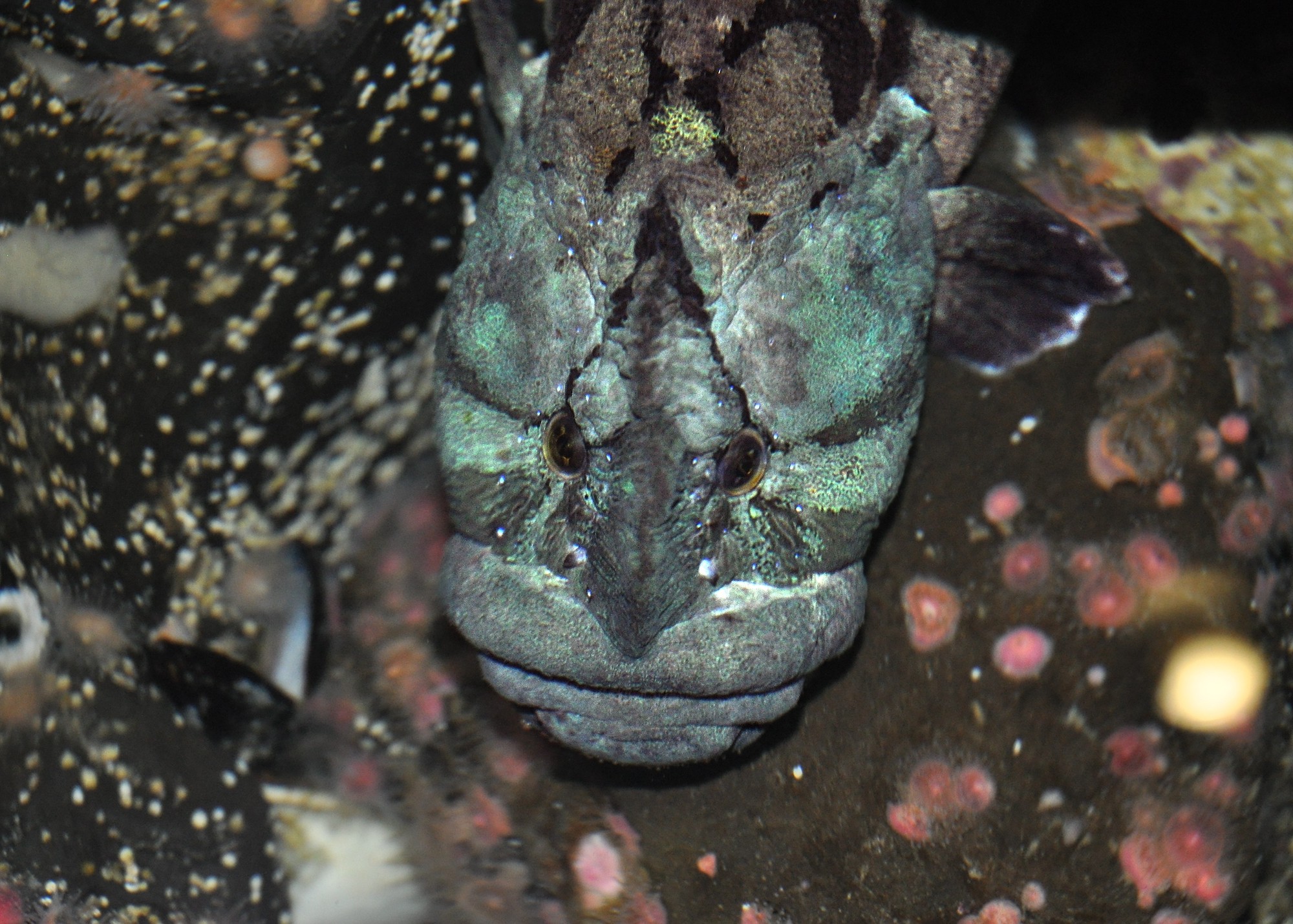
Monkeyface pricklebacks grow up to 2.5ft long, eel-shaped body of light brown to dark green, occasionally with some orange markings, and two black lines radiating from the eyes. The head is blunt, rounded snout with prominent lips. Adults develop a lumpy, soft fatty ridge of tissue on the head called the supraorbital crest and this can be used to identify between the two sexes, as the crest of males is larger and more pronounced. In addition, the eyes show sexual dimorphism, with males having larger eyes.
Habitat
Juveniles inhabit the intertidal zone while adults live in rocky reefs and kelp forests of the shallow subtidal.
Diet
Juveniles: algae, zooplankton and small crustaceans
Adults: Completely herbivorous: predominantly algae
Life History
Spawning occurs from January to August, with peak spawning from April to February. Older fish spawn earlier in the season. A female reaches sexual maturity between 4-7 years old. She will lay a mass of 17,500 to 46,000 sticky eggs on a rocky surface subtidally. The eggs are then guarded and cared for by the father. The male fans the egg mass which helps to keep it oxygenated, ideal for the developing young.
Incubation lasts at least 23 days, after which eggs will begin to hatch over an eight day period. The larvae hatch at about 0.3 inches and become planktonic. They settle out of the plankton and into the intertidal at about 0.7-0.9 inches in length. At 1 year of age–and about 2-3 inches long–they become fully herbivorous adults.
In the wild, they can reach lengths of 30 inches and live up to 18 years.
IUCN Status
Not Evaluated
Ecosystem & Cultural Importance
This fish feeds its predators including herons, great egrets, eared grebes, red-breasted mergansers, cabezon, and grass rockfish.
Monkeyface pricklebacks were often fished by indigenous Americans. Currently, they support only a small commercial fishery and recreational fishing. They are fished recreationally by a method called poke poling, where the end of a long bamboo pole is fitted with a short piece of wire with a baited hook. This baited end is then poked into rocky crevices and holes during low tide.
They also support an emerging aquaculture market in California. Monkeyface pricklebacks are considered a sustainable option due to their herbivorous nature as an adult, a rare feature amongst temperate marine fishes. In addition, traits such as a sedentary lifestyle and a high tolerance to environmental extremes make it desirable for aquaculture. Lastly, these meaty fish provide a high fillet-to-carcass ratio.
In the wild, these highly sedentary fish spend less than 1% of their time active. This active period is usually for about 5 minutes a day during a flood tide, only moving over an area that averages 6.5 square feet. They have a small home range and rarely travel more than 15 feet away from their home.
In a moist area, these fish can stay out of water for at least 35 hours, able to breathe air.
Citations & Other Resources
California Conservation Genomics Project: https://www.ccgproject.org/species/cebidichthys-violaceus-monkeyface-prickleback
Love, Milton S. Certainly more than you want to know about the fishes of the Pacific Coast: a postmodern experience. Really Big Press: Santa Barbara. 2011. 649 pp. ISBN 978-0-9628725-6-3
Hoehn, Matthew, “Assessing Monkeyface Prickleback Cebidichthys Violaceus as an Emerging Aquaculture Species in California” (2023). Capstone Projects and Master’s Theses. 1574.
https://digitalcommons.csumb.edu/caps_thes_all/1574
Monterey Bay Aquarium: https://www.montereybayaquarium.org/animals/animals-a-to-z/monkeyface-prickleback
We use cookies to improve your experience and see how our guests are navigating the website. If this is alright by you, hit 'Accept All', or 'Settings' to customize and learn more.
Read our cookie policy