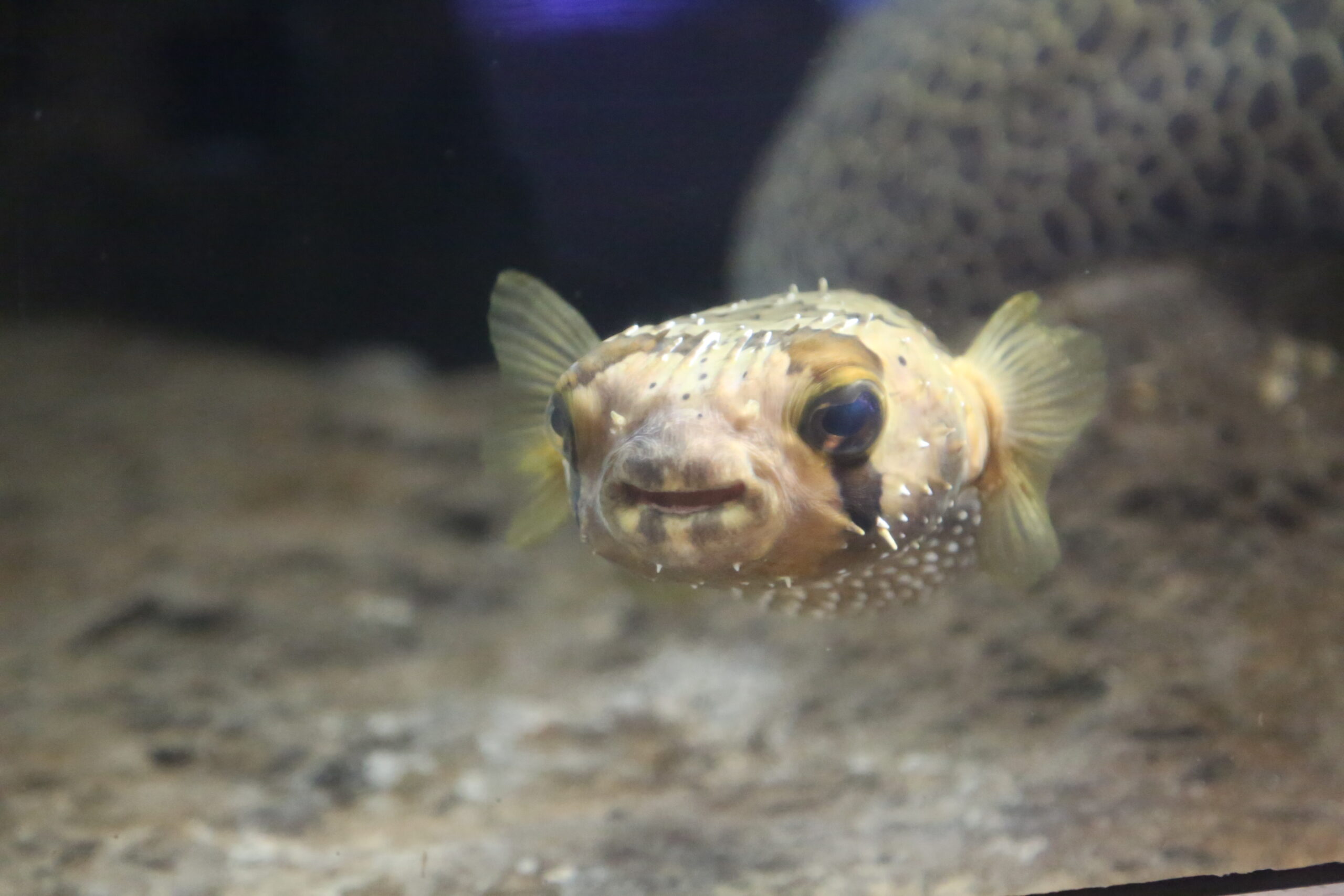
Upwards of 20 inches in length. Light sandy color with darker brown splotches. Body is covered with long spines. The teeth of the longspine porcupinefish are fused together and resemble a bird’s beak.
Habitat
Coral reefs, rocky reefs, young longspine porcupinefish live in floats of seaweed
Diet
Various small shellfish, notably urchins and crabs
Life History
Eggs are released into the ocean. After hatching small larval fish drift with the currents until they mature into adult longspine porcupinefish. Juveniles hide in floats and masses of seaweed until they reach maturity and move into reefs.
IUCN Status
Least Concern
Ecosystem & Cultural Importance
Porcupinefish appear in the media as a common tropical oceanfish. Most notably as the driving instructor of Spongebob Squarepants.
By eating shellfish and later being eaten by larger fish they can create an important link in their food chain.
This animal is not native to the Oregon Coast, however is found in the larger Pacific Ocean. It lives in the Aquarium as part of our Connected Coasts gallery.
Much like their reputation, the longspine porcupinefish is able to puff up! By swallowing large amounts of water it is able to swell its body which pushes out its spines for self defense.
Citations & Other Resources
Leis, J.L., Matsuura, K., Shao, K.-T., Hardy, G., Zapfe, G., Liu, M., Jing, L., Tyler, J. & Robertson, R. 2015. Diodon holocanthus (errata version published in 2017). The IUCN Red List of Threatened Species 2015: e.T193817A115332473. https://dx.doi.org/10.2305/IUCN.UK.2015-4.RLTS.T193817A2282138.en. Accessed on 19 March 2026.
Toshiaki F. W. Hamaura, A. Takemura, K. Takano. 1997. Histological Observations of Annual Reproductive Cycle and Tidal Spawning Rhythm in the Female Porcupine Fish Diodon holocanthus. Fisheries Science 63:5 715-720.
Froese, R. and D. Pauly. Editors. 2025.FishBase. World Wide Web electronic publication. www.fishbase.org, ( 11/2025 )
Species: Diodon holocanthus, Freckled porcupinefish, Long-spine balloonfish. Smithsonian Tropical Research Institute. https://biogeodb.stri.si.edu/sftep/en/thefishes/species/1594
Lucano-Ramírez G, Peña-Pérez E, Ruiz-Ramírez S, Rojo-Vázquez J, González-Sansón G. Reproducción del pez erizo, Diodon holocanthus (Pisces: Diodontidae) en la plataforma continental del Pacífico Central Mexicano [Reproduction of the spiny puffer, Diodon holocanthus (Pisces: Diodontidae) in the continental shelf of Mexican Central Pacific]. Rev Biol Trop. 2011 Mar;59(1):217-32. Spanish. PMID: 21516647.
We use cookies to improve your experience and see how our guests are navigating the website. If this is alright by you, hit 'Accept All', or 'Settings' to customize and learn more.
Read our cookie policy