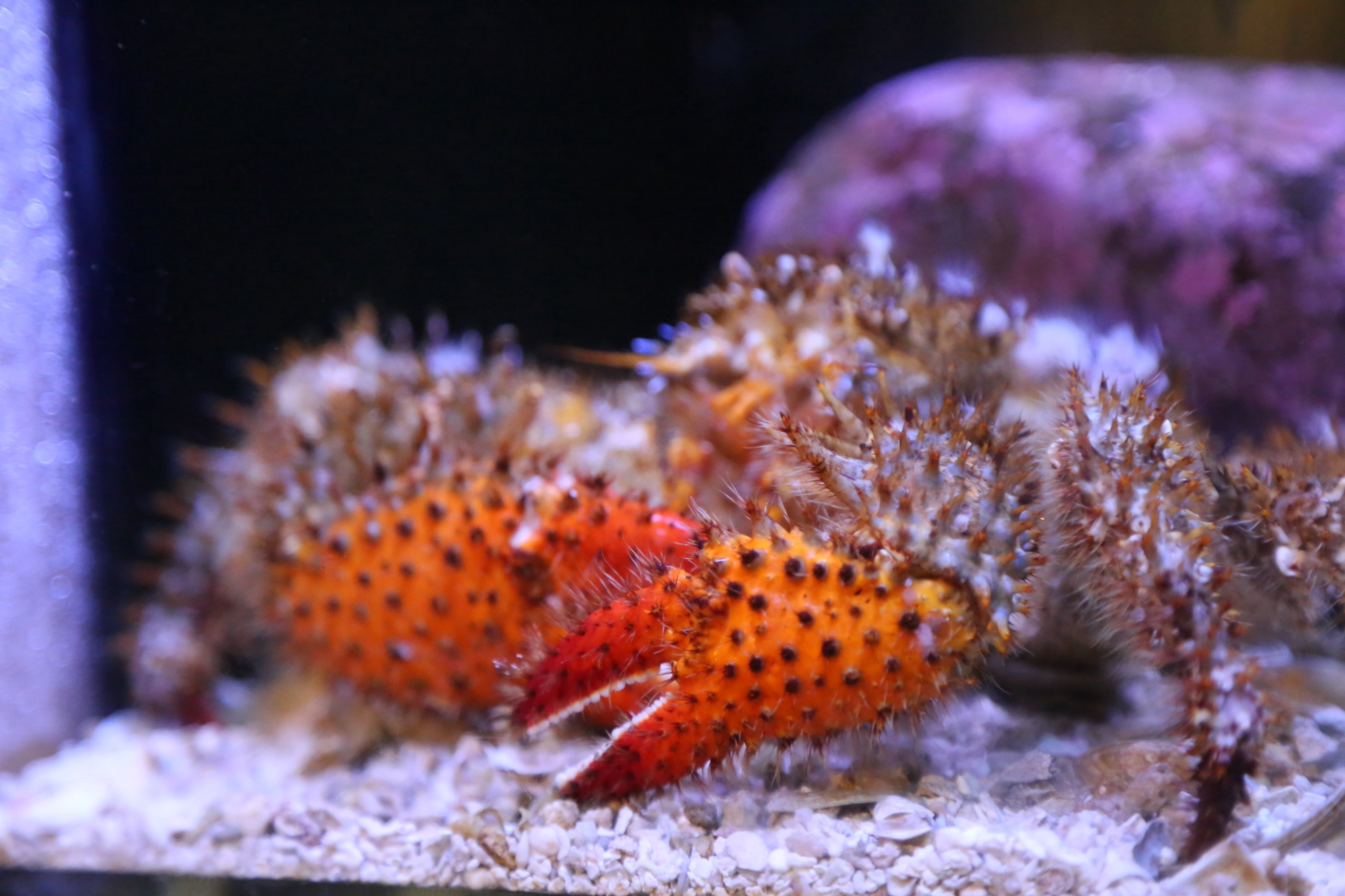
The lithode crab is named for the stiff dark red-brown, orange, and white hairs covering its body and legs. It has a heart or pear-shaped carapace covered in hairs that is flat on top widest past the midpoint.
Its eyes have orange corneas with a black dot atop small light brown eye-stalks with dark brown stripes. The claws are orange and the right claw is usually larger than the left one, and it has molar-like teeth on its claws.
Habitat
Intertidal to depths of 165m on sandy, muddy, or rocky substrate; often found on vertical rock walls
Diet
Shrimp
Life History
This crab starts life in the plankton, passing through 4 zoeal stages and 1 megalops stage before settling to the bottom.
Males tend to be slightly larger. The carapace on males can reach 6.5cm across while the carapace of females can reach 5cm.
E-Fauna BC site: https://linnet.geog.ubc.ca/efauna/Atlas/Atlas.aspx?sciname=Acantholithodes%20hispidus
Invertebrates of the Salish Sea website: https://inverts.wallawalla.edu/Arthropoda/Crustacea/Malacostraca/Eumalacostraca/Eucarida/Decapoda/Anomura/Family_Lithodidae/Acantholithodes_hispidus.html
Hong, Sung Yun, et al. “Larval development of Acantholithodes hispidus (Stimpson)(Decapoda: Anomura: Lithodidae) reared in the laboratory.” Invertebrate reproduction & development 47.2 (2005): 101-110.
We use cookies to improve your experience and see how our guests are navigating the website. If this is alright by you, hit 'Accept All', or 'Settings' to customize and learn more.
Read our cookie policy