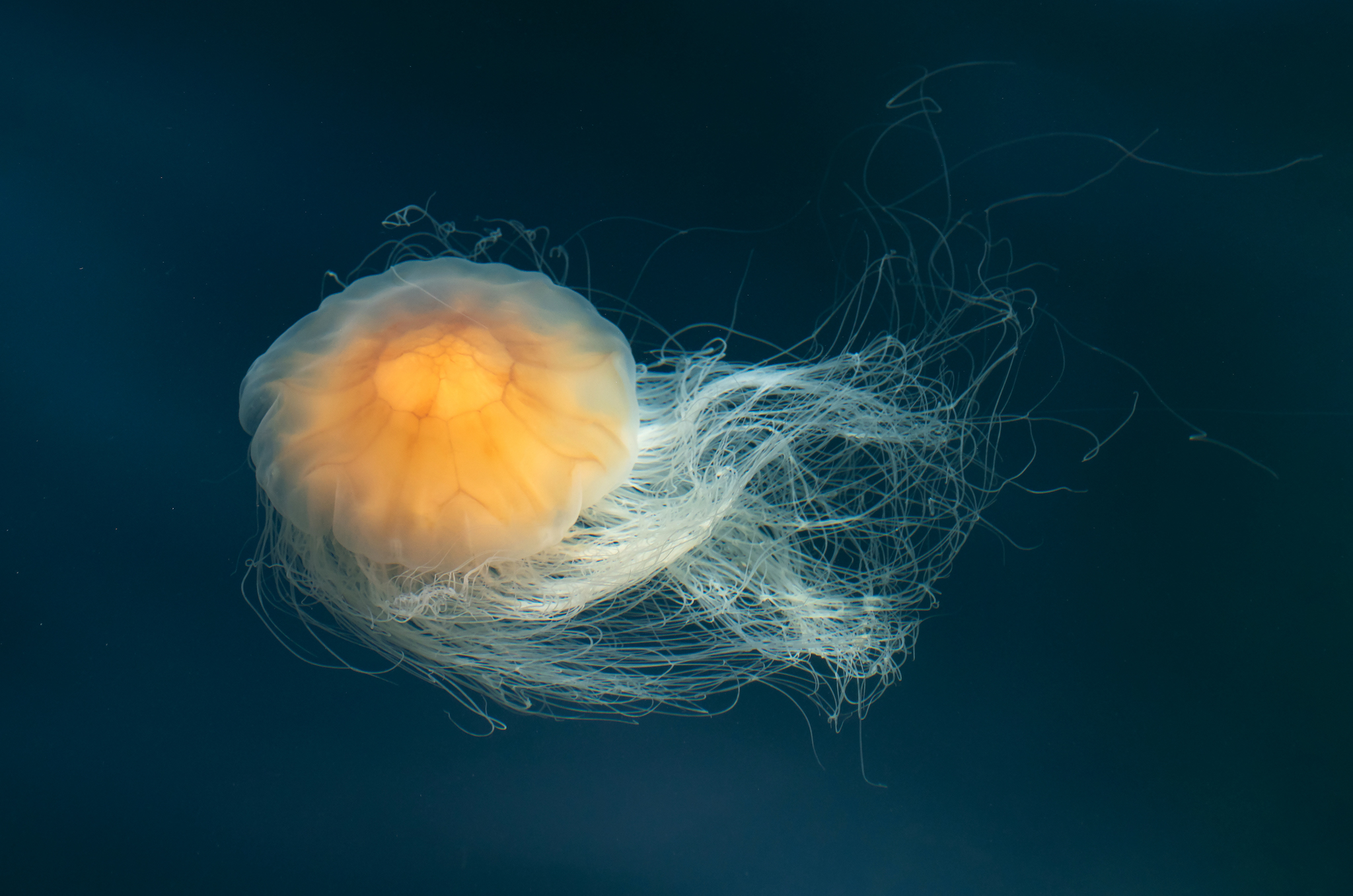
Saucer-shaped bell that is yellowish-brown, red, purplish, rose, violet, or even a milky white. Bell has a thick center and thinner margin which has 16 lobes, grouped in pairs that have a small notch between them and separated from neighboring pairs by deeper notches. Up to 150 dense and highly extendable tentacles occur in groups between pairs of lobes. The highly folded structures hanging down from under the bell are 4 oral arms that alternate with their 4 gonads.
The bell can grow to a diameter of 8.2’ and the oral arms and tentacles can reach lengths of 118’.
Habitat
Near surface of polar and temperate coastal waters and bays
Diet
Plankton, including a variety of copepods and amphipods, moon jellies, comb jellies, larvaceans, and fish including the naked goby and bay anchovy.
Life History
The eggs hatch into planulae larvae within the gonads and then are released into the water column. Planulae settle on a hard surface and metamorphose into a sessile polyp. A polyp may live for several years and will occasionally undergo asexual reproduction to release ephyrae. During a single strobilation event, the polyp releases an average of 4-5 ephyrae, which then grow into medusae. The medusae stage is typically short lived, less than a year.
When conditions are harsh, a polyp can produce podocysts, which will stay dormant until conditions improve to produce a new polyp.
IUCN Status
Not Evaluated
Ecosystem & Cultural Importance
Lion’s Mane jellies feed their predators including birds, such as razorbills and penguins, fish such as blue whiting, and leatherback sea turtles.
These jellies will play host to other species. For example, Juvenile pollack and other fishes can be found using the bell for shelter while larval crabs in the megalops stage will hitch a ride on these jellies.
Lion’s Mane jellies can be problematic to salmon aquaculture when they encounter sea cage farms and sting the salmon, wounding or killing them. A jelly’s body can smash against the cages, breaking into bits that easily reach the fish and sting them. In 1996, they killed thousands of salmon in Scotland and in 2002 and 2006, they caused severe damage to salmon aquaculture in East Iceland. During the 2006 event, 1,000 tons of salmon were lost despite the presence of a special fence meant to protect the cages.
You might see pieces of a lion’s mane jelly washed up on the beach. Do not touch it because these jellies have a painful sting that can cause blisters and even dead jellies can sting.
Lion’s Mane jellies mostly swim in a horizontal direction, with the prevailing currents but they have also been documented actively swimming to the surface and either passively sinking back down or actively swimming back towards the bottom. They are not fast swimmers, having been clocked at a vertical speed of 3.75 bell diameters a minute.
The amount of food that these jellies eat depends on the diameter of the bell and also how dense their prey is in the water column. Their speed of digestion depends on the temperature of the water, with jellies in warmer waters, such as the Gulf of Mexico, digesting prey fasting than those in the Northeast Pacific.
Miles, Jason G., and Nicholas A. Battista. “Naut your everyday jellyfish model: exploring how tentacles and oral arms impact locomotion.” Fluids 4.3 (2019): 169.
Muffett, Kaden, and Maria Pia Miglietta. “Planktonic associations between medusae (classes Scyphozoa and Hydrozoa) and epifaunal crustaceans.” PeerJ 9 (2021): e11281.
Purcell, Jennifer E. “Predation on zooplankton by large jellyfish, Aurelia labiata, Cyanea capillata and Aequorea aequorea, in Prince William Sound, Alaska.” Marine Ecology Progress Series 246 (2003): 137-152.
Sigurðsson, Guðjón Már. Gelatinous zooplankton in Icelandic coastal waters with special reference to the scyphozoans Aurelia aurita and Cyanea capillata. Diss. 2009.
We use cookies to improve your experience and see how our guests are navigating the website. If this is alright by you, hit 'Accept All', or 'Settings' to customize and learn more.
Read our cookie policy