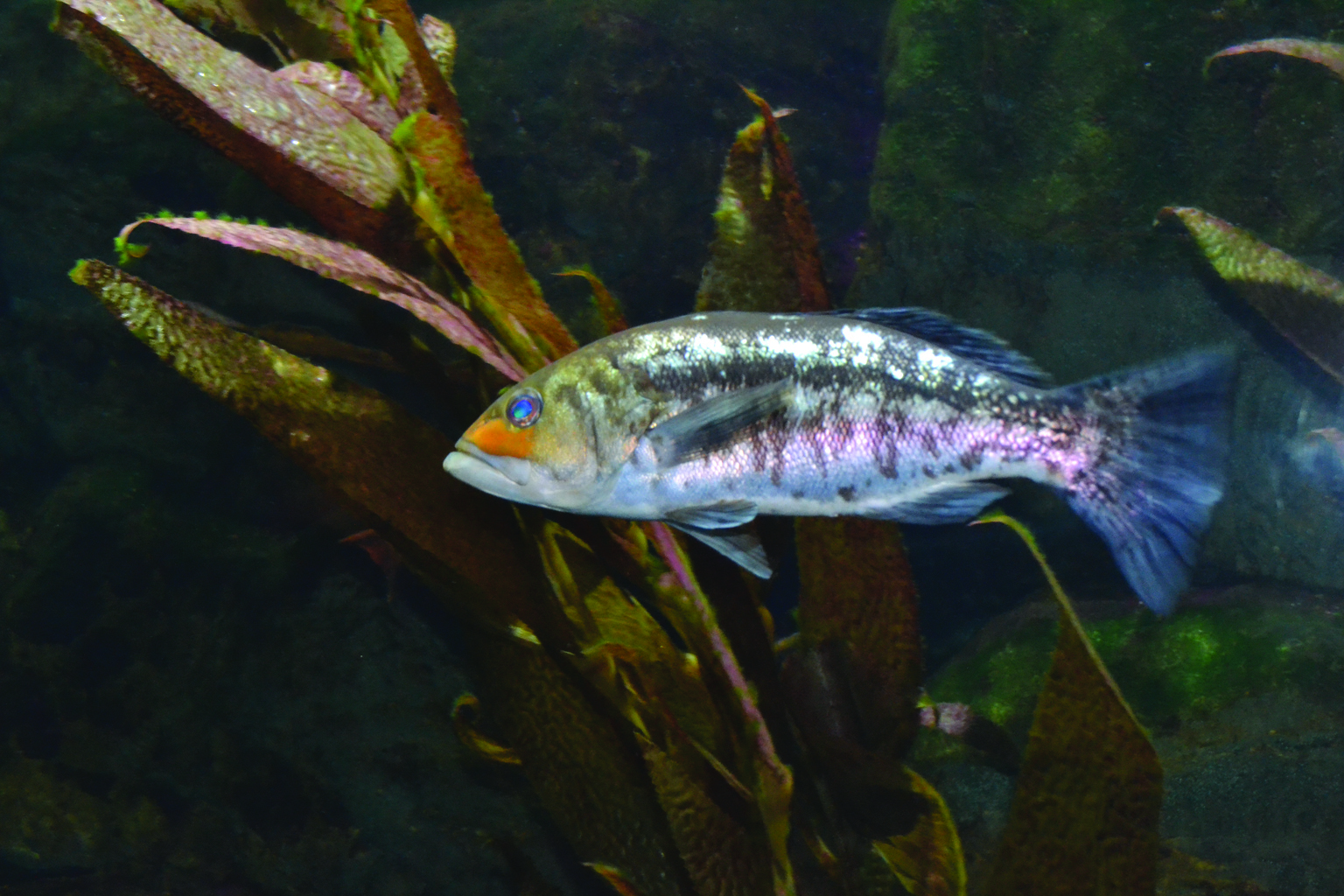
Kelp bass are olive brown in color with yellow spots on their head and two distinctive rows of white blotches on their upper back that looks like a checkerboard. They also have calico spotting on their belly and fins that are yellow-toned.
Juveniles are light brown in color and tend to lack the markings of adult kelp bass.
Kelp bass can grow up to 28.4 inches in total length and weigh up to 14.5 pounds.
During the spawning season, females will often lose their spots and become black while males usually develop yellow-orange snouts and contrasting black and white breeding colors.
Habitat
Nearshore habitats including kelp forests, bays, and estuaries to depths of 61m.
Diet
Juveniles feed on benthic invertebrates and kelp. Adults feed on fishes and cephalopods.
Life History
Mature individuals usually gather to breed in deeper water near kelp beds and rocky headlands. Kelp bass are group spawners and groups can be anywhere from three to over 200 individuals, with several subgroups forming, each consisting of several males and one female.
Kelp bass release their eggs into the water column where fertilization takes place. The eggs drift freely in the plankton of coastal waters. Larvae remain there for 28 to 30 days. They eventually settle into shallow water habitats with algae including kelp.
Kelp bass mature at two to five years old. Females can spawn multiple times within a season. The spawning season occurs from April through November, peaking in the summer months.
The oldest known kelp bass was 34 years old.
IUCN Status
Least Concern
Ecosystem & Cultural Importance
As generalist predators, kelp bass play an important role in both kelp forest and eelgrass habitats.
Kelp bass have been negatively impacted by past commercial and current sport fishing. In the 1970s and 80s, this species was among the top three species taken in sport fisheries. Kelp bass are caught for human consumption and are considered an important game fish. It is also a commercially important species in Mexico. Commercial fishing of kelp bass has been prohibited in California since the 1950s, but they are still caught recreationally in the United States.
The main predator of adult kelp bass is the giant sea bass.
Adult kelp bass will often school together to prey on small fish. The school surrounds the prey with each kelp bass pursuing from a different direction.
Citations & Other Resources
Iwamoto, T., B. Smith-Vaniz, and R. Robertson. 2010. Paralabrax clathratus. The IUCN Red List of Threatened Species 2010.
California Department of Fish and Wildlife. 2024. Kelp Bass. Marine Species Portal. https://marinespecies.wildlife.ca.gov/kelp-bass/true/
Erisman, B. E., and L.G. Allen. 2006. Reproductive behaviour of a temperate serranid fish, Paralabrax clathratus(Girard), from Santa Catalina Island, California, U.S.A. Journal of Fish Biology, 68(1), 157–184. https://doi.org/10.1111/j.0022-1112.2006.00886.x
Miller, D. J. 1976. Guide to the coastal marine fishes of California / by Daniel J. Miller and Robert N. Lea. Dept. of Fish and Game ; [Division of Agricultural Sciences, University of California], , 1972.
California Department of Fish and Wildlife. 2024. Kelp Bass Enhanced Status Report. Marine Species Portal. https://marinespecies.wildlife.ca.gov/kelp-bass/the-species/
We use cookies to improve your experience and see how our guests are navigating the website. If this is alright by you, hit 'Accept All', or 'Settings' to customize and learn more.
Read our cookie policy