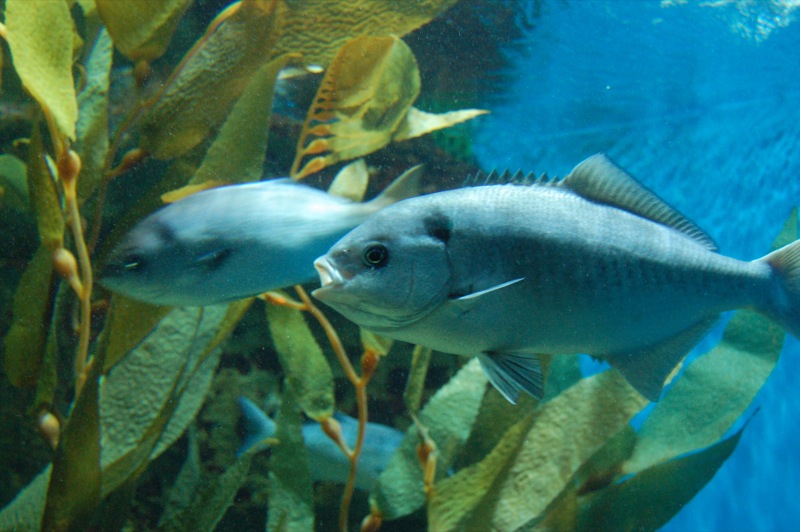
Halfmoon are blue to dark gray on their backs which fade into the silver of their belly area. Some are grayish blue all over. They have a large blackish blotch above their gills. Halfmoon also have faint slanted stripes on their sides.
Halfmoon can grow up to 48 cm.
Habitat
Rocky areas and kelp beds at depths up to 40 m.
Diet
Seaweed and small invertebrates.
Life History
Fertilized eggs and hatched larvae float in the water column and drift with ocean currents. They then enter a juvenile stage where they join small schools in near-shore areas and around floating masses of kelp. Halfmoon continue their juvenile development in these habitats. They reach maturity when they grow to about 19 cm.
Halfmoon typically live from 1 to 8 years.
IUCN Status
Least Concern
Ecosystem & Cultural Importance
Halfmoon support kelp forest ecosystems. Since they eat kelp they help control kelp growth. They are also prey to a variety of predators including sea lions, seals, larger fish, several species of marine birds, and occasionally bald eagles.
Halfmoon can be an important part of recreational fishing, depending on the year.
Halfmoon and blacksmith fish are often confused for one another since they are very similar in color. Blacksmiths are much smaller than halfmoon, only growing as long as about 30 cm.
The common name of these fish comes from the shallow curved shape of their caudal fin that looks similar to a crescent or half moon.
Allen, G., R. Robertson, and B. Lea. 2010. Medialuna californiensis. The IUCN Red List of Threatened Species 2010.
CA Marine Species Portal. (n.d.). . https://marinespecies.wildlife.ca.gov/halfmoon/false/.
California Sea Grant (n.d.). Halfmoon/Blue Perch https://caseagrant.ucsd.edu/seafood-profiles/halfmoonblue-perch.
Kells, V. A. 2016. A field guide to coastal fishes. From Alaska to California. Johns Hopkins University Press, Baltimore.
Snyderman, M. 1998. California marine life: a guide to common marine species. Roberts Rinehart Publishers in cooperation with Monterey Bay Aquarium, Niwot, Colo.
Stevens, E.G., W. Watson and H.G. Moser. 1989. Development and Distribution of Larvae and Pelagic Juveniles of Three Kyphosid Fishes (Girella nigricans, Medialuna californiensis, and Hermosilla azurea) off California and Baja California. Fishery Bulletin, US. 87: 745-768.
We use cookies to improve your experience and see how our guests are navigating the website. If this is alright by you, hit 'Accept All', or 'Settings' to customize and learn more.
Read our cookie policy





.jpg)