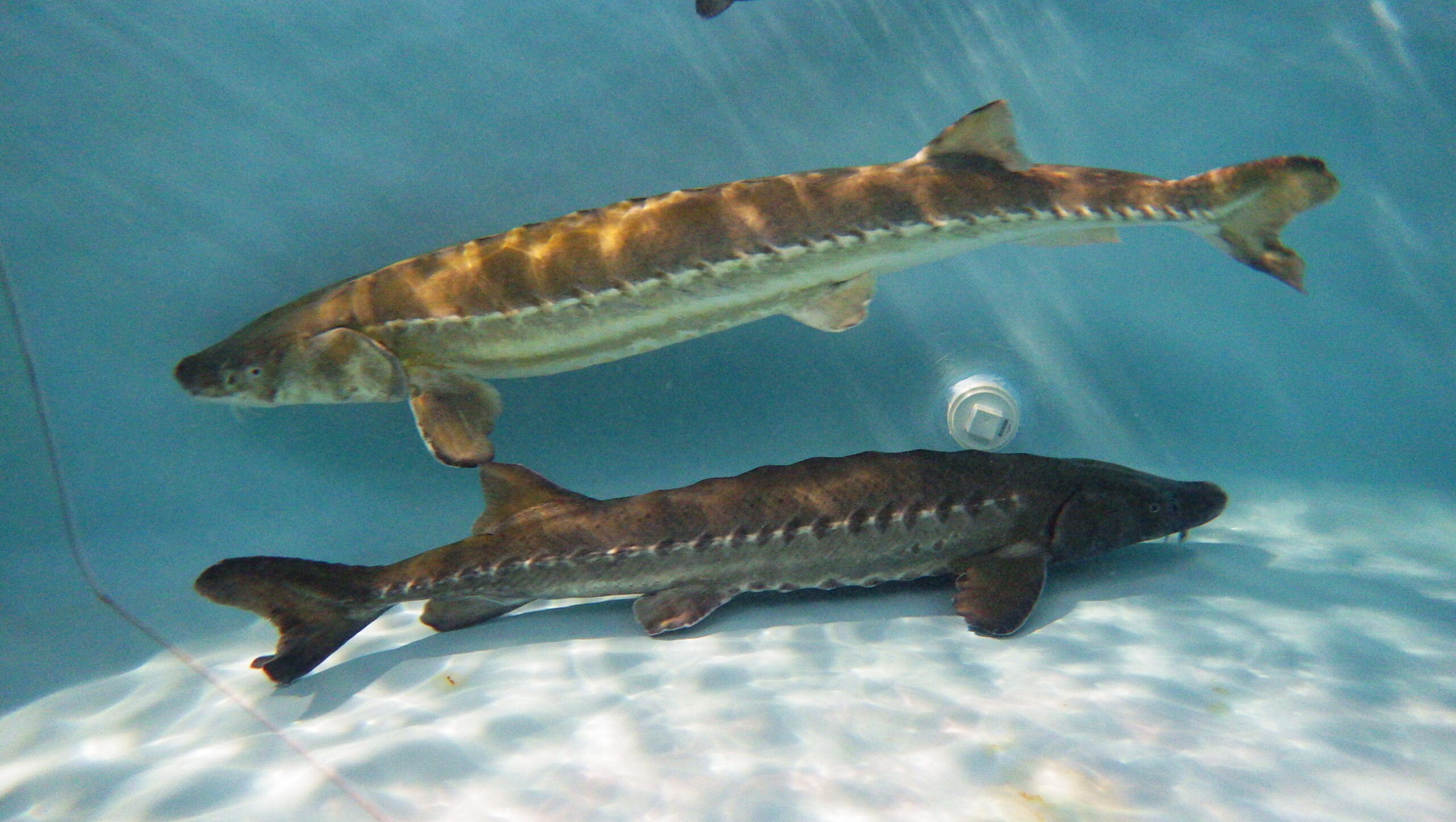
Green sturgeon are olive green to dark green with a yellowish green-white belly. They have a green stripe on each side and on the belly.
They have pointed snouts with barbels midway between the tip of the snout and mouth. Their skeletons are composed of cartilage, and they have a series of external bony plates called scutes along their backs and sides.
Instead of teeth, green sturgeon use their long, protrusible jaw to suck up food from the ocean bottom.
Green sturgeon grow to lengths of 4 ½ to 6 ½ feet and weigh up to 350 pounds. Females grow larger than males.
Habitat
Coastal waters, bays, estuaries and freshwater rivers.
Diet
Bottom-dwelling animals, including a variety of crustaceans and fishes.
Life History
Green sturgeon are an anadromous species, meaning they can live in both fresh and saltwater. From late-spring to autumn, they migrate from nearshore marine environments into coastal bays and estuaries of the West Coast. Spawning adults migrate to natal rivers in the winter and early spring to spawn from April to July. Females release eggs, which are sticky and adhere to the rocky bottom. Eggs hatch within 10 days.
Juveniles remain in the river for up to one year, then live in estuaries for up to four years before entering the marine environment. Subadults and adults remain in nearshore marine environments, coastal bays and estuaries.
There are two genetically identifiable populations, or Distinct Population Segments, of green sturgeon. The southern designated population segment (SDPS) spawns in California within the Sacramento River watershed and is found in the San Francisco Estuary. The northern designated population segment (NDPS) migrates to the Klamath river in northern California and the Rogue river in Oregon to spawn.
Unlike salmon, green sturgeon spawn several times during their long lives, returning to their natal rivers every 3 to 5 years. Green sturgeon reach maturity around age 15. They can live up to 60 to 70 years!
IUCN Status
Endangered
Ecosystem & Cultural Importance
Green sturgeon are important bottom feeders and contribute to the food web by preying on a variety of benthic animals.
Throughout the green sturgeon’s range, this species holds spiritual significance for Indigenous peoples. Green sturgeon have also been an important food source.
The decline in the green sturgeon population is somewhat due to the harvest of this species but the most significant threats to green sturgeon relate to the ongoing loss and inaccessibility of spawning habitat. Green sturgeon spawning habitats are confined to a small number of rivers, making this species vulnerable to habitat loss and climate change that may degrade or destroy those sites. Dams and other barriers can also inhibit their migration. It is illegal to fish for, catch, or keep green sturgeon. If you accidently hook a green sturgeon be prepared to catch and release with care.
Green sturgeon are found along the Oregon coast, spending more time in nearshore waters, including bays and estuaries. The northern designated population segment migrates to the Rogue River to spawn. Green sturgeon have also been observed in the Umpqua River.
We use cookies to improve your experience and see how our guests are navigating the website. If this is alright by you, hit 'Accept All', or 'Settings' to customize and learn more.
Read our cookie policy