Other Common Names The many different species of Goniopora go by different common names. For example Goniopora columna is often called flowerpot coral.
The many different species of Goniopora go by different common names. For example Goniopora columna is often called flowerpot coral.
At the Aquarium
Connected Coasts
Appearance
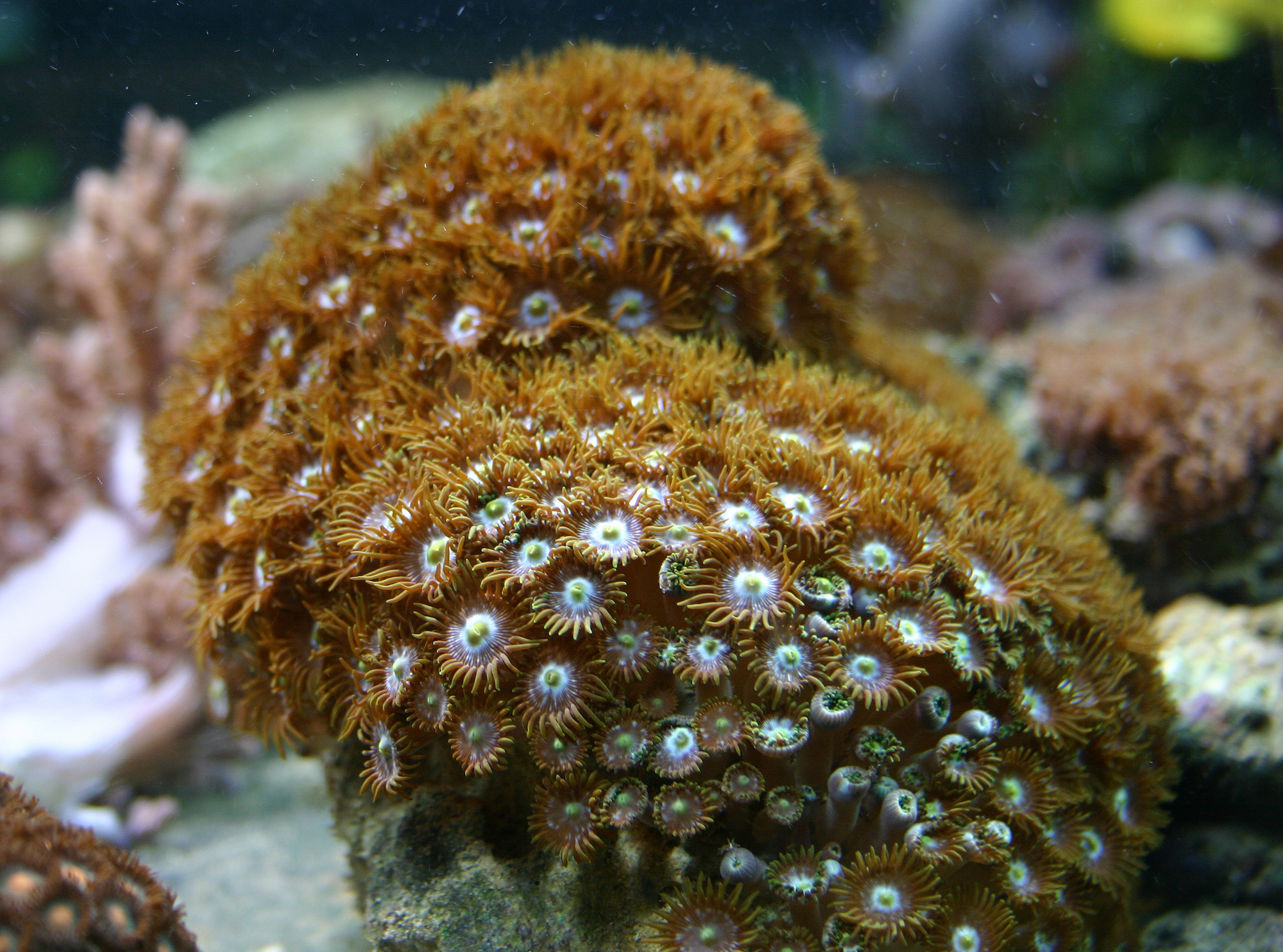
Colonies may be many metres across and sometimes entire sections of a reef face are covered by one Goniopora species. Colonies are usually columnar or massive but may be encrusting. Columnar means the colony forms columns while massive means all dimensions of the colony are approximately the same, often large and dome-shaped. Encrusting means the colony forms a thin layer over a surface.
Goniopora coral have large, fleshy and long polyps with up to 24 tentacles which usually extend in the daytime. Different species have polyps of different shapes and colors. Some Goniopora species have polyps that have a flower-like appearance.
Habitat
Intidal coral reefs
Diet
Goniopora coral receives most of its nutrients from its relationship with zooxanthellae, a type of algae that performs photosynthesis and lives within the coral. They also receive nutrients from small food particles drifting in the water.
Life History
Goniopora colonies have separate sexes. During spawning eggs and sperm are released into the water for external fertilization. Fertilized eggs hatch developing into larvae called planulae. Planulae float in ocean currents and eventually make their way back down to the bottom. If conditions are favorable they will settle, developing into polyps and forming colonies.
IUCN Status
Least Concern
Ecosystem & Cultural Importance
Members of Goniopora are important reef-building corals, helping construct and function as the foundation of reef ecosystems.
Goniopora corals are also food for a variety of marine organisms including sea slugs belonging to the genus Phestilla.
This animal is not native to the Oregon Coast, however is found in the larger Pacific Ocean. It lives in the Aquarium as part of our Connected Coasts gallery.
Goniopora corals have been involved in various research studies to examine the impacts of microplastics on stony corals and reef ecosystems.
Citations & Other Resources
Chen, Y.-T., D.-S. Ding, Y.C. Lim, R.R. Singhania, S. Hsieh, C.-W. Chen, S.-L. Hsieh, and C.-D. Dong. 2022. Impact of polyethylene microplastics on coral Goniopora columna causing oxidative stress and histopathology damages. The Science of the Total Environment, 828, 154234–154234. https://doi.org/10.1016/j.scitotenv.2022.154234
Ding, D.-S., C.-Y. Pan, W.-T. Sun, and C.-H. Pan. 2023. Evaluation of Forsythia suspensa extract for drug therapy of ciliate infection in coral (Goniopora columna). Aquaculture, 573, 739581-. https://doi.org/10.1016/j.aquaculture.2023.739581
Terraneo, T. I., F. Benzoni, R. Arrigoni, and M. L. Berumen. 2016. Species delimitation in the coral genus Goniopora (Scleractinia, Poritidae) from the Saudi Arabian Red Sea. Molecular Phylogenetics and Evolution, 102, 278–294. https://doi.org/10.1016/j.ympev.2016.06.003
Ding, D.-S., W.-T. Sun, and C.-H. Pan. 2021. Feeding of a Scleractinian Coral, Goniopora columna, on Microalgae, Yeast, and Artificial Feed in Captivity. Animals (Basel), 11(11), 3009-. https://doi.org/10.3390/ani11113009
Hu, J., Y. Zhang, S.K.F. Yiu, J.Y. Xie, and J.-W. Qiu. 2020. A New Species of Predatory Nudibranch (Gastropoda: Trinchesiidae) of the Scleractinian Coral Goniopora. Zoological Studies, 59, 1–9. https://doi.org/10.6620/ZS.2020.59-62
Veron, J. E. N. 1986. Corals of Australia and the Indo-Pacific. Angus & Robertson, North Ryde, NSW, Australia.
We use cookies to improve your experience and see how our guests are navigating the website. If this is alright by you, hit 'Accept All', or 'Settings' to customize and learn more.
Read our cookie policy