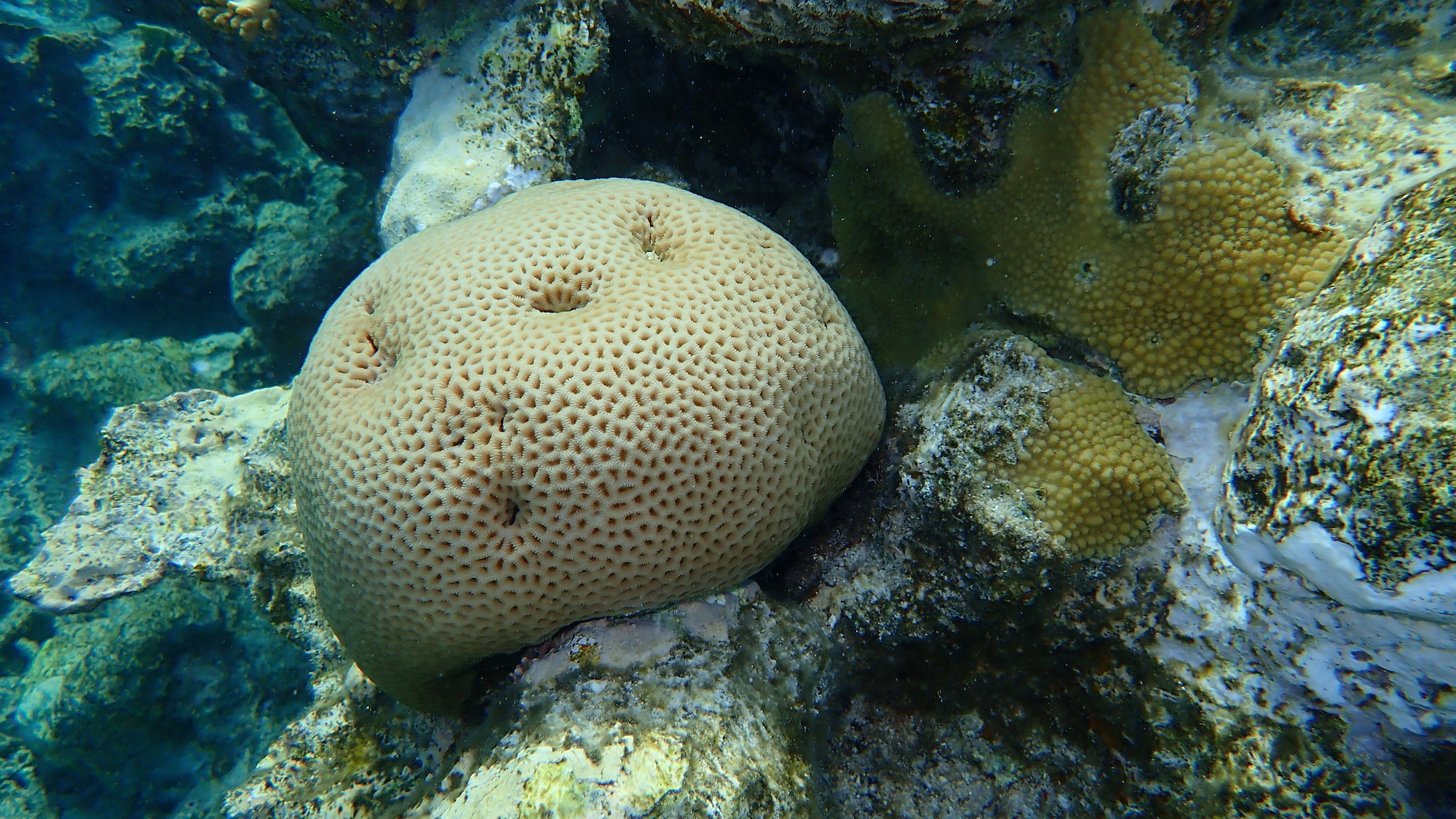
Some species of goniastrea coral are sometimes called “honeycomb corals” while others are called “brain corals”.
At the Aquarium
Connected Coasts
Appearance
Size of colonies range between species but they are generally large. The maximum average diameter of Goniastrea aspera colonies is about 50 cm.
A corallite is the skeleton of a single polyp, in which the polyp sits and can retract into. All species of Goniastrea have corallites with an organized neat appearance, some look like honeycomb while others have winding valleys that make the coral look like a brain.
Their polyps are extended only at night.
Habitat
Intertidal flats of fringing reefs and on rocky shorelines
Diet
Goniastrea coral receives most of its nutrients from its relationship with zooxanthellae, a type of algae that performs photosynthesis and lives within the coral.
Life History
Goniastrea species are hermaphrodites meaning that an individual has both male and female reproductive systems. The egg bundles are large and clearly visible, filling the whole upper surface of a corallite on smaller species.
Spawning differs slightly between species of Goniastrea. Generally, eggs from a single polyp are released in clumps and once hatched, members of this genus enter a larval stage called planulae. The planulae settle soon after emerging from the parent polyps. They develop into polyps and form colonies.
IUCN Status
Least Concern
Ecosystem & Cultural Importance
Goniastrea coral provide shelter and breeding grounds for a variety of marine species.
Goniastrea coral are important reef-building corals, helping build and function as the foundation of reefs around the world.
This animal is not native to the Oregon Coast, however is found in the larger Pacific Ocean. It lives in the Aquarium as part of our Connected Coasts gallery.
Goniastrea coral are often found in places where no coral might be expected to live. They can tolerate a range of environmental conditions including several hours of sun exposure at low ride and also muddy conditions and low salinity.
Citations & Other Resources
Kai, S., and K. Sakai. 2008. Effect of colony size and age on resource allocation between growth and reproduction in the corals Goniastrea aspera and Favites chinensis. Marine Ecology. Progress Series (Halstenbek), 354, 133–139. https://doi.org/10.3354/meps07216
Sakai, K. 1997. Gametogenesis, spawning, and planula brooding by the reef coral Goniastrea aspera (Scleractinia) in Okinawa, Japan. Marine Ecology. Progress Series (Halstenbek), 151(1/3), 67–72. https://doi.org/10.3354/meps151067
Kojis, B. L., and N.J. Quinn. 1981. Aspects of Sexual Reproduction and Larval Development in the Shallow Water Hermatypic Coral, Goniastrea Australensis (Edwards and Haime, 1857). Bulletin of Marine Science, 31(3), 558–573.
Babcock, R. C. 1984. Reproduction and distribution of two species of Goniastrea (Scleractinia) from the Great Barrier Reef province. Coral Reefs, 2(4), 187–195. https://doi.org/10.1007/BF00263572
Veron, J. E. N. 1986. Corals of Australia and the Indo-Pacific. Angus & Robertson, North Ryde, NSW, Australia.
We use cookies to improve your experience and see how our guests are navigating the website. If this is alright by you, hit 'Accept All', or 'Settings' to customize and learn more.
Read our cookie policy