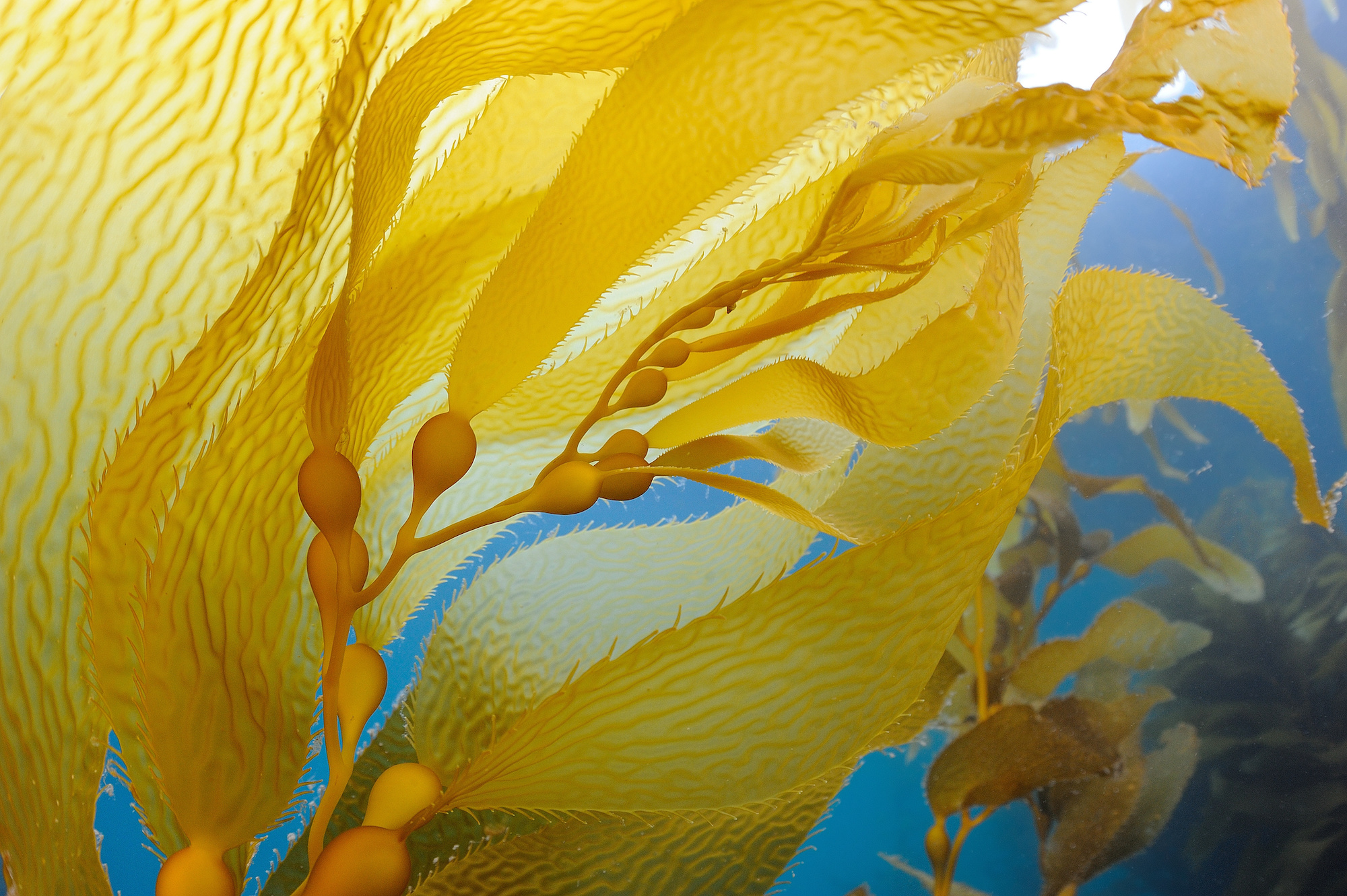
At the base of a giant kelp frond is the holdfast which looks similar to a tangled mass of roots. However, kelp plants have no root system as the holdfast’s thin and sturdy structures do not penetrate the substrate. The holdfast anchors the fronds to the seafloor.
The holdfast is connected to a stem-like structure called a stipe. The stipes are tough and flexible, holding up the kelp’s leaflike blades and allowing the kelp to sway in ocean currents.
Growing off of the stipe is many leaf-like blades and gas-filled spheres called pneumatocysts. Pnuematocysts buoy the fronds upward so the blades are more exposed to the sun. The blades are responsible for carrying out photosynthesis but the entire frond also takes part in photosynthesis.
The golden-brown fronds extend straight up from the bottom to the surface. They stretch out to form a floating surface canopy which can be up to 10 feet thick in a healthy kelp forest.
A giant kelp frond can grow to lengths of 150 feet!
Habitat
Rocky reefs from low intertidal to depths of 25 m.
Diet
Absorbs all necessary nutrients from the sun and the surrounding water. Giant kelp does this through a process called photosynthesis.
Life History
Giant kelp reproduces through a cycle known as alternation of generations. Generations alternate between macro- and microscopic life stages. All stages require specific conditions to survive including light, temperature, and nutrients. The canopy-forming stage called the sporophyte represents the macroscopic generation. The base of the sporophyte has reproductive fronds called sporophylls. These produce areas of concentrated spore called sori. When mature, sori release billions of spores year-round but mostly in the spring and summer. These spores can disperse up to 2.5 miles but usually stay within 33 feet of the parent. The spores develop on hard surfaces, forming the microscopic generation of male and female gametophytes. Male gametophytes release sperm which fertilize nearby eggs on female gametophytes. Once fertilized the eggs grow into sporophytes.
Giant kelp is a perennial algae meaning it can live for several years. The maximum life span of sporophytes is at least 7 years. The frond life span is 3 to 8 months while the microscopic life stages is about 2 to 7 months.
IUCN Status
Not Evaluated
Ecosystem & Cultural Importance
Kelp has been used by indigenous communities as medicine, fishing line, tools, a salt source, and food.
Giant kelp has been collected for commercial and recreational fisheries since the early twentieth century.
Giant kelp is the foundation for entire marine ecosystems.
Giant kelp is food for a variety of species including sea urchins, gastropods, snails, sea hares, crabs, fishes, and a diversity of small crustaceans. Many of these species eat both sporophytes and the microscopic life stages.
In the northern hemisphere, giant kelp ranges from Kodiak Island, Alaska to Baja California Sur, Mexico, but is rare north of San Francisco.
In the southern hemisphere, it ranges from Peru to Argentina including the southern tip of South America. Also distributed in southern Australia and New Zealand, as well as numerous sub Antarctic islands.
Giant kelp is the world’s largest species of marine algae.
Giant kelp can grow at a rate of up to two feet per day!
Unlike terrestrial plants that take in most of their nutrients through their roots, kelp plants absorb nutrients through all their parts including their holdfast, stipe, pneumatocysts, and blades.
Citations & Other Resources
California Department of Fish and Wildlife. 2021. Giant Kelp and Bull Kelp, Macrocystis pyrifera and Nereocystis luetkeana, Enhanced Status Report.
Giant Kelp (U.S. National Park Service). (n.d.). . https://www.nps.gov/articles/giant-kelp.htm.
Snyderman, M. 1998. California marine life: a guide to common marine species. Roberts Rinehart Publishers in cooperation with Monterey Bay Aquarium, Niwot, Colo.
We use cookies to improve your experience and see how our guests are navigating the website. If this is alright by you, hit 'Accept All', or 'Settings' to customize and learn more.
Read our cookie policy