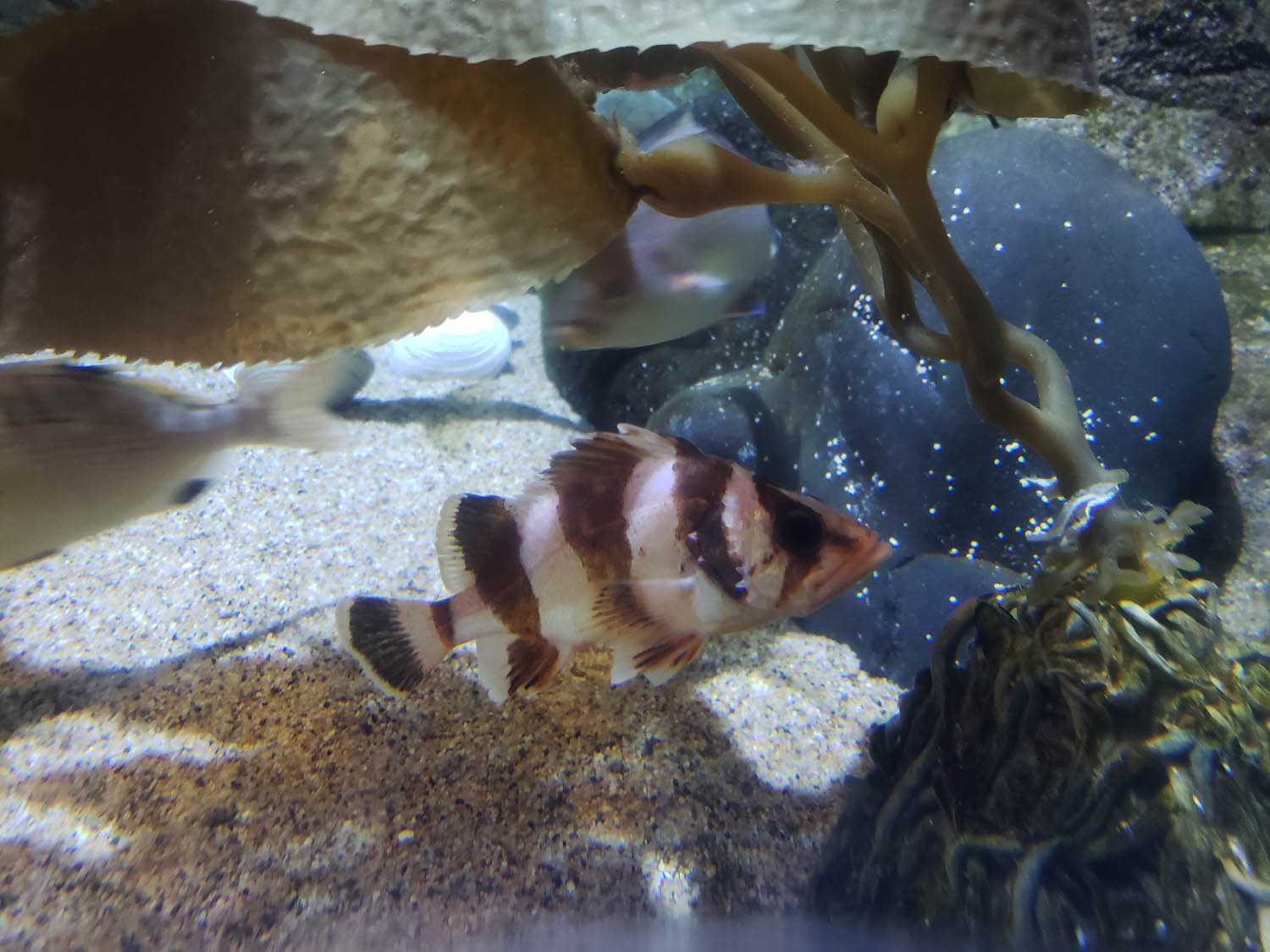
Flag rockfish are white to pinkish white with four reddish orange or brown bars on their body that extend onto their fins. Juvenile’s bars are blackish in color. The first bar covers most of their gill area. Flag rockfish can grow up to 44 cm.
Habitat
Rocky reefs at depths of 30 to 431 m.
Diet
Crustaceans, cephalopods, and small fish.
Life History
Flag rockfish are viviparous, meaning fertilization of eggs and embryo development occur inside the female. Some nutrients are provided to the developing young by the mother and she gives birth to live larval fish. Once the female gives birth, these larval fish enter a pelagic stage, swimming near the surface in the open sea. Eventually young flag rockfish will settle near rocky reefs.
Flag rockfish usually live in solitary but may form small to large groups. They tend to live in caves and crevices.
Flag rockfish may live as long as 18 years.
IUCN Status
Not Evaluated
Ecosystem & Cultural Importance
Flag rockfish help maintain ecosystem balance since they are prey for many species, including other finfish, seabirds, and marine mammals.
Flag rockfish are caught by local recreational fishermen.
Flag rockfish can occasionally be found near south of Stonewall Bank which is off the coast of Seal Rock. However, they do not commonly occur north of California.
We use cookies to improve your experience and see how our guests are navigating the website. If this is alright by you, hit 'Accept All', or 'Settings' to customize and learn more.
Read our cookie policy