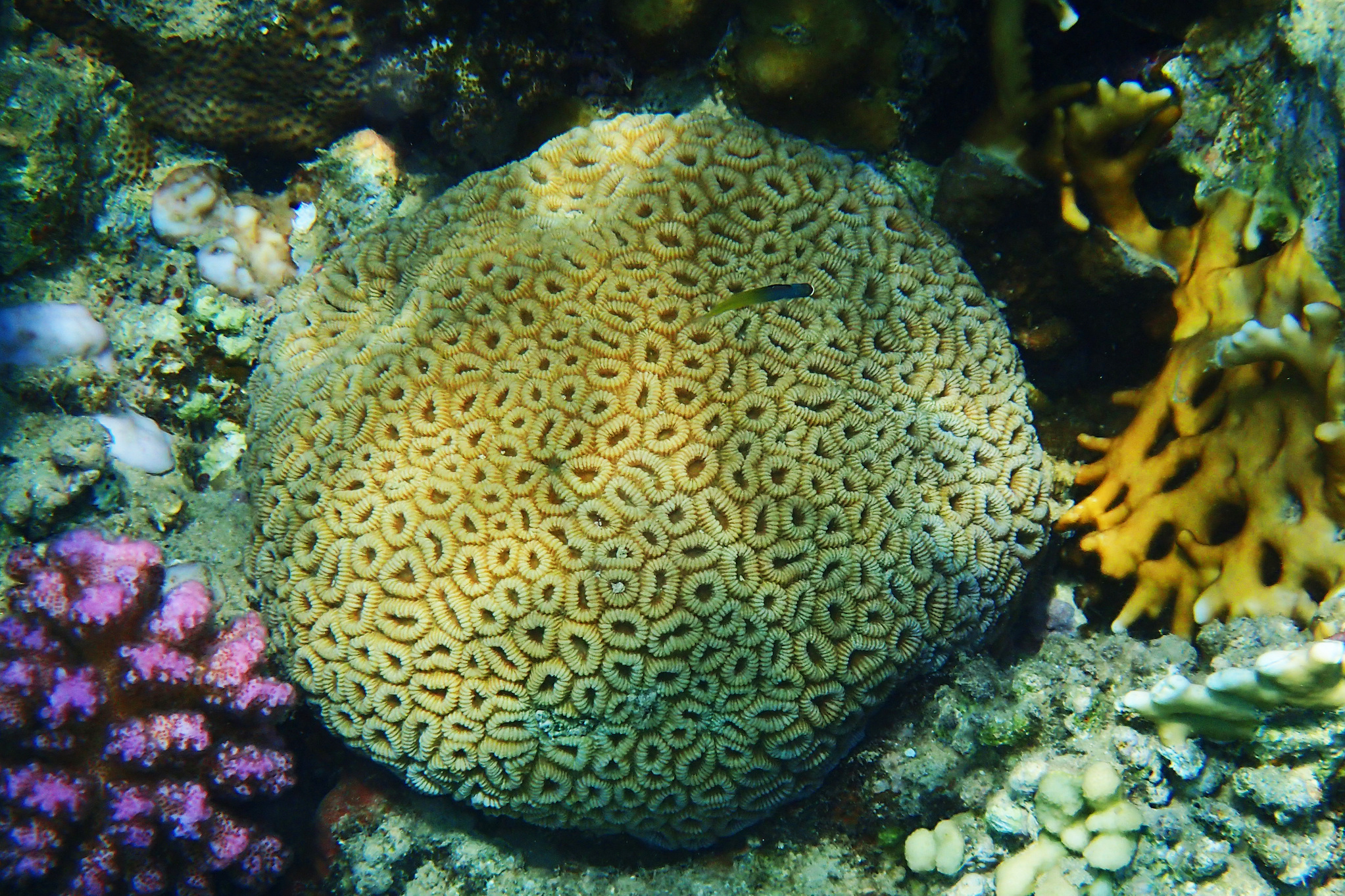
The many different species of favia coral go by a variety of names.
At the Aquarium
Connected Coasts
Appearance
These corals make large flat or domed bodies. Small circular ridges surround the individual polyps. Color and size vary by exact species.
Habitat
Different types of reef flats and also around fringing reefs and similar areas where the water is often cloudy.
Diet
Like other corals favia coral is able to photo synthesize using a symbiotic algae. Favia coral reveals its small tentacles on its polyps during the night. These tentacles are used to catch small bits of food floating in the water.
Life History
Colonies of coral can divide in order to create new colonies. Favia corals, much like other coral species, will broadcast spawn. Eggs are released into the water and hatch in the water column. Larvae settle to the sea floor and create new colonies of coral!
IUCN Status
Least Concern
Ecosystem & Cultural Importance
Much like other corals, favia corals are ecosystem engineers. The large skeleton that corals construct act as hiding spots and habitats for other species. Simply by living their lives, corals are able to build entire ecosystems around themselves.
This animal is not native to the Oregon Coast, however is found in the larger Pacific Ocean. It lives in the Aquarium as part of our Connected Coasts gallery.
Favia corals are one of the most commonly found corals in shallow waters.
Citations & Other Resources
J. E. N. Veron. 1993. Corals of Australia and the Indo-Pacific. University of Hawaii Press, Honolulu, Hi, USA.
WoRMS Editorial Board (2026). World Register of Marine Species. Available from https://www.marinespecies.org at VLIZ. Accessed 2026-03-24. doi:10.14284/170
We use cookies to improve your experience and see how our guests are navigating the website. If this is alright by you, hit 'Accept All', or 'Settings' to customize and learn more.
Read our cookie policy