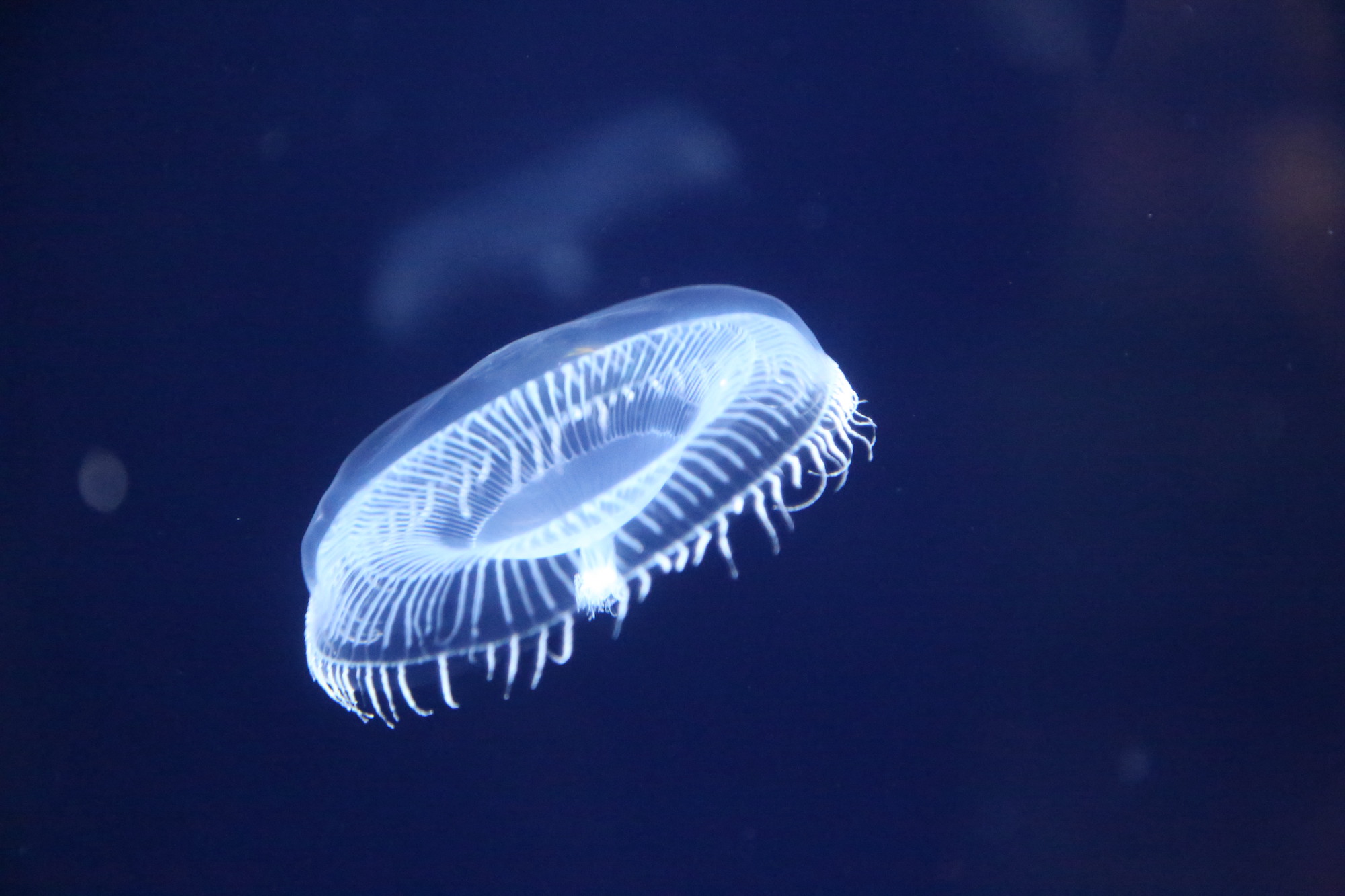
The medusa phase is usually colorless and saucer-shaped. A row of up to 150 tentacles of varying lengths surround the bell. The wide mouth with fringed lips hangs from the inside of the bell. There are 60 or more radial canals extending from the mouth to the bell margin, with gonads along most of their length, which are blue in males and rosy in females. The tiny sessile polyp phase is for asexual reproduction and grows to just 0.1” in length and has about 20 tentacles.
Habitat
Bays and nearshore waters
Diet
Mostly other jellies, including moon jellies, hydromedusae and ctenophores, but also other prey including crustacean larvae and fish eggs and larvae, including Pacific herring, Pacific sand soles, English soles, and starry flounders. These jellies will be cannibalistic.
Life History
The free-swimming medusa phase is involved in sexual reproduction. These medusa tend to concentrate near surface waters during spawning. A fertilized egg will develop into a planula larva, which will settle on a hard surface to become a tiny polyp in the intertidal. The medusa stage buds off of the polyp.
Bell grows up to 16” in diameter and 1.6” in height.
IUCN Status
Not Evaluated
Ecosystem & Cultural Importance
Crystal jellies are bioluminescent, giving off green light from over 100 tiny organs along the mantle edge, due to 2 proteins: green fluorescent protein (GFP) and the luminescent protein aequorin. These proteins are used in biomedical research, able to watch how nerve cells develop inside the brain and how cancer spreads.
These jellies feed their predators including the giant sunfish (Mola mola), chum salmon, nudibranchs, and other jellies including the hanging stomach jelly (Stomotoca atra) and the egg yolk jelly (Phacellophora camtschatica). In addition, they will host amphipods during the winter.
This is not a true jelly, but instead is a hydrozoan. Most hydromedusae are 0.4” or less in diameter but these medusa are especially large, reaching up to 16” in diameter.
We use cookies to improve your experience and see how our guests are navigating the website. If this is alright by you, hit 'Accept All', or 'Settings' to customize and learn more.
Read our cookie policy