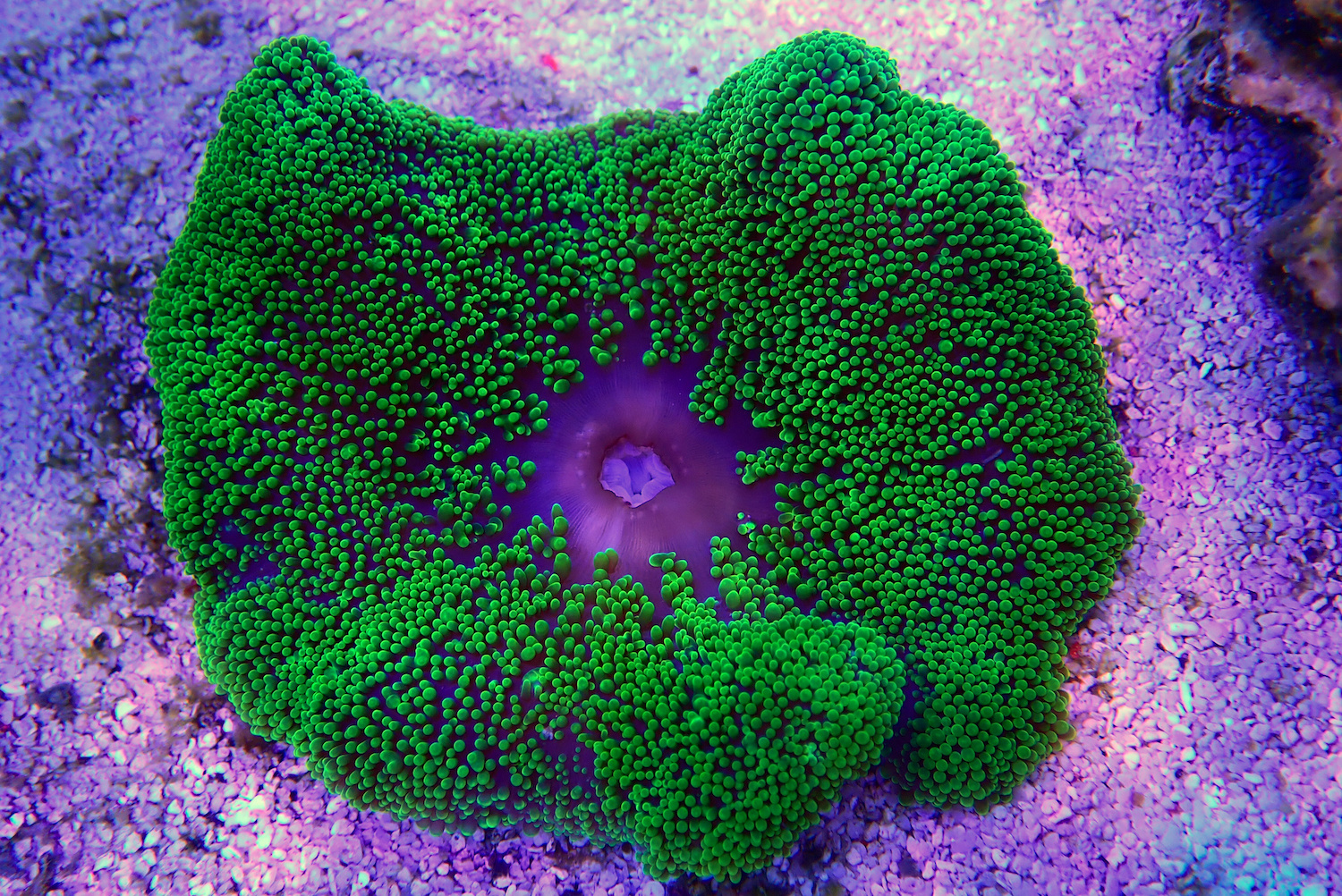
This species is usually 50cm, but may reach up to 95cm in diameter. As its name might suggest this anemone resembles a carpet with its large flat oral disk being densely covered with short tentacles. The tentacles of the carpet anemone are short, stubby and may have bulbous tops.
Its long body column is usually buried and ends in a pedal disk that anchors the anemone.
The carpet anemone varies in color from deep purple, green, pastel blue, grey and tan.
Habitat
Found primarily in the intertidal zone in soft sand amongst reef habitats.
Diet
Zooxanthellae via photosynthesis and small invertebrates and juvenile fish.
Life History
The carpet anemone reproduces by broadcast spawning. Eggs and sperm are released into the water and after the eggs are fertilized, they develop into larvae that float and drift with ocean currents. Eventually, these young carpet anemone settle onto a suitable surface.
The spawning periods and pelagic larval duration of the carpet anemone remains unknown so more research is needed to fully understand this species life history.
Carpet anemones can also reproduce by asexual division.
IUCN Status
Not Evaluated
Ecosystem & Cultural Importance
The carpet anemone has a symbiotic relationship with the peacock-tail shrimp Ancylocaris brevicarpalis. Their relationship maintains the population as well as breeding patterns.
This species also provides habitat for anemonefish.
Carpet anemone has a symbiotic relationship with zooxanthellae.
This animal is not native to the Oregon Coast, however is found in the larger Pacific Ocean. It lives in the Aquarium as part of our Connected Coasts gallery.
The carpet anemone has stingers in its tentacles used for both catching prey and deterring predators. These stingers typically do not harm humans, but they can leave welts on sensitive skin.
Citations & Other Resources
Sim, Y. K., O. Ahmad, and K. Yahya. 2014. Seashore organism in Penang National Park. Penerbit Universiti Sains Malaysia.
Prakash, S., A. Kumar, M.K. Okla, AI. Ahmad, Z.K. Abbas, A.A. Al-ghamdi, G. Beemster, and H. AbdElgawad. 2022. Physiological responses of the symbiotic shrimp Ancylocaris brevicarpalis and its host sea anemone Stichodactyla haddoni to ocean acidification. Marine Pollution Bulletin, 175, 113287–113287. https://doi.org/10.1016/j.marpolbul.2021.113287
Chan, W. W. R., Y.C. Tay, H.P. Ang, K. Tun, L.M. Chou, D. Huang, and R. Meier. 2020. Reproduction in Urbanised Coastal Waters: Shallow-Water Sea Anemones (Entacmaea quadricolor and Stichodactyla haddoni) Maintain High Genetic Diversity and Panmixia. Diversity (Basel), 12(12), 467-. https://doi.org/10.3390/d12120467
Bennett-Smith, M. F., J. E. Majoris, B. M. Titus, and M. L. Berumen. 2021. Clownfish hosting anemones (Anthozoa, Actiniaria) of the Red Sea: new associations and distributions, historical misidentifications, and morphological variability. Marine Biodiversity Records 14:22.
We use cookies to improve your experience and see how our guests are navigating the website. If this is alright by you, hit 'Accept All', or 'Settings' to customize and learn more.
Read our cookie policy