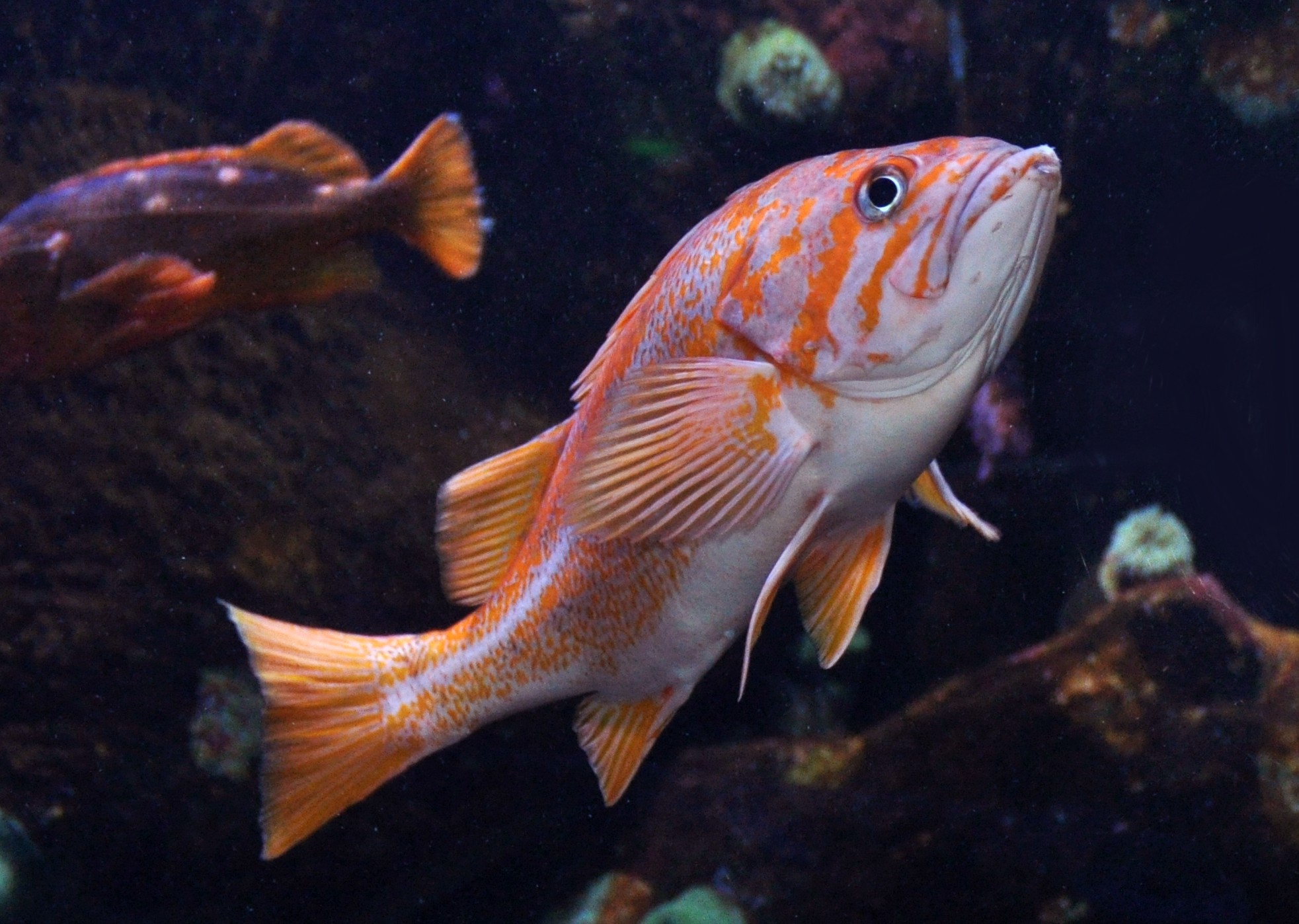
Canary rockfish are bright yellowish orange with mottling above and gray underneath. They have three orange stripes across the head, and orange fins. Their tail fin is forked and their lateral line is white.
Smaller individuals (less than 14 inches) often have a black spot near the back of the first dorsal fin.
Canary rockfish grow up to 30 inches and can weigh over 7 pounds.
Habitat
Juveniles stay in shallow waters while adults move deeper and mainly live in rocky habitats at depths of 59 to 2,749 feet.
Diet
Juveniles eat copepods, amphipods, and krill, while adults eat small crustaceans, invertebrates and fish.
Life History
Like other rockfish, canary rockfish are primitively viviparous. Fertilization of eggs and embryo development occur internally. The mother then gives birth to live larval fish. Female canary rockfish can have 260,000 to 1.9 million eggs, which is considerably more than many other rockfish species.
Larvae live in surface waters and may be distributed over a wide area extending several hundred miles offshore. Larvae and small juveniles may remain in open waters for several months. They are dispersed by ocean currents. Juveniles settle in shallow waters near rocky reefs, kelp canopies, and artificial structures. Then as adults, canary rockfish move into deeper water with rocky bottoms and outcrops.
This species reaches maturity between 5 and 6 years of age. They spawn during the winter months.
Canary rockfish may live to be 75 years old.
IUCN Status
Not Evaluated
Ecosystem & Cultural Importance
Rockfish are prey for many different species, including other finfish, seabirds, and marine mammals.
Since at least the early 1880s, canary rockfish have been an important commercial species. There are fisheries for canary rockfish off San Francisco, California and Washington state. The population of the U.S. West Coast was declared overfished in 2000 and a recovery plan was implemented in 2001. The population was declared rebuilt in 2015. Canary rockfish as well as all rockfish are managed under the federal Groundfish Fishery Management Plan.
We use cookies to improve your experience and see how our guests are navigating the website. If this is alright by you, hit 'Accept All', or 'Settings' to customize and learn more.
Read our cookie policy