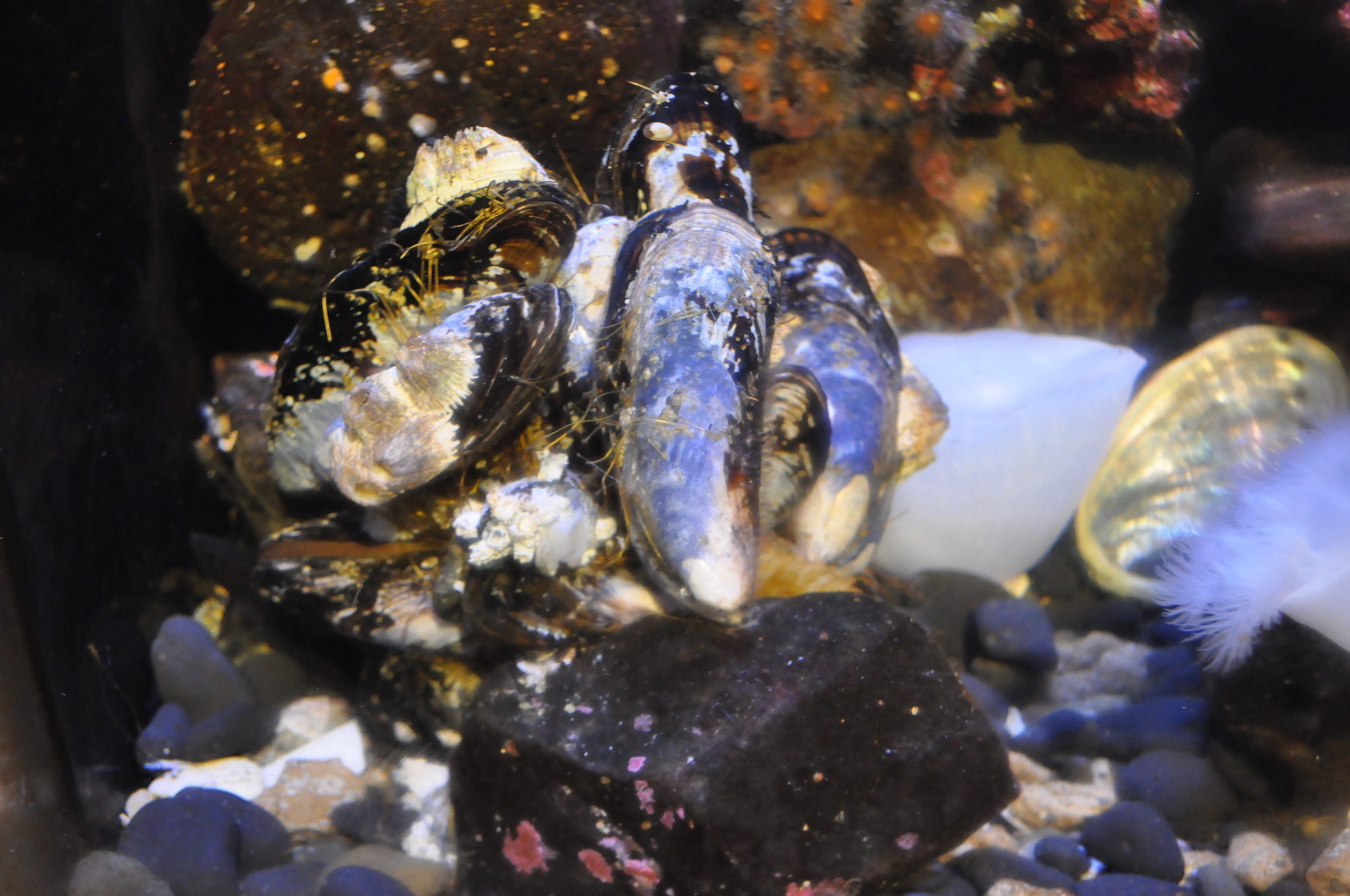
The california mussel has a tear-drop shaped shell that is dark shades of purple, blue, or black, with concentric grooves and radial lines. The bump above the shell’s hinge, called the umbone, is broad and rounded. It has an orange, slender foot.
Habitat
Rocky shores along the coast, estuaries, kelp forests, and pilings. Found from the mid-intertidal range to a maximum depth of 26m.
Diet
As filter feeders, their diet is mostly suspended food particles such as phytoplankton and fine organic detritus.
They can filter 2-3 liters of water an hour, but must be underwater to feed. They will slightly open their shell, drawing water into their mantle cavity with the rhythmical beating of millions of tiny cilia on their gills. The gills trap the suspended food particles and pass them to the mouth.
Life History
Though it breeds year-round, reproductive activity peaks around July and December in California. These broadcast spawners synchronize these activities with phytoplankton blooms, so their larvae have a plentiful food supply. It takes 3 years to grow to full-size. This mussel grows up to 12cm in length, though the ones in the intertidal usually only reach 10cm.
IUCN Status
Not Evaluated
Ecosystem & Cultural Importance
Humans currently harvest these mussels to eat and have for over 10,000 years.
Habitat engineers: The large beds that California mussels create provide a home and protection to other organisms from over 10 different marine invertebrate phyla. These mussels feed their predators including the ochre sea star, other sea stars, snails, crabs, shorebirds, and sea otters.
Since filter–feeding can concentrate environmental toxins in their tissues, this mussel helps to monitor our water quality. The United States Mussel Watch Program uses these mussels to monitor for organic pollutants and heavy metals, such as lead and cadmium.
These mussels grow on rocks and even other mussels. Very large groups of mussels can have over a million individuals.
To attach, mussels produce fibers called byssal threads. The mussel will extend its foot against the hard surface it’s going to attach to. The byssal gland releases a liquid that runs down the mussel’s foot within a groove. As the foot pulls away and seawater touches this liquid, it turns solid.
A large mussel can move by breaking its old threads and making new ones to bring it to a new spot.
Citations & Other Resources
California Conservation Genomics Project: https://www.ccgproject.org/species/mytilus-californianus-california-mussel
Monteray Bay Aquarium website: https://www.montereybayaquarium.org/animals/animals-a-to-z/california-mussel
We use cookies to improve your experience and see how our guests are navigating the website. If this is alright by you, hit 'Accept All', or 'Settings' to customize and learn more.
Read our cookie policy