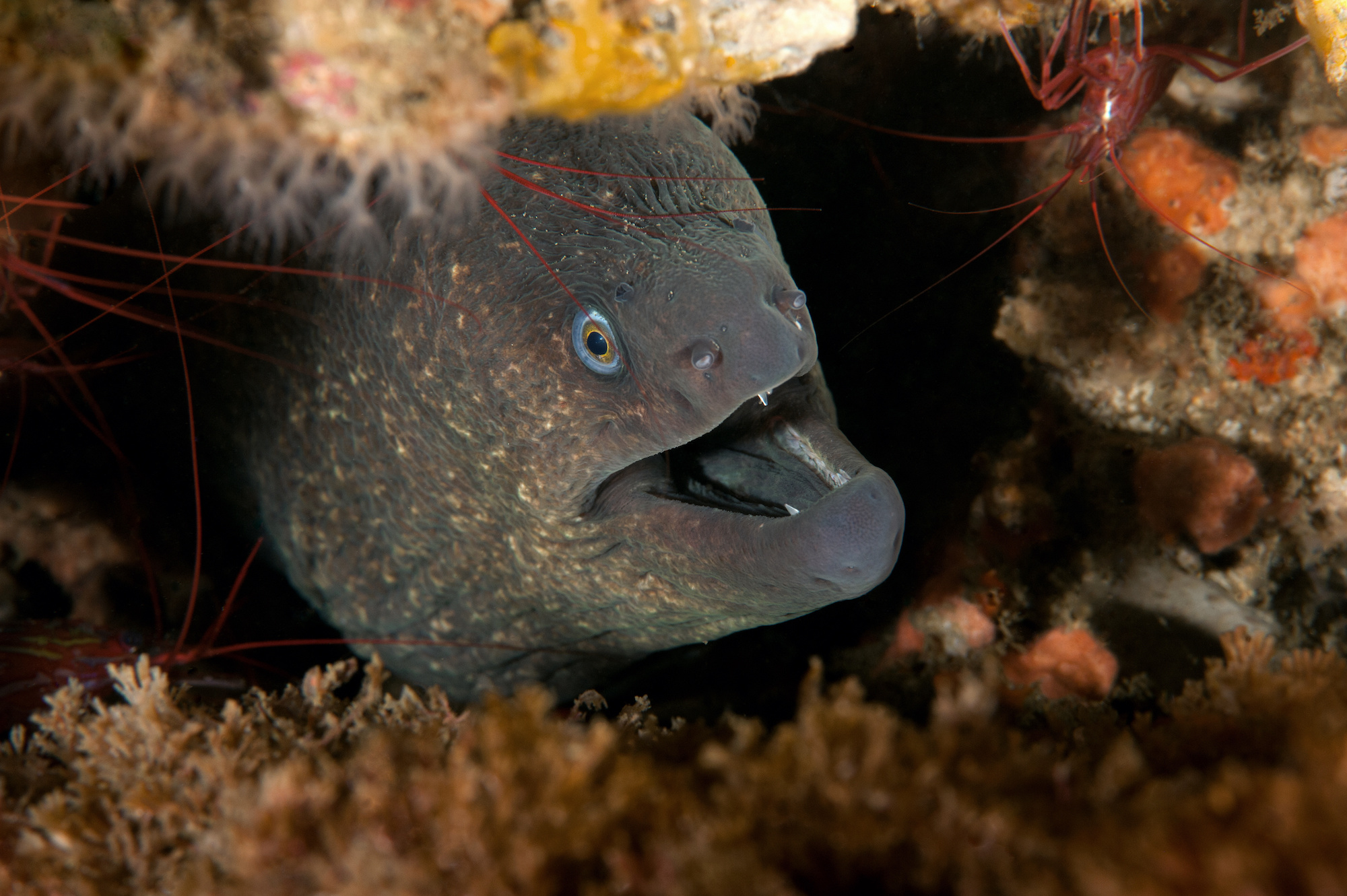
The head and body of the California moray are densely spotted with shades of dark brown to olive. The opening near its gills is blackish. Its dorsal and anal fins are continuous around its tail. The California moray does not have pectoral fins. The California moray can grow up to 5 feet.
Habitat
Shallow reef areas and kelp forests, in crevices and holes at depths of 1 to 40 m.
Diet
Crustaceans, octopuses and small fishes.
Life History
California morays reproduce by releasing sperm and eggs into the water where fertilization takes place. Once eggs hatch they enter a larval stage, drifting in ocean currents for up to a year. They eventually settle out of the water column and mature into their adult form.
Scientists believe that morays found in California do not hatch there because the waters are too cold for them to reproduce. Instead, they hatch in Baja California, Mexico and some drift north as larvae. They then settle and mature in California waters.
The California moray can live upwards of 30 years.
IUCN Status
Least Concern
Ecosystem & Cultural Importance
California morays have a symbiotic relationship with red rock shrimp. The shrimps gain both food, in the form of parasites and dead tissues they find on the eels, and protection by being near the eels. Meanwhile, the eels benefit from the removal of potentially harmful creatures and dead tissues. Blueband gobies and zebra gobies are also known to provide cleaning services to California morays.
As a predator they keep prey populations under control, helping to maintain ecosystem balance.
This animal is not native to the Oregon Coast, however is found in the larger Pacific Ocean. It lives in the Aquarium as part of our Connected Coasts gallery.
Unlike other fishes, California morays lack large gill covers and instead have a small, round gill opening. Without a gill covering California morays use their mouth to circulate a fresh supply of oxygenated water across their gills. This style of breathing results in their mouths constantly opening and closing, revealing their fang like teeth. This has led to California morays being negatively portrayed as monsters in the media and scary movie scenes. This portrayal is contradictory to the usual shy and reclusive behavior of California morays. They won’t bite unless disturbed or frightened.
They rely on their strong sense of smell to detect prey. California morays also have two sets of jaws. When its front jaws bite into prey the second pair located in its throat spring forward, dragging the prey into the moray’s throat.
Citations & Other Resources
Smith, D.G., J. McCosker and K. Tighe. 2019. Gymnothorax mordax. The IUCN Red List of Threatened Species 2019.
CA Marine Species Portal. (n.d.). . https://marinespecies.wildlife.ca.gov/california-moray-eel/false/.
Kells, V. A. 2016. A field guide to coastal fishes. From Alaska to California. Johns Hopkins University Press, Baltimore.
Mehta, R. S., K. E. Dale, and B. A. Higgins. 2020. Marine Protection Induces Morphological Variation in the California Moray, Gymnothorax mordax. Integrative and comparative biology 60:522–534.
Snyderman, M. 1998. California marine life: a guide to common marine species. Roberts Rinehart Publishers in cooperation with Monterey Bay Aquarium, Niwot, Colo.
We use cookies to improve your experience and see how our guests are navigating the website. If this is alright by you, hit 'Accept All', or 'Settings' to customize and learn more.
Read our cookie policy