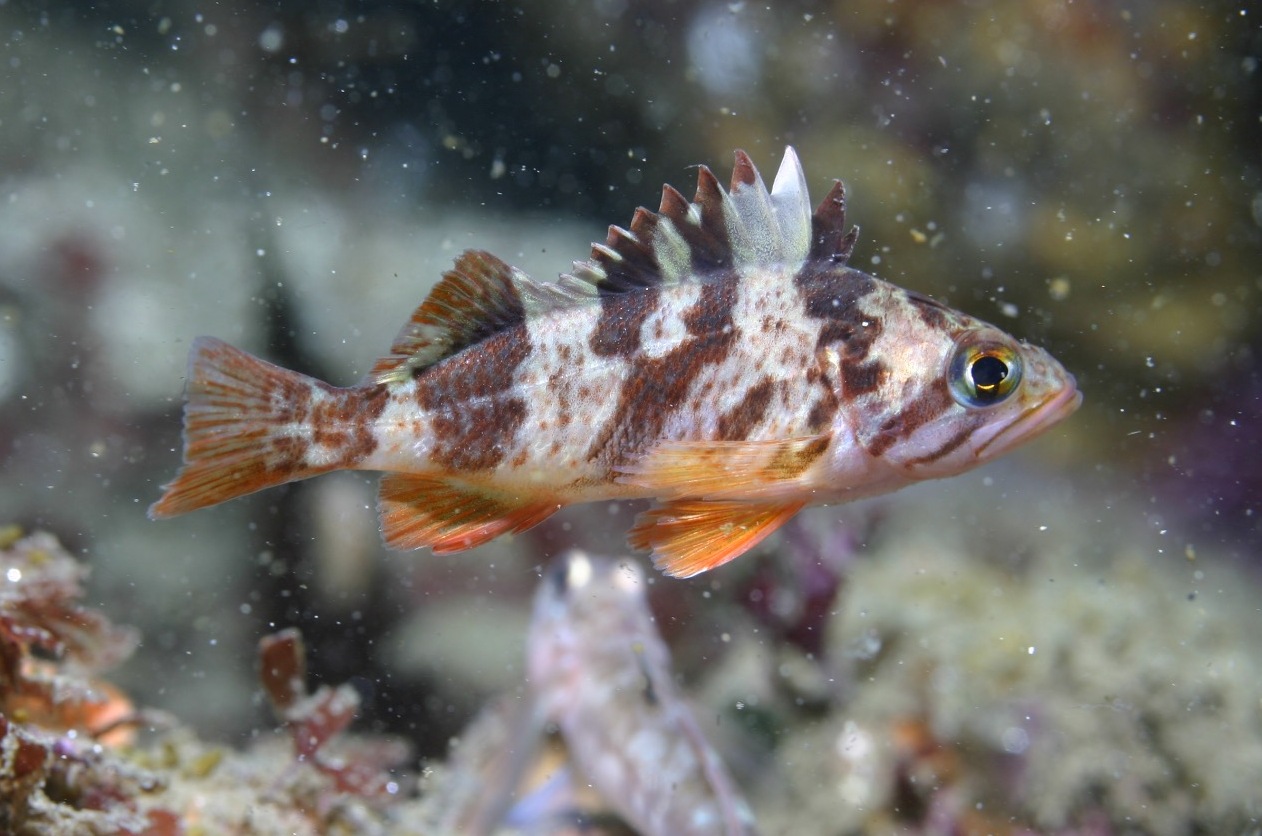
Calico rockfish are dusky to pale orange on their head and body with slanted brown to reddish brown bands that extend onto their fins. They have dark spots and speckles on their body. Their caudal fin also has dark spots and streaks. The calico rockfish can reach a maximum length of 25 cm.
Habitat
Rocky areas where there is mud-rock or sand-mud bottoms with fine sediments. Lives at depths from the intertidal zone to 305 m.
Diet
Crustaceans such as euphausiids, fishes, and cephalopods.
Life History
Spawning occurs in southern California between January and May, with peak spawning occurring in February. Male calico rockfish are ready to reproduce at age seven and females are ready at age nine. Calico rockfish are viviparous, meaning they give birth to live young. Fertilization and embryo development occurs internally, and the mother provides nutrients to the developing young. A female calico rockfish can produce between 1,700 to 18,000 eggs.
Once the female gives birth, these larval fish enter a pelagic stage, swimming near the surface in the open sea. Then once they reach about 0.08 to 0.1 inches in length they settle in rocky areas. They live alone or in large groups.
Calico rockfish can live up to 12 years.
IUCN Status
Not Evaluated
Ecosystem & Cultural Importance
Calico rockfish are important members of the food chain since they are prey for many species, including other finfish, seabirds, and marine mammals.
This animal is not native to the Oregon Coast, however is found in the larger Pacific Ocean. It lives in the Aquarium as part of our Connected Coasts gallery.
As you might suspect, the common name for rockfish comes from the fact that they usually frequent rocky habitats.
All species of rockfish including calico rockfish are a part of the family Scorpaenidae, which contains more species than any other family of fishes found in the Eastern Pacific.
Citations & Other Resources
CA Marine Species Portal. (n.d.). https://marinespecies.wildlife.ca.gov/calico-rockfish/.
David, O. 2001. Calico Rockfish. California’s Marine Living Resources: A Status Report. California Department of Fish and Game:179-180.
Kells, V. A. 2016. A field guide to coastal fishes. From Alaska to California. Johns Hopkins University Press, Baltimore.
We use cookies to improve your experience and see how our guests are navigating the website. If this is alright by you, hit 'Accept All', or 'Settings' to customize and learn more.
Read our cookie policy