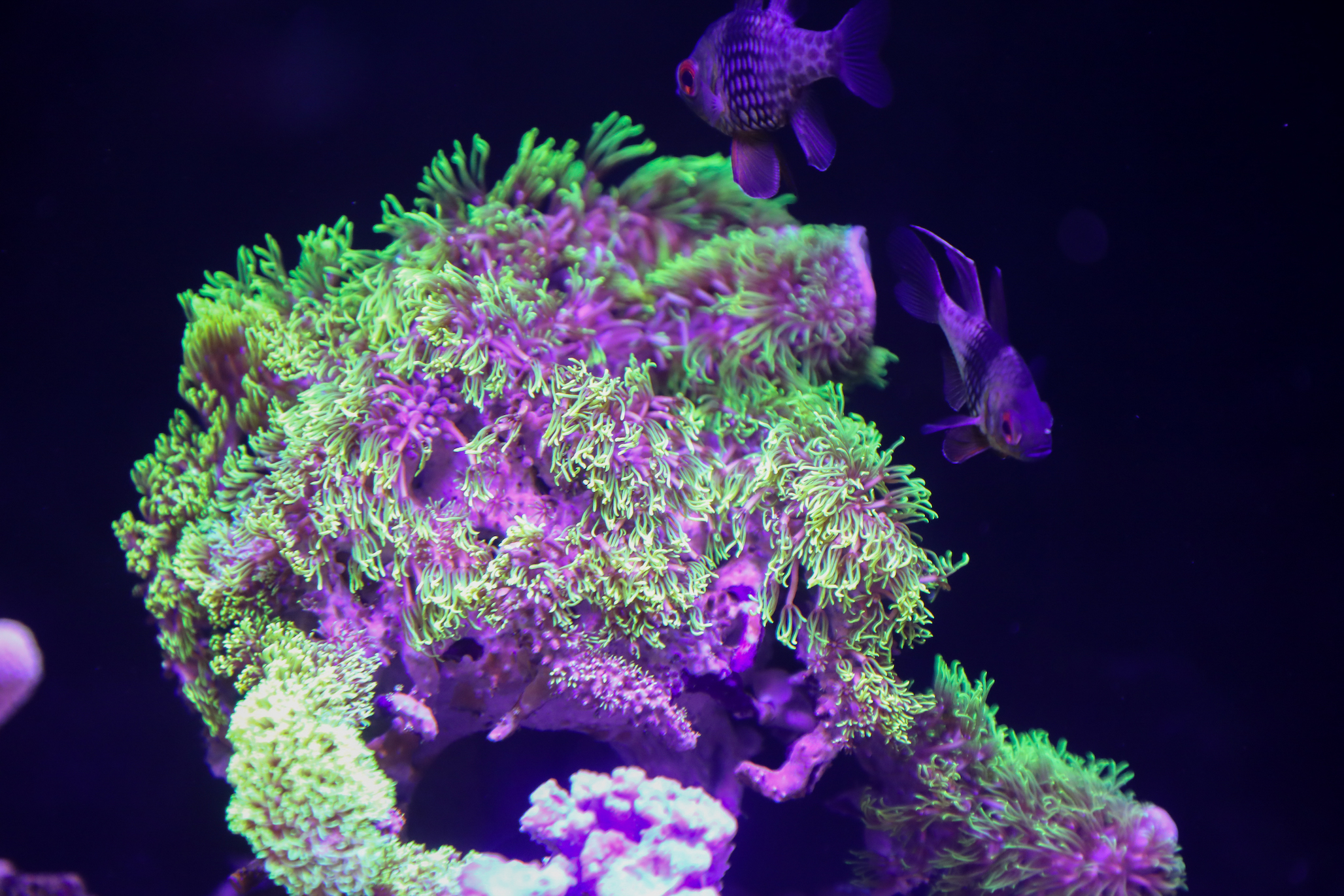
These corals are characterized by having many branching long spindles. Braiarium are soft corals and do not build a hard skeleton. Individual appearances vary based on environmental conditions
Habitat
Well-lit shallow waters
Diet
Symbiotic zooxanthellae live inside of the briareum coral. This algae photosynthesizes and gives the nutrition to the briareum in exchange for a safe
Life History
Corals engage in broadcast spawning. Both halves of the process are released into the ocean and eggs drift in the water column. They eventually settle to the seafloor and grow into new coral polyps.
IUCN Status
Not Evaluated
Ecosystem & Cultural Importance
Corals act as homes for symbiotic zooxanthellae. They provide protection to the zooxanthellae in exchange for nutrients.
A species of briareum coral named green star polyp is common for home aquariums
This animal is not native to the Oregon Coast, however is found in the larger Pacific Ocean. It lives in the Aquarium as part of our Connected Coasts gallery.
The name briareum seemingly comes from the ancient Greek giant named Briareus. This giant had 100 hands which parallels the many branching spindles of this coral.
Citations & Other Resources
Samimi-Namin K, van Ofwegen LP (2016) Overview of the genus Briareum (Cnidaria, Octocorallia, Briareidae) in the Indo-Pacific, with the description of a new species. ZooKeys 557: 1-44. https://doi.org/10.3897/zookeys.557.6298
WoRMS Editorial Board (2026). World Register of Marine Species. Available from https://www.marinespecies.org at VLIZ. Accessed 2026-03-24. doi:10.14284/170
We use cookies to improve your experience and see how our guests are navigating the website. If this is alright by you, hit 'Accept All', or 'Settings' to customize and learn more.
Read our cookie policy