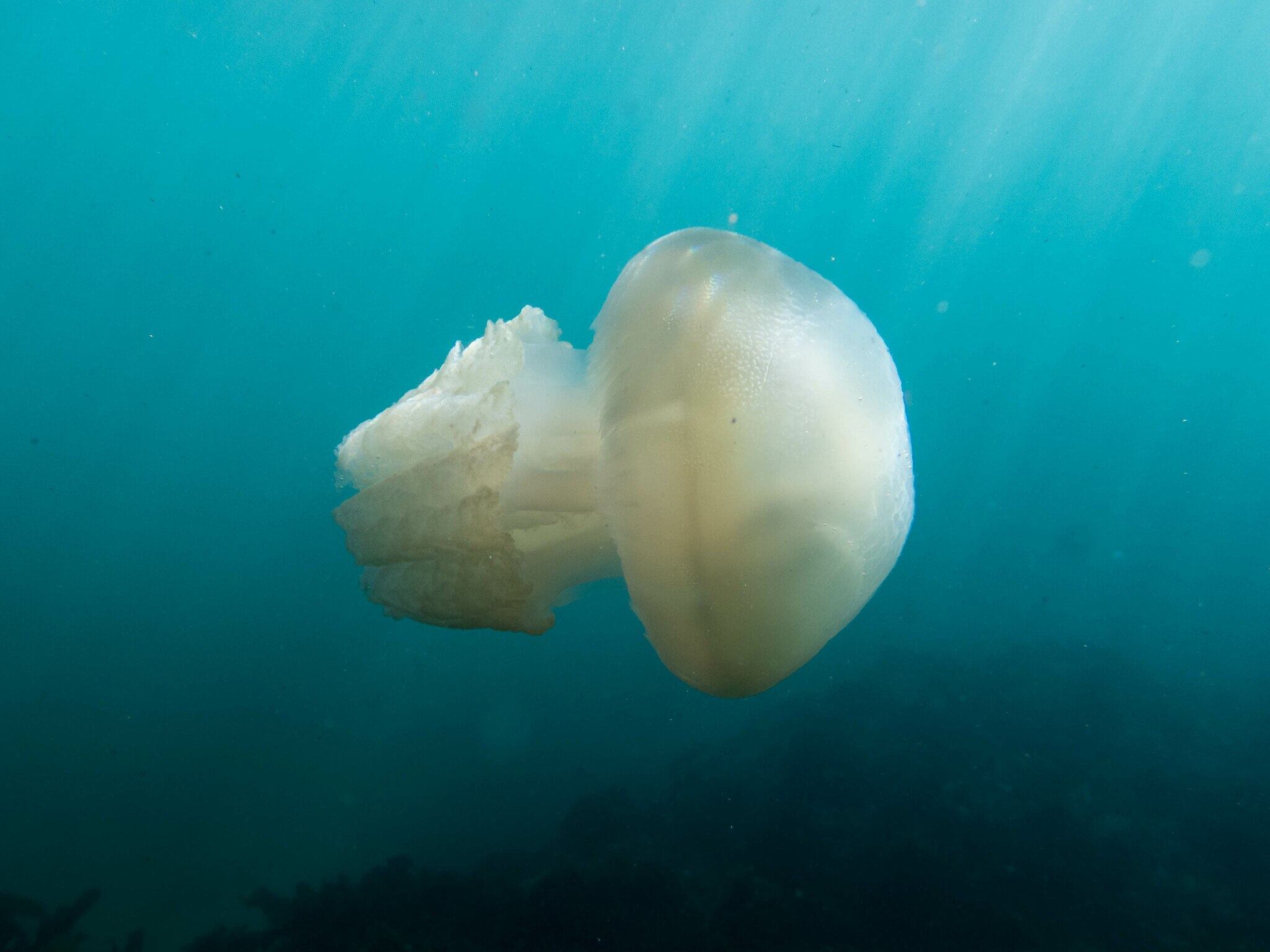
The mushroom-shaped bell can come in a variety of colors including blue, creamy white, and brownish-yellow. There are 8 oral arms hanging from the center of the bell underside.
Habitat
Coastal waters, bays, and estuaries
Diet
Larvae and small crustaceans
Life History
These jellies alternate between a sessile, asexually-reproducing polyp phase and a free-swimming sexually-reproducing medusa phase. Planulae spend 4-5 days in the water column before settling to the bottom and turning into a polyp. Polyps often settle in locations near other polyps, resulting in clumps or aggregations of polyps in an area. During strobilation, a polyp can be 0.08” tall and produces between 1-5 medusae. The medusae grow to an average of 9.8-11.8” in diameter. Sexual reproduction likely occurs year-round, though it may slow in winter.
A polyp is able to asexually reproduce more polyps through producing podocysts, via pedal cysts, or via budding. Podocysts are dormant and can survive through harsh conditions, such as low food, and will metamorphose into a polyp when conditions improve. Pedal cysts are a bit of pedal disk material that is left behind when a polyp moves across a surface.
IUCN Status
Not Evaluated
Ecosystem & Cultural Importance
Eaten by leatherback sea turtles, fish including yellowfin leatherjackets, and the longnose spider crab.
These jellies have been harvested in both Australia and Asia.
In the lab, blue blubber polyps have been observed to move across a surface by producing, attaching, and retracting stolons, which act a bit like legs.
Pitt, K. A. “Life history and settlement preferences of the edible jellyfish Catostylus mosaicus (Scyphozoa: Rhizostomeae).” Marine Biology 136.2 (2000): 269-279.
Pitt, K. A., and M. J. Kingsford. “Reproductive biology of the edible jellyfish Catostylus mosaicus (Rhizostomeae).” Marine Biology 137.5 (2000): 791-799.
We use cookies to improve your experience and see how our guests are navigating the website. If this is alright by you, hit 'Accept All', or 'Settings' to customize and learn more.
Read our cookie policy