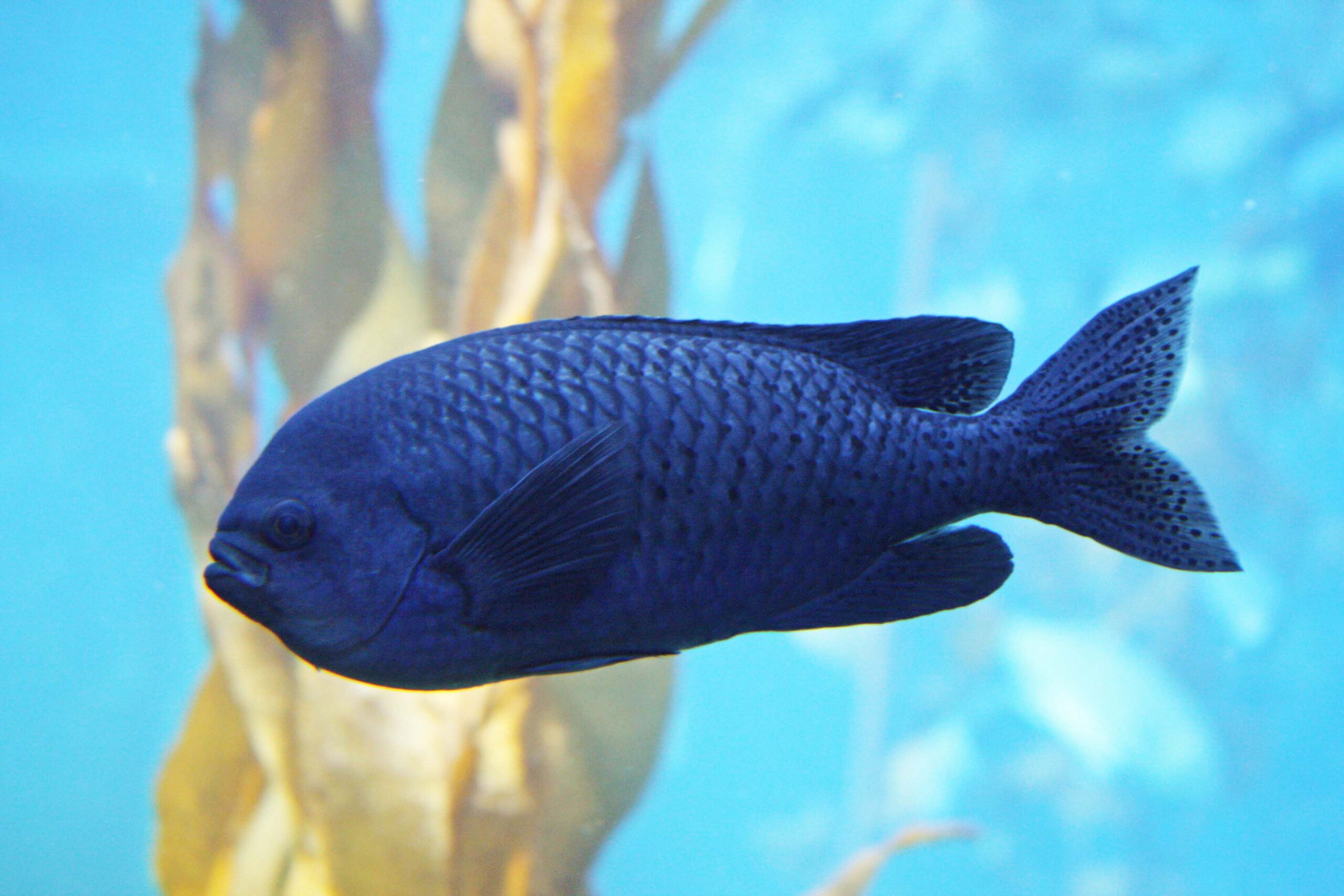
Blacksmiths vary in color from blue gray to violet gray or blue. Their backs are often green and their scales have darker edges. Their caudal fin and part of their dorsal fin have distinct black spots. While resting, blacksmiths become blotched with white. Breeding males have a dark bar between their eyes while nesting males become pale and blotchy. The front of juveniles is purple blue while their back half is yellowish orange. Blacksmiths can grow up to 12 inches.
Habitat
Rocky bands, reefs and among kelp beds at a depth of 2 to 46m. Also found over man-made structures like oil platforms and bridge pilings.
Diet
Wide variety of zooplankton. Juveniles feed on small crustaceans and young squid when abundant
Life History
Blacksmiths spawn mostly in the summer. Males build nests and once females lay their eggs, a male will fertilize and guard them for a few weeks. When the eggs hatch they begin a planktonic larval stage, drifting in ocean currents. Eventually they grow into juveniles, settling near reefs and forming schools. Juveniles and adults form schools according to size. At night blacksmiths shelter within rocky crevices of the reef. At dawn, they emerge into the open water, over rocky areas, and within kelp beds. They migrate to areas where they can feed on lots of zooplankton. The lifespan of blacksmiths is unknown.
IUCN Status
Least Concern
Ecosystem & Cultural Importance
Blacksmiths are caught by recreational fishers.
Blacksmiths have a symbiotic relationship with a type of wrasse fish called Senorita. Senoritas clean blacksmiths, eating small parasites and dead skin. Blacksmiths benefit from being freed from these irritants. When waiting for senoritas to come by and clean them, blacksmiths will gather into a tight ball and hang upside down. If a senorita tries to leave before all the blacksmiths are cleaned, the unclean ones will often try to block their path.
Blacksmiths are prey to a variety of predators including bald eagles, blue sharks, harbor seals, lingcod, moray eels and others.
This animal is not native to the Oregon Coast, however is found in the larger Pacific Ocean. It lives in the Aquarium as part of our Connected Coasts gallery.
Juvenile blacksmiths have been observed cleaning other fish, ridding them of dead skin and small parasites.
Citations & Other Resources
Collen, B., N. Richman, A. Beresford, A. Chenery & M. Ram. (Sampled Red List Index Coordinating Team).2010. Chromis punctipinnis. The IUCN Red List of Threatened Species 2010.
CA Marine Species Portal. (n.d.). . https://marinespecies.wildlife.ca.gov/blacksmith/false/.
Kells, V. A. 2016. A field guide to coastal fishes. From Alaska to California. Johns Hopkins University Press, Baltimore.
Snyderman, M. 1998. California marine life: a guide to common marine species. Roberts Rinehart Publishers in cooperation with Monterey Bay Aquarium, Niwot, Colo.
We use cookies to improve your experience and see how our guests are navigating the website. If this is alright by you, hit 'Accept All', or 'Settings' to customize and learn more.
Read our cookie policy