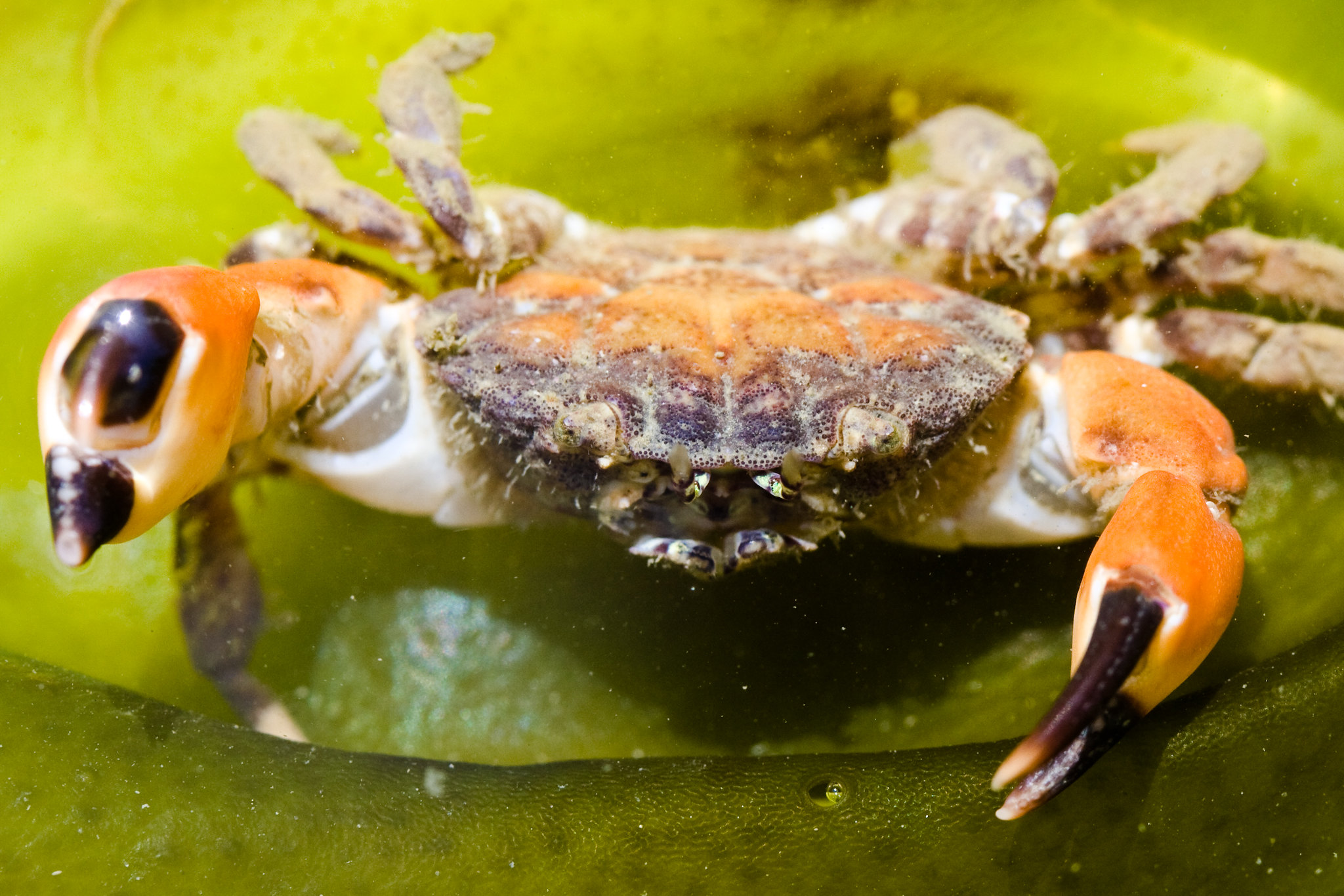
They have ten visible legs, with black-tipped claws/chela that are ideal for breaking-shells. The carapace color can be red, orange, green, purple, brown, gray, creamy white, or calico patterned. There are three ‘teeth’ or points at the front corner on each side of the carapace next to the eyes.
Habitat
Intertidal to depths of 262 feet, under rocks, on gravel, or on kelp holdfasts.
Diet
Algae, small mollusks, barnacles, other crabs, and young abalone
Life History
A brood can contain from 6,000 to 36,000 eggs, and many females produce 2 broods a year. In British Columbia, eggs are carried starting from March and hatching occurs from May to August. Larvae are planktonic for a prezoea stage, four zoea stages, and then one megalops stage.
The male carapace reaches 1.3 inches across while females are only up to 0.9 inches across.
IUCN Status
Not Evaluated
Ecosystem & Cultural Importance
This crab feeds its predators which includes the quillback rockfish
There are two distinct subspecies recognized for this crab. Lophopanopeus bellus bellus lives in the intertidal and has smooth claws while Lophopanopeus bellus diegensis lives subtidally and has tubercles on its claws.
Citations & Other Resources
Ueda, K. (2009, March 31). A Firm Handshake. iNaturalist. https://www.inaturalist.org/photos/2742
Harbo, Rick M. Whelks to Whales: Coastal Marine Life of the Pacific Northwest. Harbour Publishing, 2011.
Lamb, Andy, and Bernard P. Hanby. Marine Life of the Pacific Northwest: A Photographic Encyclopedia of Invertebrates, Seaweeds and Selected Fishes. Harbour Publishing, 2005.
We use cookies to improve your experience and see how our guests are navigating the website. If this is alright by you, hit 'Accept All', or 'Settings' to customize and learn more.
Read our cookie policy