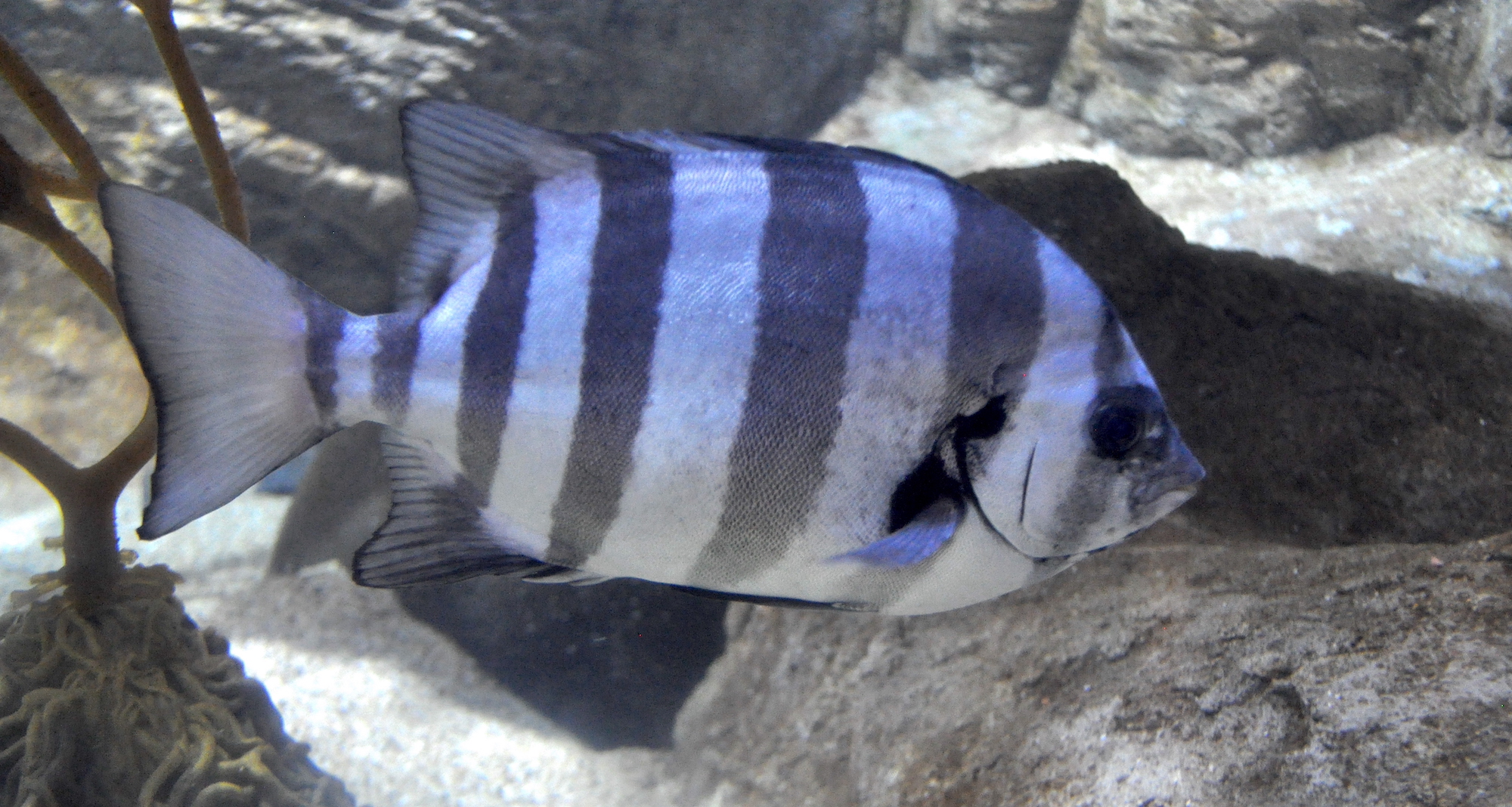
The banded knifejaw is black and white striped. The first black stripe is through its eye and their caudal fin is edged in black. The stripes are more distinct in juveniles and may be absent in large adults, especially in adult males. The teeth in each jaw are fused together, forming a sharp beak. This beak helps them easily crush molluscs and barnacles. The banded knifejaw can grow to a maximum total length of 80cm.
Habitat
Coastal rocky reefs
Diet
Crustaceans and molluscs
Life History
Females of this species spawn several times between April to July, releasing their eggs on the sandy gravel bottom. Eggs hatch at around 36 hours after laying and develop into post larvae 35 days after hatching. They develop from larvae into juveniles, drifting near the surface with debris, seaweed and other floating objects. Once banded knifejaws grow to a length of about 5 cm they move to the sea floor. While juveniles prefer to live among rocky reefs in shallow waters, adults can be found in deeper waters. The banded knifejaw can live up to 10 to 20 years.
IUCN Status
Least Concern
Ecosystem & Cultural Importance
In Korea, the banded knifejaw is an important food source and native populations are replenished through hatcheries. The meat of the banded knifejaw is considered a delicacy, eaten as sashimi or dried filet.
The impacts of this species are unknown. More research is needed to know how the banded knifejaw has affected ecosystems in their nonnative range.
Native to the coastal waters of Sakhalin and the Sea of Okhotsk in Russia, Japan, the Korean Peninsula, the Yellow Sea, and China. The banded knifejaw can also be found near the Hawaiian Islands.
After the tsunami that occurred in Japan in 2011 the banded knifejaw has been observed on the western U.S. coast in California, Oregon and Washington.
The banded knifejaw appears in the video game Animal Crossing.
Citations & Other Resources
Williams, J.T. 2024. Oplegnathus fasciatus. The IUCN Red List of Threatened Species 2024.
Brown, M.E. and P.J. Schofield, 2024, Oplegnathus fasciatus (Temminck and Schlegel, 1844): U.S. Geological Survey, Nonindigenous Aquatic Species Database, Gainesville, FL, https://nas.er.usgs.gov/queries/FactSheet.aspx?SpeciesID=2902
Gong, J., J. Zhao, Q. Ke, B. Li, Z. Zhou, J. Wang, T. Zhou, W. Zheng, and P. Xu. 2022. First genomic prediction and genome‐wide association for complex growth‐related traits in Rock Bream (Oplegnathus fasciatus). Evolutionary Applications 15:523–536.
Non-Native Fish Show Up On West Coast. 2017, January 26. https://seagrant.oregonstate.edu/sgpubs/non-native-fish-show-west-coast.
Randall, J. E. 1998. Shore fishes of Hawaiʻi. University of Hawaiʻi Press, Honolulu.
Shimada, Y., K. Nokubi, S. Yamamoto, O. Murata, and H. Kumai. 2009. Reproduction between Oplegnathus fasciatus and O. punctatus, and fertility of their interspecies. Fisheries Science 75:521–523.
We use cookies to improve your experience and see how our guests are navigating the website. If this is alright by you, hit 'Accept All', or 'Settings' to customize and learn more.
Read our cookie policy