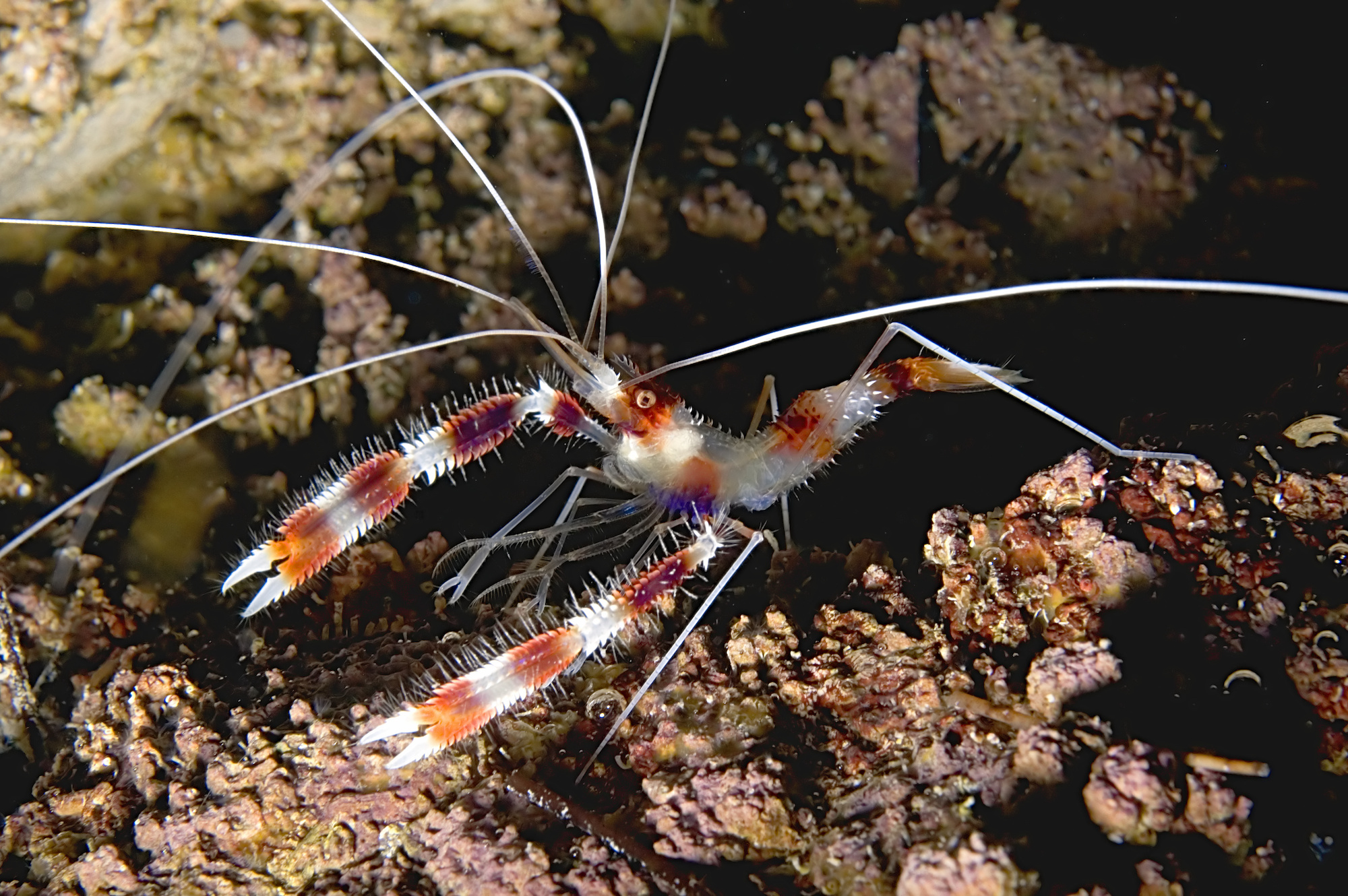
The banded coral shrimp has a pair of claw-like appendages called chelipeds which are used for defense and capturing prey. Its body is covered with spines. Both its body and chelipeds are striped red and white. This species also has long white antennae.
The banded coral shrimp reaches 5cm in length.
Males are typically smaller than females.
Habitat
Variety of reef habitats, including under coral ledges, rocky ledges and crevices. At depths of 1 to 210m.
Diet
Ectoparasites, wounded or dead tissues, and extra food particles from larger reef fishes.
Life History
The banded coral shrimp is often seen in mating pairs with males following and protecting their female mates.
After a courtship ritual and spawning, females can be seen with a greenish mass of eggs underneath the abdomen. The eggs first appear pale bluish green and as they mature they turn dark green then orange-brown with dark spots. Once the eggs hatch, the banded coral shrimp begins a pelagic larval stage. During this time this species floats and drifts with ocean currents for up to 210 days.
This species then settles near reefs and looks for areas that provide shelter like ledges and crevices.
IUCN Status
Not Evaluated
Ecosystem & Cultural Importance
The banded coral shrimp is known as a cleaner shrimp and helps to remove mucous, diseased tissues, parasites, and fungus from the body of a large variety of reef fishes.
Distributed in the Indo-Pacific region from South Africa, Red Sea, Malaysia, Vanuatu, Philippines, Hawaii and Caribbean. In the Atlantic it is widely distributed from southern Florida to the Guineas and Bermuda.
This animal is not native to the Oregon Coast, however is found in the larger Pacific Ocean. It lives in the Aquarium as part of our Connected Coasts gallery.
The banded coral shrimp uses its long white antennae to attract fish that it will clean.
Citations & Other Resources
Gosliner, T., D.W. Behrens, and G.C. Williams. 1996. Coral reef animals of the Indo-Pacific : animal life from Africa to Hawaii exclusive of the vertebrates. Sea Challengers.
Colin, P. L. (Patrick L. (1988). Marine invertebrates and plants of the living reef. T.F.H.
Poore, G. C. B., CSIRO, & S.T. Ahyong. 2004. Marine decapod Crustacea of southern Australia : a guide to identification. CSIRO Pub.
Wainwright, B. J., I.S. Arlyza, and S.A. Karl. 2020. Population genetics of the banded coral shrimp, Stenopus hispidus (Olivier, 1811), in the Indonesian archipelago. Journal of Experimental Marine Biology and Ecology, 525, 151325-. https://doi.org/10.1016/j.jembe.2020.151325
Esaka, Y., Yoshioka, E., Takeuchi, Y., Hur, S.-P., & Takemura, A. (2016). Effect of Light Intensity and Wavelength on Diurnal Activity of the Banded Coral Shrimp Stenopus hispidus (Decapoda, Stenopodidae): A Possible Adaptation for a Cleaner Shrimp in Reef Environments. Pacific Science, 70(2), 191–200. https://doi.org/10.2984/70.2.5
Madhavan, M., T.K. Teena Jayakumar, T.T.A. Kumar, and U.K. Sarkar. 2023. Mating behaviour and embryonic development of the marine ornamental shrimp, Stenopus hispidus Olivier, 1811 in captivity. Aquaculture, 574, 739655-. https://doi.org/10.1016/j.aquaculture.2023.739655
We use cookies to improve your experience and see how our guests are navigating the website. If this is alright by you, hit 'Accept All', or 'Settings' to customize and learn more.
Read our cookie policy