No other common names for the genus, but the many different species of Acropora coral go by a variety of names.
At the Aquarium
Connected Coasts
Appearance
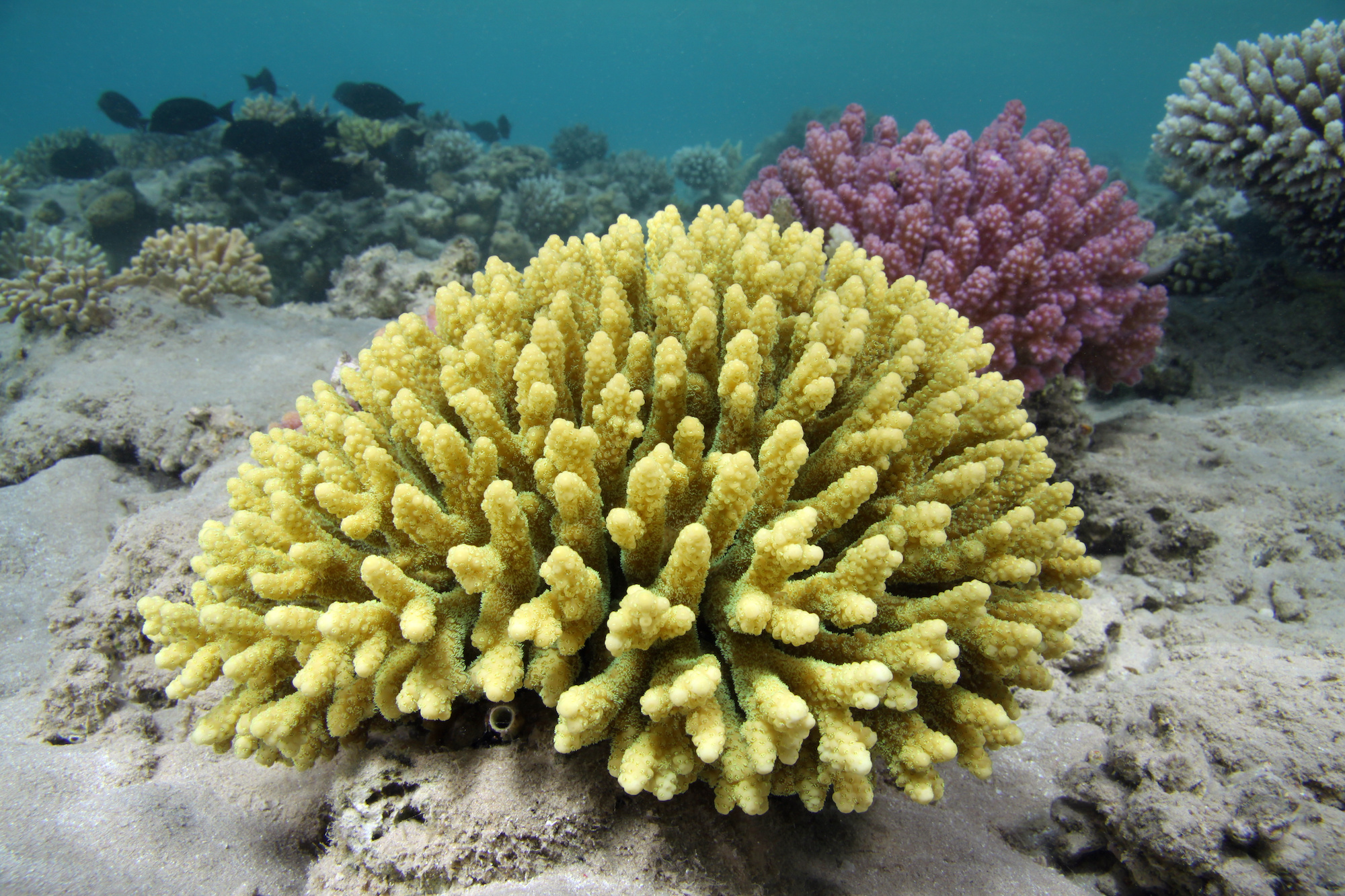
Acorpora coral comes in a diverse range of appearances. The shape, size and color of Acropora depends on the species. Some colonies are flat, while others have tree-like branches and some grow as thick pillow-like clumps.
Their polyps are usually extended only at night.
Habitat
Upper reef slopes where the water is clear. Habitat preferences vary between species.
Diet
Acropora coral receives most of its nutrients from its relationship with zooxanthellae, a type of algae that performs photosynthesis and lives within the coral. For more information on this special relationship continue reading here.
Acropora coral also eats zooplankton.
Life History
Most species of Acropora have light skeletons which allows them to grow quickly and take over the reef.
Acropora coral reproduce and grow similarly to other corals, releasing eggs and sperm into the water. Once eggs hatch they develop into larvae called planulae. Planulae float in ocean currents and eventually swim back down to the bottom. If conditions are favorable they will settle, developing into polyps and forming colonies. To learn more about how Acropora corals and other stony corals reproduce and grow, continue your reading here.
IUCN Status
Vulnerable, Endangered
Ecosystem & Cultural Importance
Acropora corals are important reef-building corals, helping build and function as the foundation of reefs around the world.
Creatures all over the world rely on Acropora corals. For instance Coralliocaris graminea, a common shrimp, are found living within different species of Acropora corals.
This animal is not native to the Oregon Coast, however is found in the larger Pacific Ocean. It lives in the Aquarium as part of our Connected Coasts gallery.
The Acropora genus has the most species of coral compared to other genera of coral.
Citations & Other Resources
Mather, P., I. Bennett, and Australian Coral Reef Society. 1993. A Coral reef handbook: a guide to the geology, flora and fauna of the Great Barrier Reef. 3rd ed. Surrey Beatty & Sons, Chipping Norton, NSW.
Veron, J. E. N. 1986. Corals of Australia and the Indo-Pacific. Angus & Robertson, North Ryde, NSW, Australia.
Wood, E. M. 1983. Reef corals of the world: biology and field guide. T.F.H. Publications, Neptune City, NJ.
We use cookies to improve your experience and see how our guests are navigating the website. If this is alright by you, hit 'Accept All', or 'Settings' to customize and learn more.
Read our cookie policy