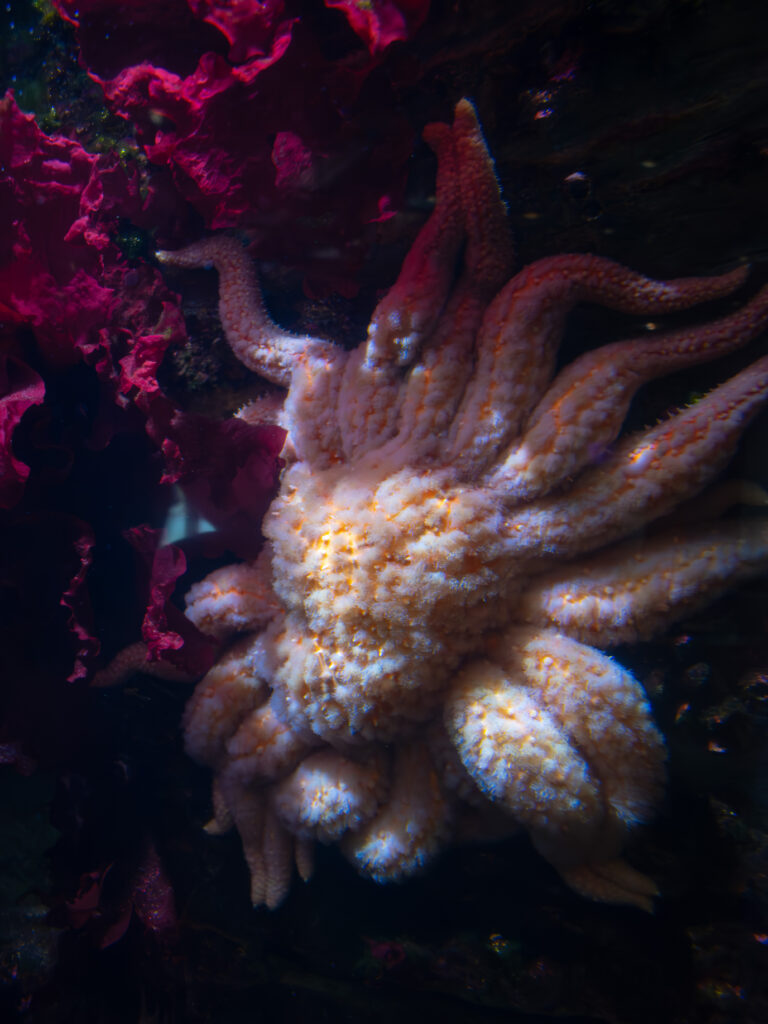
Save the stars, save the kelp. In 2013, a climate-driven shift along much of the North American Pacific coast caused Sea Star Wasting Syndrome, resulting in a massive die-off of sea stars. Sea Star Wasting Syndrome persists to this day.
With nearly 100% of sunflower sea stars decimated along the west coast, purple sea urchin populations exploded. Over the past decade, urchins have taken over the sea floor, mowing down kelp forests. These vital marine ecosystems serve as nurseries for juvenile fish, provide critical habitats for gray whales and sea lions, and produce approximately 75% of the Earth’s oxygen.
The Oregon Coast Aquarium is working to save sunflower sea stars, and in turn, protect our treasured kelp forests. Senior Aquarist Tiffany Rudek has developed a reliable method of treating ill and injured sea stars, boosting their immune systems. Her innovative treatment of Sea Star Wasting Syndrome has garnered both professional support and national media coverage from The Washington Post.
Now, the Aquarium has partnered with The Nature Conservancy, the Oregon Department of Fish and Wildlife, and the Oregon Kelp Alliance to raise juvenile sunflower sea stars in tanks and release them at strategic restoration sites to manage urchin populations. That’s where you come in.
To increase sunflower sea star abundance at restoration sites, the Aquarium needs $100,000 for staffing and infrastructure requirements including dedicated holding and grow-out systems, chilling and temperature control, disease sampling supplies, and monitoring equipment to assist with quarantine, health screening, water quality, collection, and transport.
Donors who give $500 or more by December 31, 2026, will have the opportunity to name a juvenile sunflower sea star.