Orange spotted river ray, peacock-eye stingray, black river stingray
At the Aquarium
Amazon Basin
Appearance
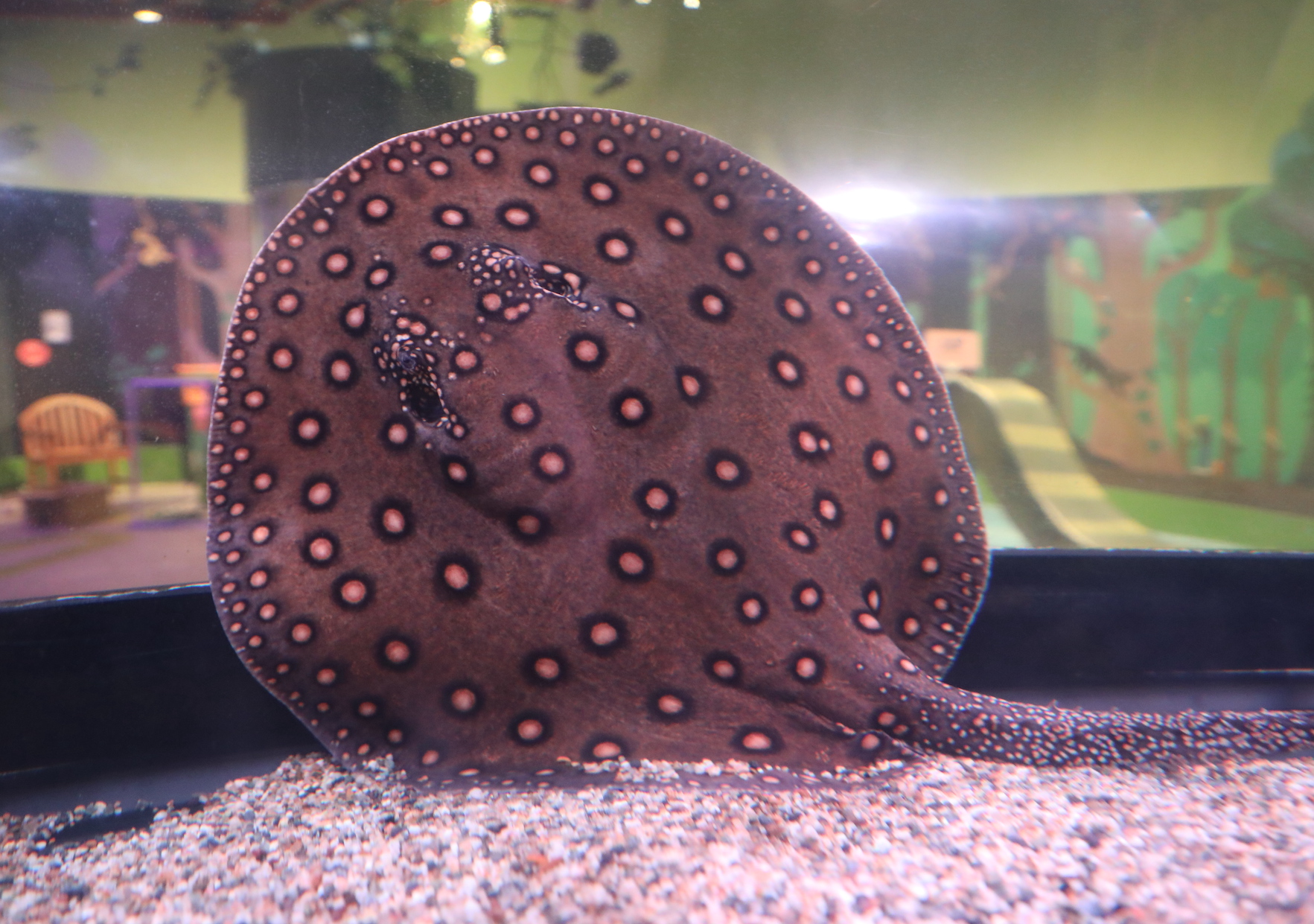
Ocellate freshwater stingray are mostly circular, in beige or brown with a variety of yellow-orange spots with dark rings. The placement, size, arrangement, and exact color varies based on individual and by region.
Habitat
Inland wetlands
Diet
Small fish and invertebrates like crustaceans, aquatic insect larvae and worms
Life History
These flat fish live on river bottoms, where they bury themselves in mud and sand to stay hidden. Their eyes sit on top of their heads so they can closely observe what’s happening above while remaining covered.
IUCN Status
Least Concern
Ecosystem & Cultural Importance
Local sport hunting, and internationally used for food, pets, and within Aquariums.
This animal is not found on the Oregon Coast. It can be found at the Oregon Coast Aquarium as part of our temporary exhibit Amazon Basin: Adventure for the Senses.
This stingray’s tail spine is no joke! This venomous weapon works like a scorpion’s stinger – whipping forward in a flash to defend the ray from danger. It’s strong enough to pierce bone and often breaks off in the wound. The spine, covered in toxic mucus, is barbed like an arrowhead, making it hard to remove. The good news! Stingrays aren’t aggressive; they only use their tail spine to protect themselves when they feel threatened.
Citations & Other Resources
https://www.iucnredlist.org/species/39404/2923869
Froese, Rainer; Pauly, Daniel (eds.). “Potamotrygon motoro”. FishBase. March 2007 version.
“Potamotrygon motoro”. Integrated Taxonomic Information System. Retrieved 26 August 2026
Silva, J.P.C.B.; T.S. Loboda (2019). “Potamotrygon marquesi, a new species of neotropical freshwater stingray (Potamotrygonidae) from the Brazilian Amazon Basin”. Journal of Fish Biology. 95 (2): 594–612. Bibcode:2019JFBio..95..594C. doi:10.1111/jfb.14050. PMID 31095730.
Loboda, T.S. (2010). Revisão taxonômica e morfológica de Potamotrygon motoro (Müller & Henle, 1841) na bacia Amazônica (Chondrichthyes: Myliobatiformes: Potamotrygonidae) (MSc thesis) (in Brazilian Portuguese). University of São Paulo, Brazil.
We use cookies to improve your experience and see how our guests are navigating the website. If this is alright by you, hit 'Accept All', or 'Settings' to customize and learn more.
Read our cookie policy