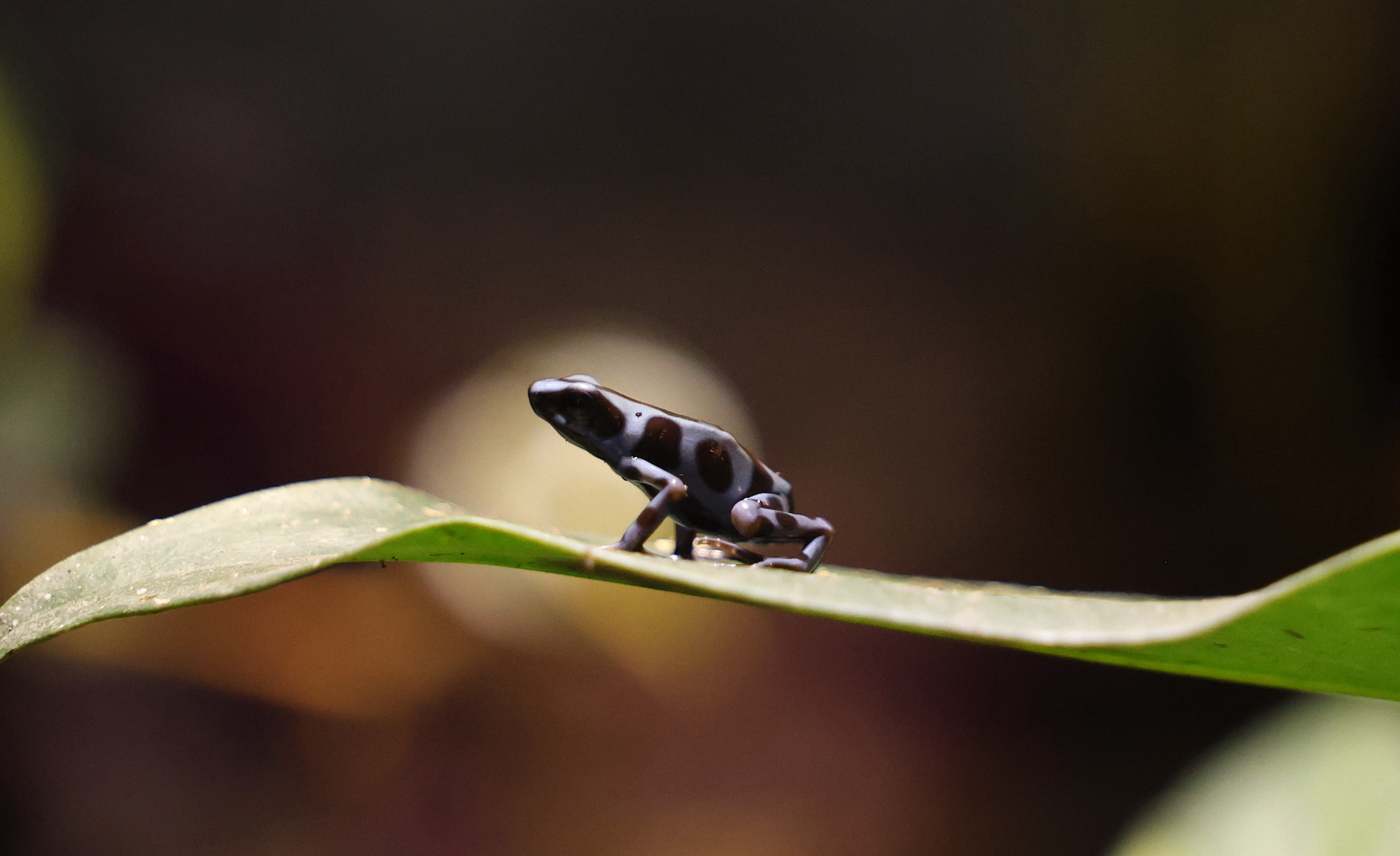
Most range about 2 in. (5cm) in length
There are over 30 recognized morphs of Dendrobates tinctorius, with each boasting their own palette. From the azureus and their brilliant blue coloration, to the matécho with their bright yellow, ‘dart frog’ can cover all kinds of different looks.
Across all morphs, their bright colors stand as a warning to predators of their inherent toxicity.
Habitat
Typically these frogs will be found in canopy covered forests or wetlands. While occasionally found climbing foliage or trees, they spend most of their time on the ground.
Diet
Ants, beetles, and other insects.
Life History
After hatching, tadpoles will be fully grown after only 10 – 12 weeks.
This animal is not found on the Oregon Coast. It can be found at the Oregon Coast Aquarium as part of our temporary exhibit Amazon Basin: Adventure for the Senses.
Despite their name, poison dart frogs that are found in captivity are not poisonous! Their wild counterparts earn their name through their diet. The toxins are largely gained from types of ants, beetles, and other insects that the frogs eat in the wild.
These frogs can jump a distance of about 5 ft (1.5m) and a height of 1.6 ft (.5m). This is almost 50 times the length of their entire body!
The Amazon basin is home to approximately 11% of the world’s amphibian species, making it the most amphibian-diverse tropical forest on earth. Many of these amphibians are poison dart frogs, each sporting its own bright colors and patterns.
Citations & Other Resources
IUCN SSC Amphibian Specialist Group. (2023). “Dendrobates tinctorius”. IUCN Red List of Threatened Species. 2023 e.T55204A61395760. doi:10.2305/IUCN.UK.2023-1.RLTS.T55204A61395760.en. Retrieved 25 August 2026.
“Dyeing Poison Dart Frog”. frogsandco.com. 2 April 2021. Retrieved 25 August 2026.
We use cookies to improve your experience and see how our guests are navigating the website. If this is alright by you, hit 'Accept All', or 'Settings' to customize and learn more.
Read our cookie policy