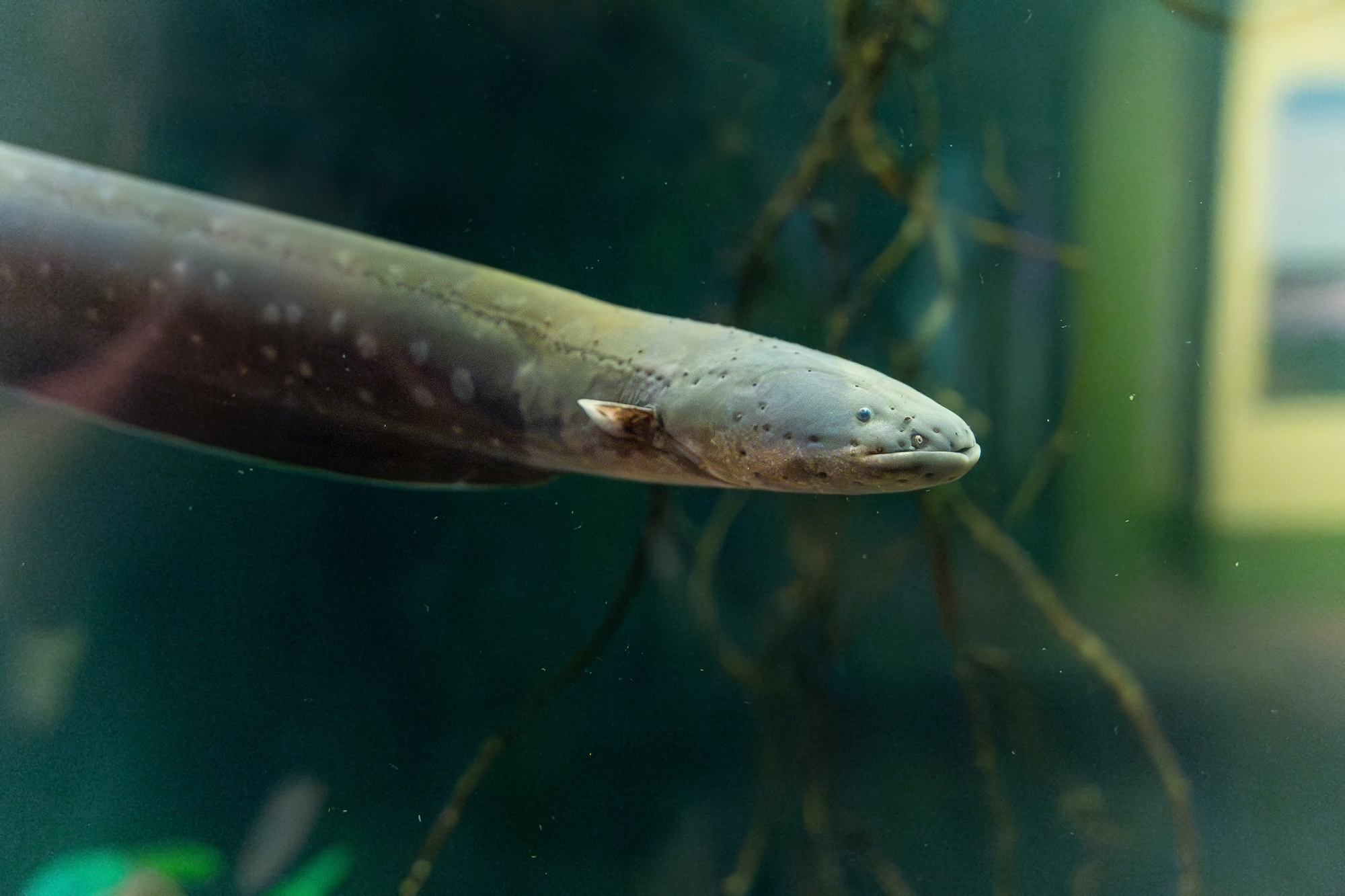
Electric eels are long, cylindrical like fish that can reach lengths of around 6 1/2ft (2m). They are not actually eels, but gained the name due to their similarity in appearance. They are typically a dark grey along their body, with a lighter orange brown along their stomachs. They do not have scales, instead having smooth skin. Their heads are usually blunt and square shaped.
They can weigh up to 45 pounds (~20kg)
Habitat
Muddy river bottoms, swamps, or flooded forests.
Diet
Fish, amphibians, and invertebrates – including shrimp and crabs; Also known to eat small mammals and birds that venture near the water
Life History
Electric eels reproduce between September and December. Mothers will lay up to 1200 eggs at a time for the fathers to fertilize. Spawn will hatch around a week after eggs are fertilized. When they reach about half an inch (15mm) in length, they will eat the remaining eggs in the nest.
They will typically live up to 15 years in the wild, and 20 in captivity.
IUCN Status
Least Concern
Ecosystem & Cultural Importance
Like any predator in an ecosystem, they play an important part in maintaining populations in their prey’s species.
This animal is not found on the Oregon Coast. It can be found at the Oregon Coast Aquarium as part of our temporary exhibit Amazon Basin: Adventure for the Senses.
They are well known for stunning their prey by generating electricity, delivering shocks of up to 860 volts
Despite the name, they are not actually eels, but part of the knifefish order.
Electric eels have a poor sense of eyesight, instead navigating by electrolocation.
They are obligate air breathers–while they do have gills like any other fish, near 80% of their oxygen is actually obtained by surfacing and breathing in through the mouth.
What makes this fish really special is its ability to generate electricity. Most of its body is made up of electric organs that use low-voltage pulses to sense its surroundings in dark water. But when it’s time to hunt, the eel can deliver a high-voltage shock strong enough to stun its prey!
Citations & Other Resources
“electric eel: Diet & Electric Shock”. www.britannica.com. Retrieved 2022-01-20.
Albert, J. S. (2001). “Species diversity and phylogenetic systematics of American knifefishes (Gymnotiformes, Teleostei)”. Miscellaneous Publications (190): 1–127. hdl:2027.42/56433.
“Electrophorus electricus: Electric eel”. Animal Diversity Web. Retrieved 15 July 2022.
Cormier, L. 2000. “More Information about Electric Eels” (On-line). Accessed August 25, 2026 at http://whozoo.org/Intro2000/tashcorm/tempagetwo.htm .
We use cookies to improve your experience and see how our guests are navigating the website. If this is alright by you, hit 'Accept All', or 'Settings' to customize and learn more.
Read our cookie policy