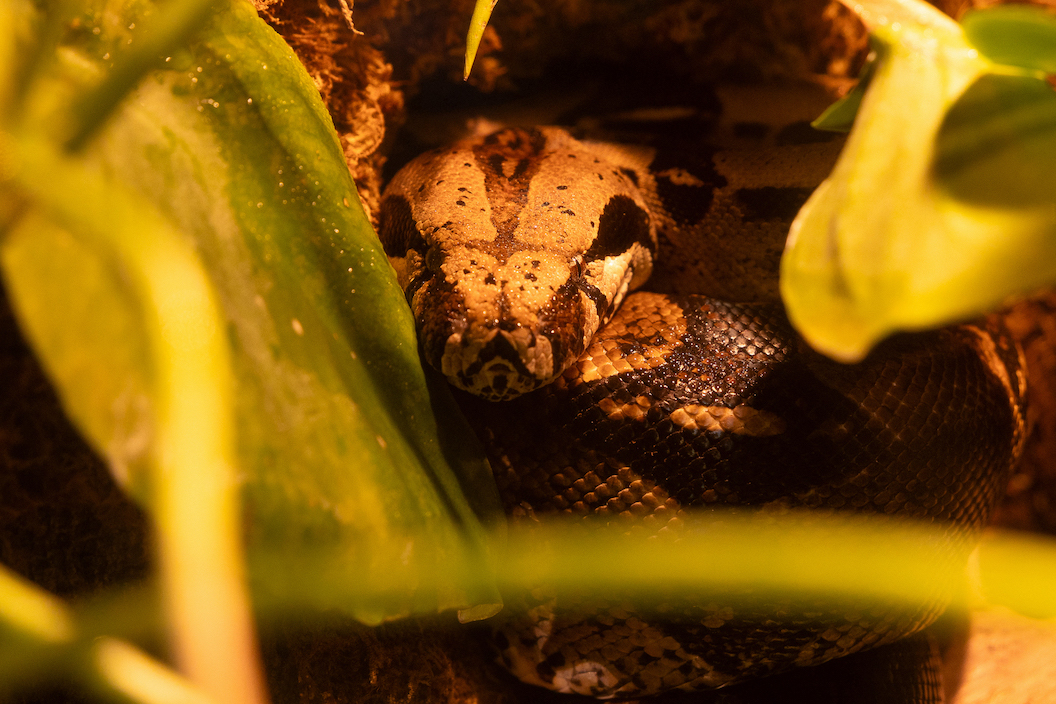
This subspecies of boa constrictor is famous for their striking reds. Red-tailed boas can be up to 10ft in length. Females are usually larger, ranging between 7 – 10ft, while smaller males are typically between 6 – 8ft in length.
Their size and weight typically will vary by region, based on diet.
Habitat
Younger red-tailed boas are semi-arboreal, and can be seen foraging and basking up in the canopy, while older snakes typically keep to a terrestrial life on the forest floor. They predominately are found in rainforest clearings or edges. Less commonly found in woodlands, grasslands, scrub, and semi-desert. They are often spotted near streams and rivers in the above ecosystems, and will take over the burrows of other animals.
Diet
Red tailed boas are opportunistic ambush predators, most of their diet consisting of a variety of rodents like rats, agoutis, mice, or squirrels. In addition to rodents, they’ll also eat various amphibians, lizards, marsupials, birds, and other small mammals.
Once prey has been caught, boas will wrap their coils around the animal to kill it by asphyxiation. Given their strength, this usually happens within a couple of minutes.
Life History
Red-tailed boas live a solitary life outside of when they want to mate. They are nocturnal, but can be found sun-bathing during the day if nighttime temperatures drop too low.
IUCN Status
Least Concern
Ecosystem & Cultural Importance
Like any predator in an ecosystem, boas play an important part in maintaining populations in their prey’s species.
Boa constrictors are popular within the exotic pet trade, as well as hunted for their meat or skins.
This animal is not found on the Oregon Coast. It can be found at the Oregon Coast Aquarium as part of our temporary exhibit Amazon Basin: Adventure for the Senses.
Depending on the size of the meal they eat, boa constrictors can take up 4-6 days to digest. Their metabolism is slow enough that, after digesting, they won’t need to eat again for a week to several months.
The Aquarium’s red-tailed boa is named Gideon
Citations & Other Resources
Glaw, F.; Franzen, M. (2016). “On the maximum length of Boa constrictor (Serpentes, Boidae)” (PDF). Spixiana. 39 (#2): 264. Archived (PDF) from the original on 2018-02-20. Retrieved 2026-08-12.
Mattison, C. (2007). The New Encyclopedia of Snakes. Princeton University Press. ISBN 0-691-13295-X.
“Boa constrictor Page”. Boa-constrictors.com. Archived from the original on 2010-03-25. Retrieved 2010-08-24.
We use cookies to improve your experience and see how our guests are navigating the website. If this is alright by you, hit 'Accept All', or 'Settings' to customize and learn more.
Read our cookie policy