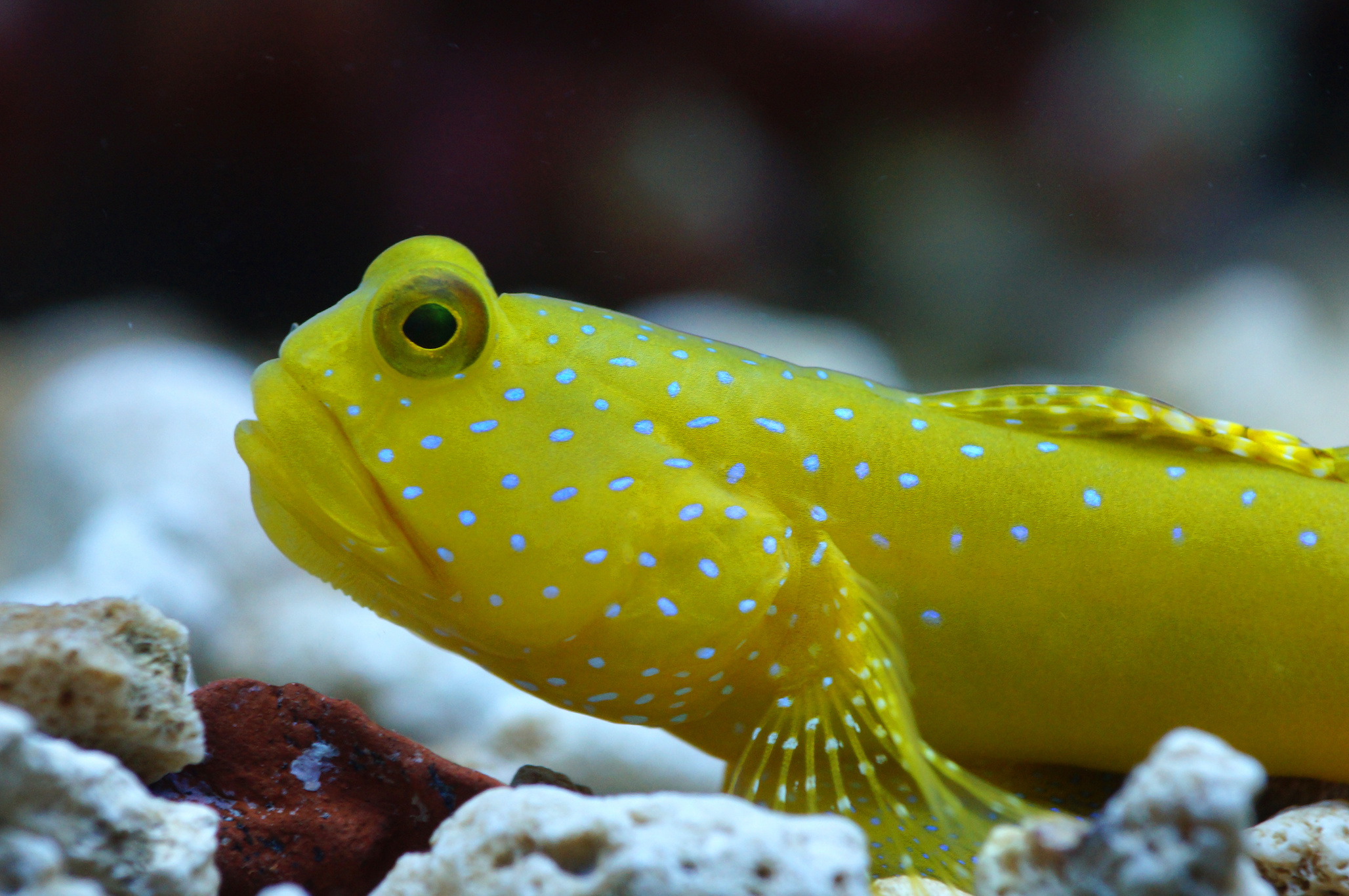
This species has two color phases, one primarily yellow and another that is whitish with brown bars on its side. Yellow individuals may also have brown markings but these bars are usually faint in color.
The yellow watchman goby also has fine pale blue or white spotting on its head and the top part of its body.
The yellow watchman goby can grow to lengths of about 10 cm.
Habitat
Sandy bottoms of seagrass beds, lagoons and sheltered coral reefs at depths of 2 to 15 m.
Diet
Algae and bivalves.
Life History
The life history of yellow watchman gobies, including their spawning mode and development, is mostly unknown. More research is needed to fully understand this species.
IUCN Status
Least Concern
Ecosystem & Cultural Importance
Yellow watchman gobies have a symbiotic relationship with alpheid shrimp. The shrimp builds and maintains a burrow while the yellow watchman goby guards the burrow.
Distributed in the eastern Indian Ocean and western Pacific Ocean from the Maldives, the Gulf of Mannar, India, Sri Lanka, the Andaman Sea, Thailand, Indonesia, Malaysia, and Singapore to northern Australia, Papua New Guinea, the Solomon Islands, New Caledonia, and the Caroline Islands northward to the Yaeyama Islands, Japan.
This animal is not native to the Oregon Coast, however is found in the larger Pacific Ocean. It lives in the Aquarium as part of our Connected Coasts gallery.
While sharing a burrow, alpheid shrimp and yellow watchman gobies communicate by touch and movement. The yellow watchman goby warns the shrimp of approaching predators.
Yellow watchman gobies are a part of family Gobiidae which is the largest family of marine fishes with more than 200 different genera and 500 Indo-Pacific species.
Citations & Other Resources
Larson, H., D. Hoese, E. Murdy, F. Pezold, K. Cole, and K. Shibukawa. 2021. Cryptocentrus cinctus. The IUCN Red List of Threatened Species 202.
Myers, R. F. 1991. Micronesian reef fishes : a practical guide to the identification of the coral reef fishes of the tropical central and western Pacific (2nd ed.). Coral Graphics.
Randall, J. E., G.R. Allen, and R.C. Steene. 1990. Fishes of the Great Barrier Reef and Coral Sea. University of Hawaii Press.
Thacker, C. E., A.R. Thompson, and D.M. Roje. 2011. Phylogeny and evolution of Indo-Pacific shrimp-associated gobies (Gobiiformes: Gobiidae). Molecular Phylogenetics and Evolution, 59(1), 168–176. https://doi.org/10.1016/j.ympev.2011.02.007
Patzner, R. A. (2011). The biology of gobies (1st ed.). Science Publishers.
We use cookies to improve your experience and see how our guests are navigating the website. If this is alright by you, hit 'Accept All', or 'Settings' to customize and learn more.
Read our cookie policy