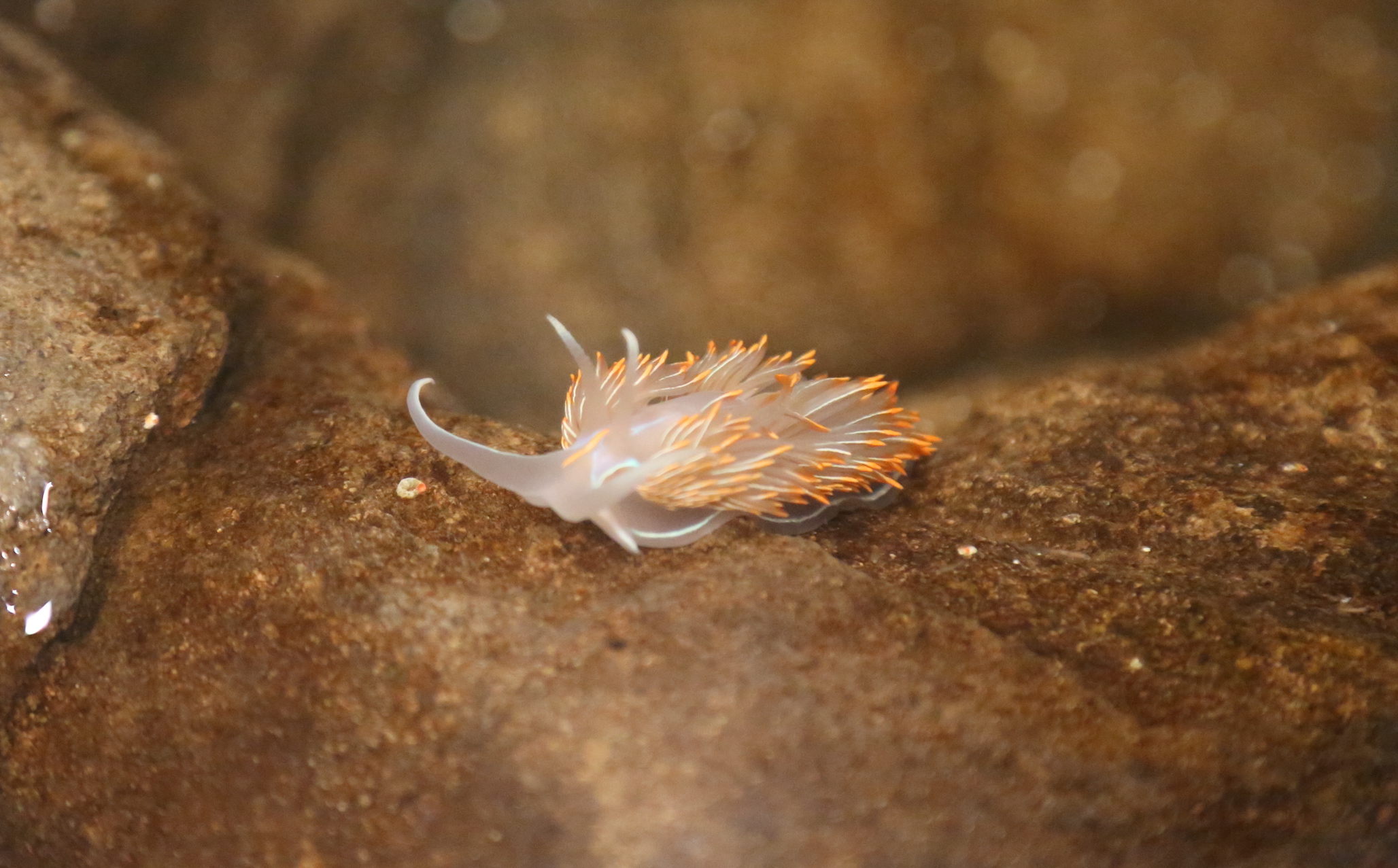
This small sea slug has a white body, orange stripe on its head, and vivid orange cerata running down its back.
Habitat
Tide pools, bays and estuaries
Diet
Tunicates, small cnidarian polyps
Life History
Every opalescent nudibranch can both produce eggs and fertilize the eggs of others. After two nudibranchs pair up, each one lays a ribbon-shaped spiral of eggs.
IUCN Status
Not Evaluated
Ecosystem & Cultural Importance
Opalescent nudibranchs–like all nudibranchs–play an important role in tidepools ecosystems!
Eating small cnidarians allows this nudibranch to steal the stinging cells and use it for self defense.
Citations & Other Resources
Megina, Cesar & Gosliner, Terrence & Cervera, Juan Lucas. (2007). The use of trophic resources by a generalist eolid nudibranch: Hermissenda crassicornis (Mollusca: Gastropoda). Cahiers de biologie marine. 48. 1-7.
Lindsay T, Valdés Á (2016) The Model Organism Hermissenda crassicornis (Gastropoda: Heterobranchia) Is a Species Complex. PLoS ONE 11(4): e0154265. https://doi.org/10.1371/journal.pone.0154265
We use cookies to improve your experience and see how our guests are navigating the website. If this is alright by you, hit 'Accept All', or 'Settings' to customize and learn more.
Read our cookie policy