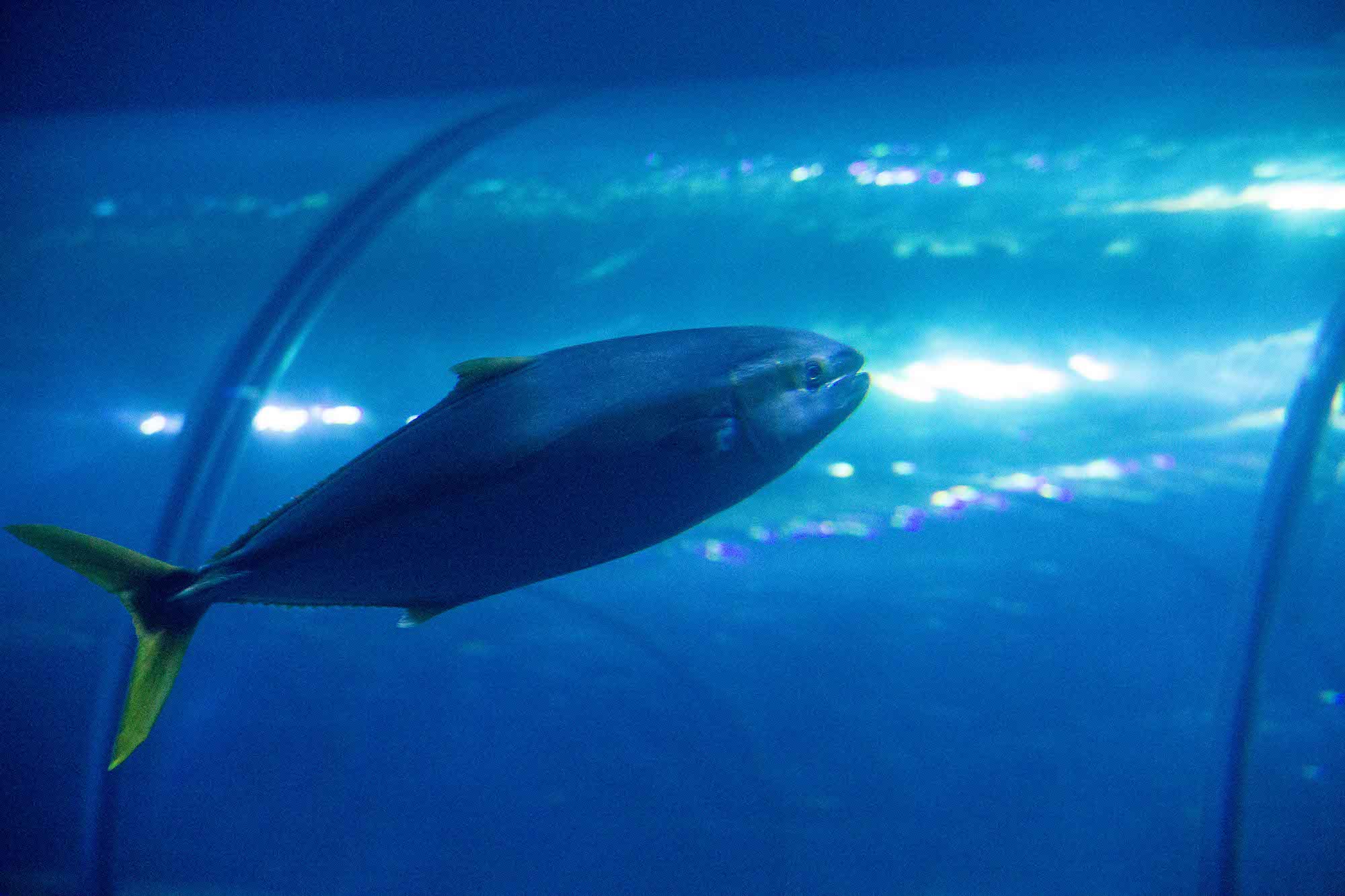
The body of the yellowtail jack tapers at both ends. Their body is blue-indigo, while their sides and belly are silver. They have a yellowish bronze stripe along the lateral line. The caudal fin is also yellow.
Yellowtail jack may grow up to 2.5 meters in length and may weigh up to 80 pounds.
Habitat
Coastal and oceanic waters, off kelp beds, rocky areas and estuaries.
Diet
Small fishes and squids.
Life History
Yellowtail jacks are mostly solitary, but can sometimes be found in small groups. Schools of juveniles are generally found in offshore waters, near or beyond the continental shelf.
Yellowtail jack spawn during the summer, from June to October. Most females can release up to 150 eggs during spawning. Yellowtail jack eggs are externally fertilized.
Fertilized eggs develop into larvae that grow into juveniles. Yellowtail jack are fast growing, with most individuals reaching maturity at 2 to 3 years old.
Yellowtail jack have an average lifespan of 5 to 6 years with a max of 12 years.
IUCN Status
Least Concern
Ecosystem & Cultural Importance
Yellowtail jacks are of high recreational and commercial value globally. There are established aquaculture industries in Japan, China, New Zealand and Australia.
Yellowtail jack eggs and larvae are eaten by mollusks, echinoderms, crabs, and fish. Adults are prey for a variety of species including great white sharks and California sea lions.
Historically, yellowtail have been lumped into a single species, Seriola lalandi. However, a recent study has found that yellowtail make up three distinct genetic populations. Those found in the southern hemisphere are still classified as S. landandi while those found in the Northwestern Pacific are now S. aureovittata. Yellowtail found along the West Coast of the United States are now classified as Seriola dorsalis.
Over 40 species of symbiotic parasites live on the gills and within the guts of yellowtail jack.
Citations & Other Resources
Smith-Vaniz, W.F. and I. Williams. 2015. Seriola lalandi. The IUCN Red List of Threatened Species 2015.
Goddard, B. K., L.M. Otter, J.M. Hughes, F.R.A. Jaine, J.C. Martino, U. Troitzsch, J. Doherty, and H.T. Schilling. 2025. Structure and composition of yellowtail kingfish ( Seriola lalandi ) otoliths: implications for using aquaculture‐reared fish to reconstruct life histories. Journal of Fish Biology, 107(4), 1188–1200. https://doi.org/10.1111/jfb.70110
California Sea Grant. N.d. Yellowtail (Seriola lalandi). California Seafood Profiles. https://caseagrant.ucsd.edu/seafood-profiles/yellowtail
California Department of Fish and Wildlife. N.d. California Yellowtail Enhanced Status Report. Marine Species Portal. https://marinespecies.wildlife.ca.gov/yellowtail/the-species/#sec-1-1
We use cookies to improve your experience and see how our guests are navigating the website. If this is alright by you, hit 'Accept All', or 'Settings' to customize and learn more.
Read our cookie policy