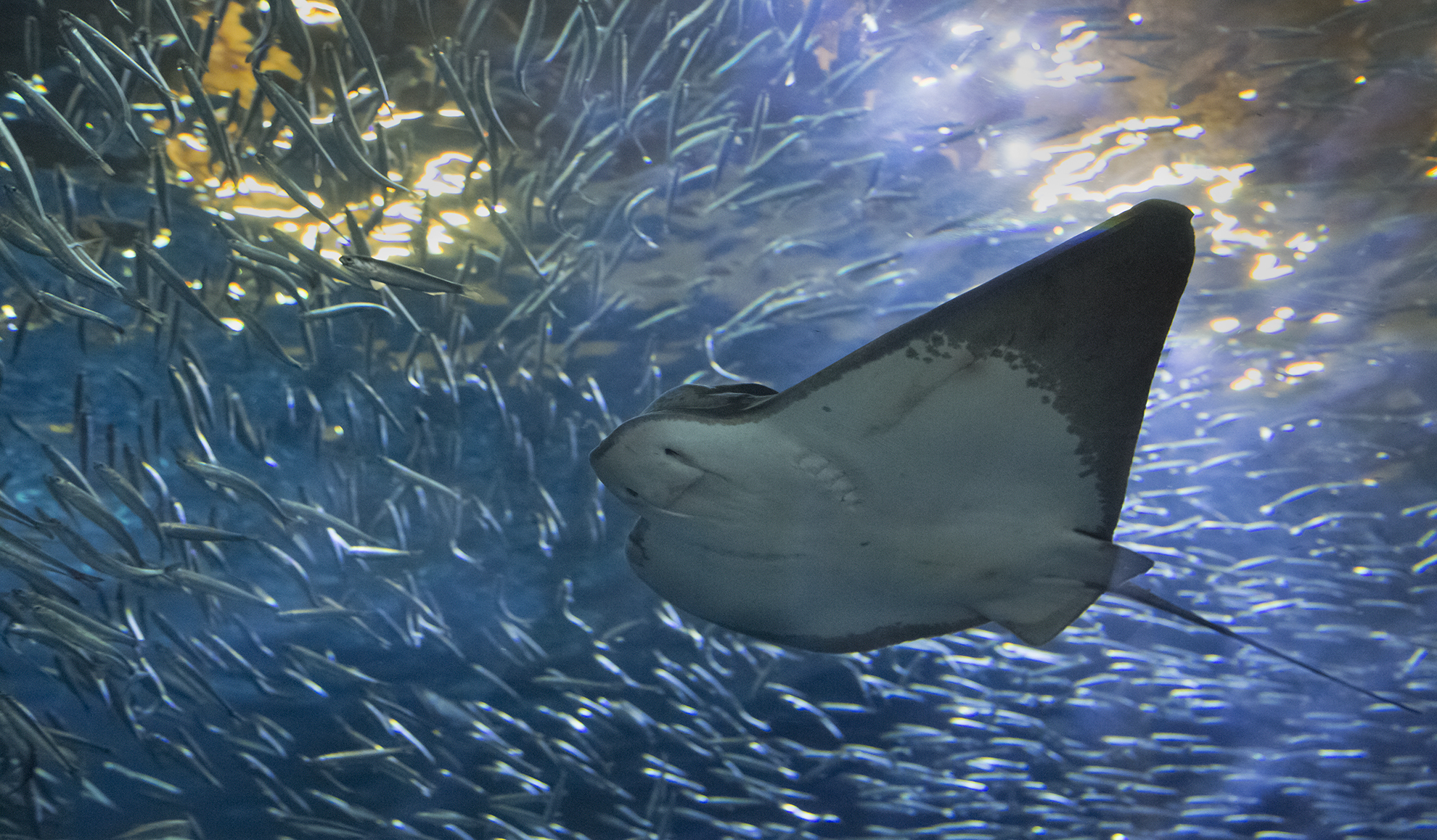
Bat rays have a smooth and flattened, triangular shaped body. The dorsal or top side of bat rays are brown to olive or almost black in color. The bottom side is white. Like most other rays, the mouth of bat rays is located on the ventral (bottom) side.
As their name implies, this animal has batlike wings (pectoral fins) which helps them swim gracefully over the sea floor. Bat rays have a maximum wingspan of 1.8 meters (6 feet) and weigh up to 200 pounds. Females tend to be larger than males.
Bat rays have one to three venomous barbed spines at the base of its long tail. This species only stings to defend itself.
Habitat
Muddy and sandy-bottom bays, kelp forests and reefs from the surface to depths of 150 feet.
Diet
Mollusks, crustaceans and small fishes.
Life History
Like other types of rays, bat rays often rest, semi-buried, in the sand. They typically live alone but may be found in groups of thousands.
Bat rays are viviparous, meaning they give birth to live young. Mating takes place during the summer months. Females are pregnant for nine to twelve months and produce 2 to 12 offspring in an annual reproductive cycle. The number of offspring depends on the size of the mother. The young are born tail-first with their wings rolled up over the body.
Males reach maturity at 2 to 3 years of age while females reach maturity at about 5 years of age.
Bat rays live up to 10 years in the wild.
IUCN Status
Least Concern
Ecosystem & Cultural Importance
Bat rays are sometimes caught recreationally but are not specifically sought by commercial fishermen in the United States. Commercial fishing for this animal exists in Mexican waters. For a long time oyster growers thought bat rays ate large numbers of oysters and as a result they would trap the bat rays. It was recently discovered that bat rays rarely eat oysters. Bat rays are actually helpful to oyster growers since they eat the crabs that eat oysters.
Bat rays are prey for marine mammals, sharks, and other large fishes.
Bat rays use their pectoral fins to expose buried prey and their lobe-like snout to dig prey out from the sand. Their teeth are fused into plates, allowing them to crush clam shells. Bat rays crush the entire mollusc inside their mouths. They then spit out the shells and eat the fleshy parts. Similarly to sharks, rays grow new teeth continuously. When a tooth breaks or wears out, a new tooth replaces it.
Bat rays are known to jump out of the water and skim along the surface.
We use cookies to improve your experience and see how our guests are navigating the website. If this is alright by you, hit 'Accept All', or 'Settings' to customize and learn more.
Read our cookie policy