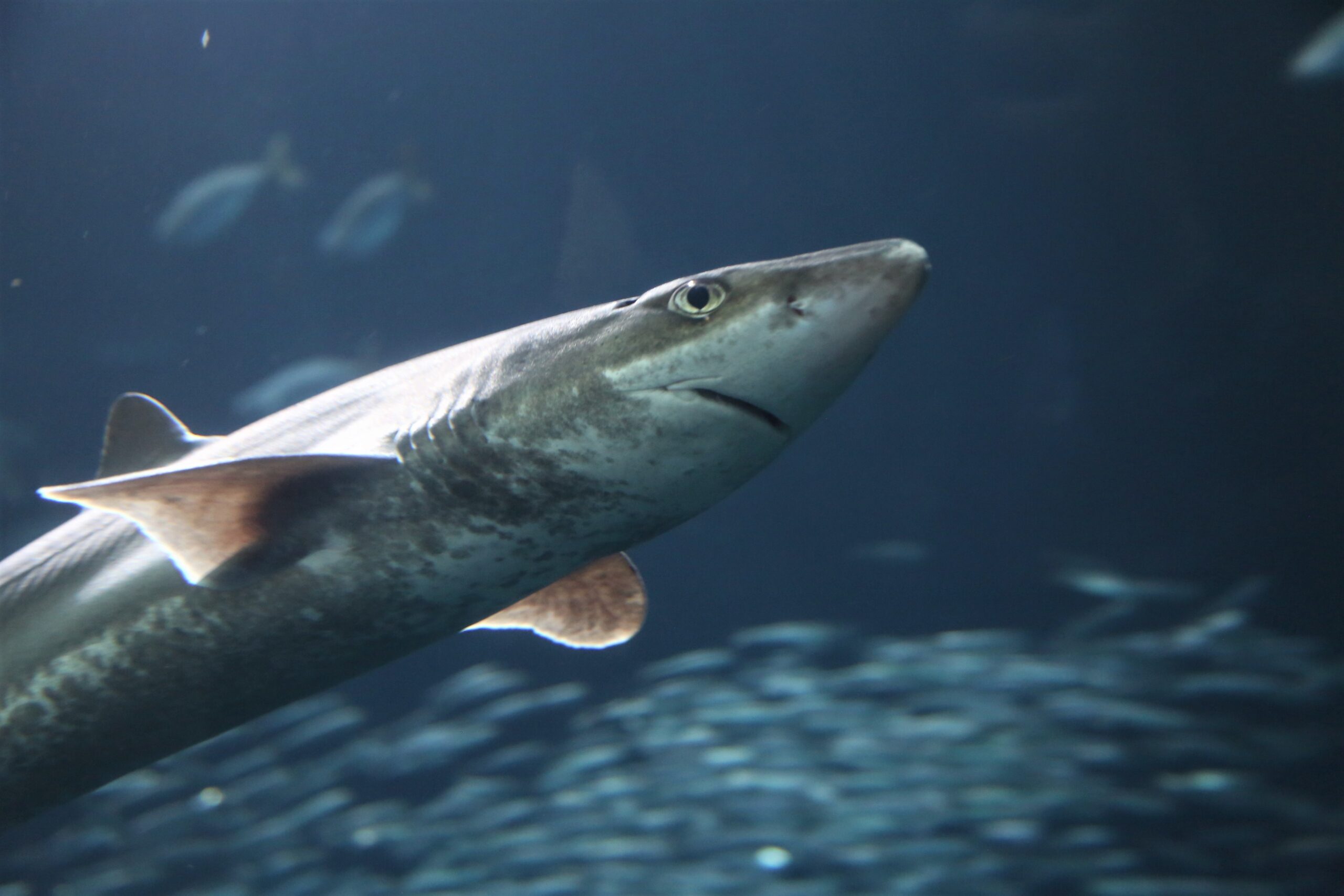
Spiny dogfish sharks are slim, with a narrow, pointed snout. They are gray above with white spots and a white belly. This shark has two dorsal fins with ungrooved large spines.
Males grow up to 3.3 feet, and females grow up to 4 feet.
Habitat
Offshore and inshore waters, in bays and estuaries from the surface to depths of 1,978 m.
Diet
As opportunistic feeders, spiny dogfish sharks prey on whatever is most available. Smaller individuals prey on crustaceans, while larger spiny dogfish feed on jellyfish, squid, and schooling fish.
Life History
Spiny dogfish sharks swim in large schools and migrate seasonally with changes in water temperature. Much of the population travels north in the spring and summer and south in the fall and winter. Meanwhile, some spiny dogfish sharks remain in northern waters throughout the year and move offshore during the winter.
Mating occurs in the fall. Spiny dogfish sharks spawn in the winter in offshore waters. Females are pregnant for 12 to 24 months. Spiny dogfish sharks give birth to live young with litters averaging six pups.
Like all sharks, spiny dogfish grow slowly, mature late in life, and live a long life. Females mature later than males, with them reproducing at age 12 compared to males at age 6. Spiny dogfish live up to 35 to 40 years.
IUCN Status
Vulnerable
Ecosystem & Cultural Importance
This species is used extensively for its meat, fins, and liver oil. Populations have decreased due to fishing activities, but they also may be threatened by habitat loss and degradation. In the United States NOAA Fisheries, the Mid-Atlantic and New England Fishery Management Councils and the Atlantic States Marine Fisheries Commission manage the spiny dogfish fishery.
Dogfish is used for fish and chips in England, and as a popular beer garden snack called shillerlocken in Germany.
Spiny dogfish sharks are preyed upon by cod, red hake, goosefish, other spiny dogfish, larger sharks, seals, and orcas.
Spiny dogfish have cultural importance for Indigenous peoples as a key figure and symbol in art and stories.
Global distribution in boreal and temperate waters in the Northeast and Northwest Atlantic, including the Mediterranean and Black Seas, the Southeast Pacific and Southwest Atlantic off South America, the Southeast Atlantic off South Africa, and the Southwest Pacific and Eastern Indian Oceans off Australia and New Zealand.
The spiny dogfish found along the Oregon coast were once considered the same species as Squalus acanthias, but they have recently been proven to be two distinct species. Squalus suckleyi commonly known as the Pacific spiny dogfish is found from the Bering Sea to Baja California.
The two large dorsal spines are mildly venomous which the dogfish uses to defend itself.
Dogfish are named for their pack-like behavior, which reminded fishermen of packs of dogs.
Citations & Other Resources
Finucci, B., J. Cheok, G.E. Chiaramonte, C.F. Cotton, N.K. Dulvy, D.W. Kulka, F.C. Neat, N. Pacoureau, C.L. Rigby, S. Tanaka, and T.I. Walker. 2020. Squalus acanthias. The IUCN Red List of Threatened Species 2020.
Stehlik, L. L., and Northeast Fisheries Science Center. 2007. Essential fish habitat source document. Spiny dogfish, Squalus acanthias, life history and habitat characteristics (2nd ed.). U.S. Dept. of Commerce, National Oceanic and Atmospheric Administration, National Marine Fisheries Service, Northeast Region, Northeast Fisheries Science Center. https://purl.fdlp.gov/GPO/LPS121055
Tribuzio, C. A., M.E. Matta, C. Gburski, N. Atkins, and W. Bubley. 2016. Methods for the Preparation of Pacific Spiny Dogfish, Squalus suckleyi, Fin Spines and Vertebrae and an Overview of Age Determination. Marine Fisheries Review, 78(1–2), 1. https://doi.org/10.7755/MFR.78.1-2.1
We use cookies to improve your experience and see how our guests are navigating the website. If this is alright by you, hit 'Accept All', or 'Settings' to customize and learn more.
Read our cookie policy