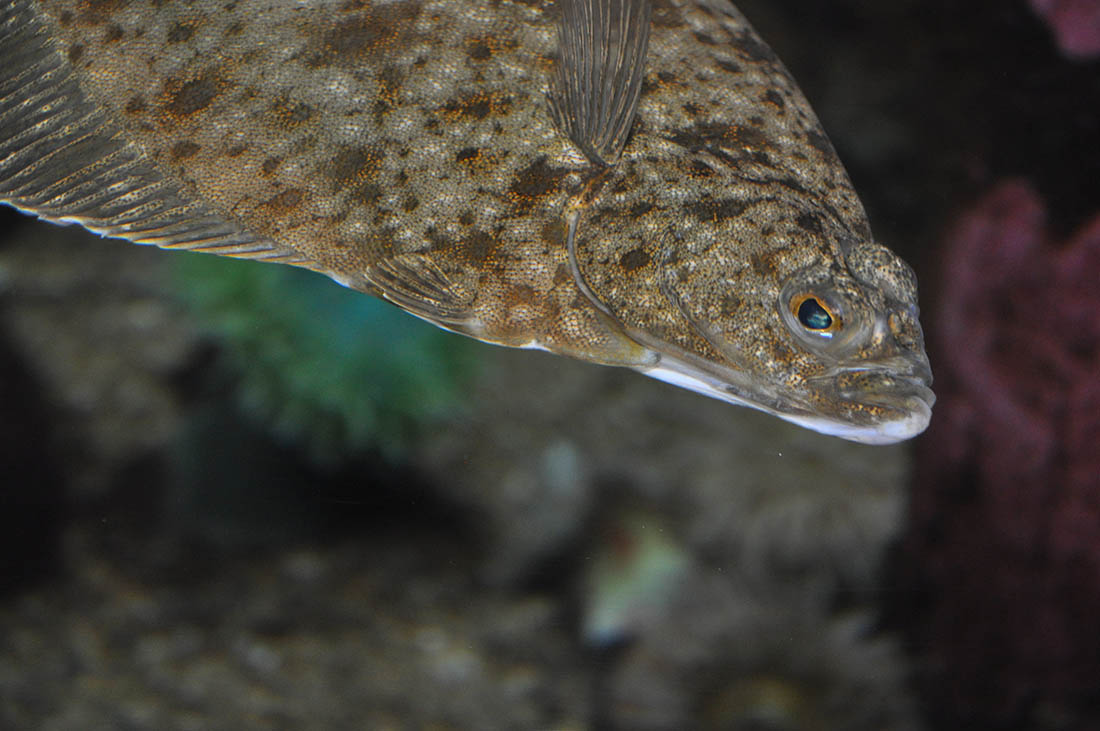
When Pacific halibut are born they swim similar to salmon, with eyes on both sides of their heads. By the time they are 6 months old, one eye moves to the right side of the head. The young halibut begins to swim sideways, with both eyes on the top of their bodies.
Pacific halibut bodies are flat and diamond shaped with the upper side typically mottled gray to dark brown. This helps them blend in with sandy or muddy bottoms. Their underside is usually white. Their scales are small and buried in the skin, giving them a smooth appearance.
Pacific halibut is the largest species of flatfish, growing up to 8 feet in length and 5 feet in width. They can weigh up to 500 pounds but on average are 40 pounds. Females grow faster and reach larger sizes than males, but they reach maturity slower than males.
Habitat
Sandy environments along the continental shelf in a broad range of depths from inshore to 1,485 feet.
Diet
Larval halibut feed on zooplankton, while juveniles eat small crustaceans and other species living on the seafloor. Adults prey on a variety of groundfish, sculpins, sand lance, herring, octopus, crabs, clams, and occasionally smaller halibut.
Life History
Pacific halibut undergo annual feeding and spawning migrations. During the summer they typically live in shallower waters and then move to deep water in the autumn. Then they move even deeper in the winter. The following spring pacific halibut return to shallow water.
Pacific halibut typically spawn between November and March in deep waters. Most spawning areas are north of Vancouver Island, British Columbia. Depending on their size, females can produce between 50,000 and 4 million eggs!
Pacific halibut batch spawn pelagic eggs that hatch after 15 to 20 days. Larvae float close to the surface where they are carried counterclockwise around the northeast Pacific by the Alaskan Stream and/or Alaska Coastal Current for 5 to 6 months.
Juveniles settle in shallow nursery areas. This is followed by an southerly and easterly migration over an additional 2 to 3 years where they potentially travel for hundreds of miles before reaching the adult stage. Males reach maturity at about eight years of age while females mature at about 12 years.
Pacific halibut can live up to 55 years but halibut over age 30 are rare.
IUCN Status
Least Concern
Ecosystem & Cultural Importance
Marine mammals and sharks sometimes eat Pacific halibut, but due to their large size, adult halibut are rarely preyed upon by other fish.
Throughout its range, Pacific halibut are highly valued by commercial, subsistence and recreational fisheries.
This species is of high importance to indigenous peoples of Alaska, British Columbia and the state of Washington. They are an important source of spiritual and physical sustenance. Historically in Alaska, hooks were made of wood or bone, and often ornately carved with spirit figures to attract halibut. Lines were made of twisted fibers of cedar, animal sinew, or kelp. Halibut meat was preserved by drying or smoking.
Pacific halibut are found along the Oregon coast typically in deeper waters with popular fishing sites in Newport and Depoe Bay. Of the halibut population that can be fished commercially, 2% is found off Washington, Oregon, and California, 15% off of British Columbia, and the remainder off of Alaska.
When Pacific halibut are in shallower waters they will hunt by sight and sound, but when they are in deeper water they mainly hunt by smell.
The age of pacific halibut is estimated by counting rings in the otolith, or ear bone.
Nearly all halibut have both eyes on the right side of the fish, but about 1 in every 20,000 halibut has its eyes on the left side.
Citations & Other Resources
Hicks, A., A. Orlov, I. Stewart, I. Volvenko, and D. Wilson. 2021. Hippoglossus stenolepis. The IUCN Red List of Threatened Species 2021.
NOAA Fisheries. N.d. Pacific Halibut. Species Directory. https://www.fisheries.noaa.gov/species/pacific-halibut
Oregon Department of Fish & Wildlife. N.d. Pacific halibut. https://myodfw.com/fishing/species/pacific-halibut
California Department of Fish and Wildlife. 2021. Pacific Halibut. Marine Species Portal. https://marinespecies.wildlife.ca.gov/pacific-halibut/false/
Alaska Department of Fish and Game. N.d. Pacific Halibut (Hippoglossus stenolepis). https://www.adfg.alaska.gov/index.cfm?adfg=halibut.printerfriendly.
We use cookies to improve your experience and see how our guests are navigating the website. If this is alright by you, hit 'Accept All', or 'Settings' to customize and learn more.
Read our cookie policy