
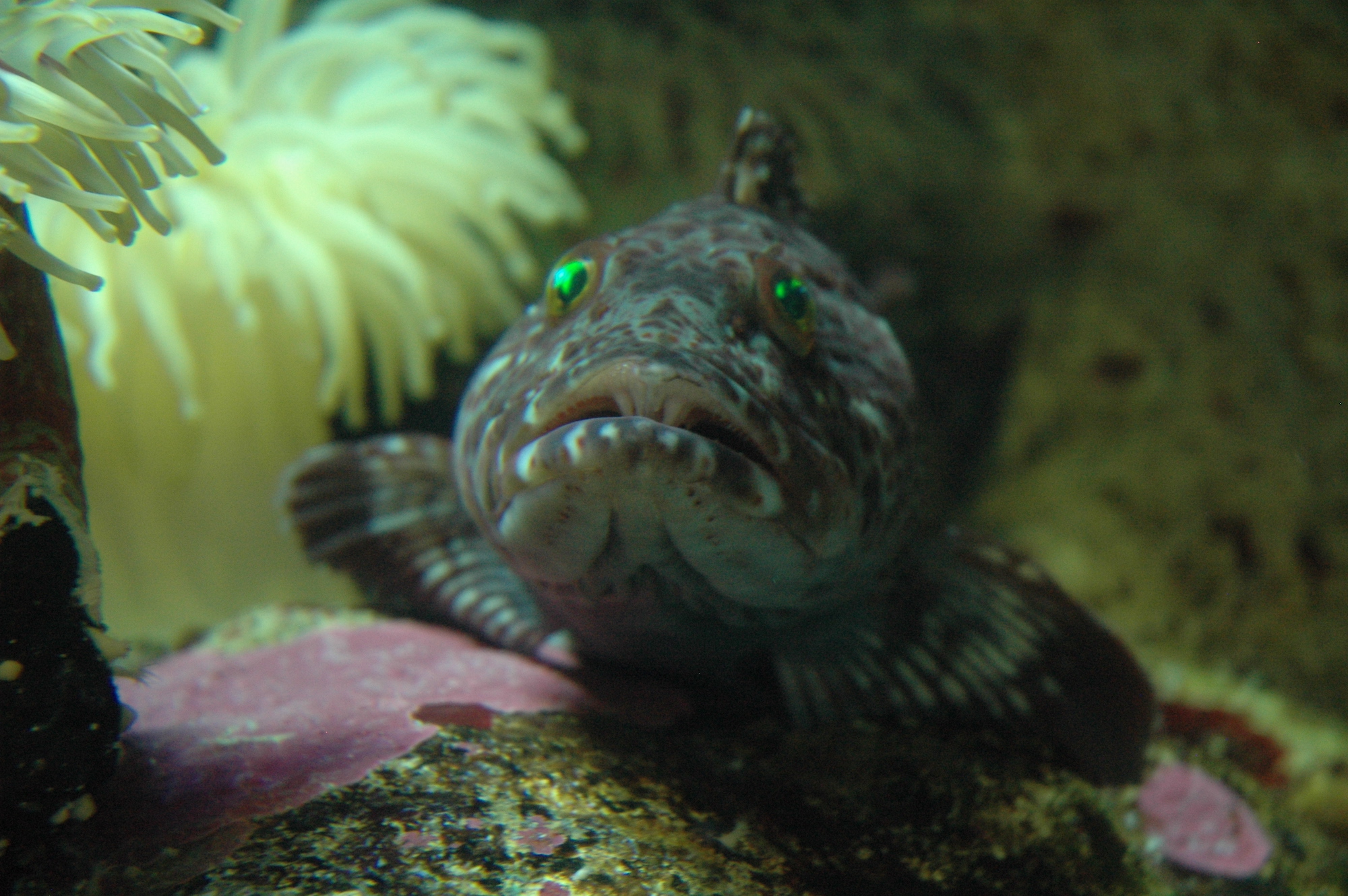
Lingcod are dark gray, brown, or greenish on the back with some copper-colored mottling or spotting along the upper back. The belly is lighter and they have a prominent whitish lateral line. The body is covered with round scales.
This species has a large head and mouth with 18 large, sharp teeth.
Their long bodies narrow toward the tail and can grow up to 5 feet. Lingcod can weigh up to 80 pounds with females being larger than males.
Habitat
Rocky reefs and kelp beds at depths from 30 to 330 feet.
Diet
Bottom-dwelling prey including fish, squid, octopi, and crab.
Life History
Males begin reproducing when they are about 2 years old and almost 20 inches long. Females are able to reproduce when they are 3 years old and 30 inches long.
In late fall, males gather and become territorial over spawning areas. These areas are usually shallow, rocky habitats. Females briefly visit spawning areas during winter and spring to deposit their eggs in crevices and under ledges. Males guard the nests for 8 to 10 weeks until the eggs hatch. Eggs hatch between January and June.
After hatching, larvae live near the surface of the ocean. Juveniles settle on nearshore, sandy ocean bottoms near eelgrass or kelp beds. Males don’t usually move far from where they are born. Immature fish sometimes migrate more than 60 miles and females migrate seasonally to spawn.
Lingcod can live more than 20 years.
IUCN Status
Not Evaluated
Ecosystem & Cultural Importance
Juvenile and adult lingcod are prey for marine mammals, sharks, seabirds and other finfish.
Lingcod are caught in both commercial and recreational fisheries. In 2023, commercial landings of lingcod totaled 2 million pounds and were valued at $2.8 million.
In Alaska, lingcod have been harvested for centuries by the indigenous coastal populations of Southeast, Southcentral, and Western Alaska.
Lingcod are found along the Oregon coast. Adults prefer to be near rocks and inshore. Young lingcod like the sand or mud bottoms of bays and inshore areas.
Despite its name, the lingcod is neither a cod nor a ling. They belong to the family Hexagrammidae.
Citations & Other Resources
NOAA Fisheries. N.d. Lingcod. Species Directory. https://www.fisheries.noaa.gov/species/lingcod
Washington Department of Fish & Wildlife. N.d. Lingcod (Ophiodon elongatus). https://wdfw.wa.gov/species-habitats/species/ophiodon-elongatus#desc-range
Oregon Department of Fish & Wildlife. N.d. Lingcod. https://myodfw.com/fishing/species/lingcod
California Department of Fish and Wildlife. 2021. Lingcod. Marine Species Portal. https://marinespecies.wildlife.ca.gov/lingcod/false/

We use cookies to improve your experience and see how our guests are navigating the website. If this is alright by you, hit 'Accept All', or 'Settings' to customize and learn more.
Read our cookie policy